Java Tutorial - A Simple Introduction to Inheritance

This tutorial provides a simple introduction to the concept of inheritance in Object Oriented Programming (OOP). Using Java as our programming language, we illustrate how to create a base class and a derived class. Next, we illustrate how to leverage the derived class in a simple main().
Figure 01 describes our base class. The class has only one member, which is a public property called baseClassInt, declared as an integer. Because it is public, it will be visible to the derived class that we will create shortly. As this class is intended to be a learning tool, we omit many of the details necessary to a useful class in the real world.
Spoiler Alert: The baseClassInt property really shouldn't be public, but we'll address that in a few minutes. :)
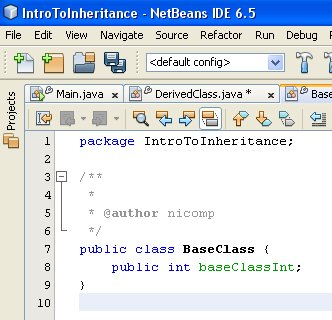
Figure 02, below, introduces the derived class. Note the keyword extends in the class definition. This keyword causes all the members of BaseClass to be included in the derived class. Even the private members of the base class become members of the derived class.
We are keeping it very simple; usually there would be one or more members in the derived class. For clarity, we are leaving them out. A derived class with no members is syntactically correct but not common.
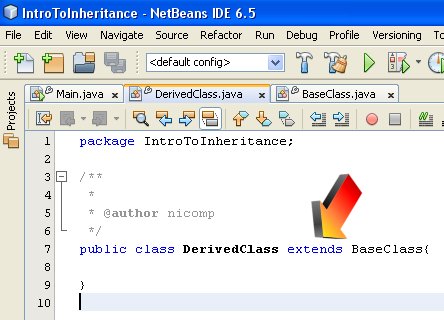
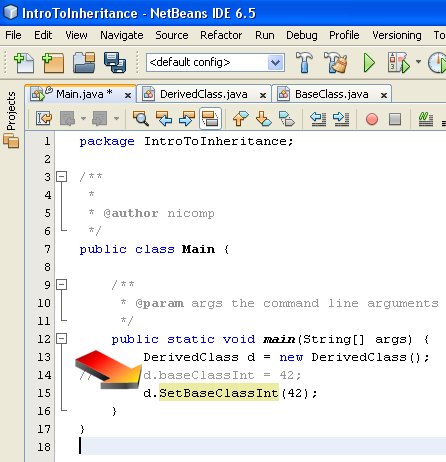
Figure 03 is the main() for this project. Here we declare and instantiate an object of type DerivedClass. Instantiating a derived class object creates memory-based copies of all non-static data items in the derived class and the corresponding base class.
Next, we use our new object to reference the member that was declared in the Base Class.
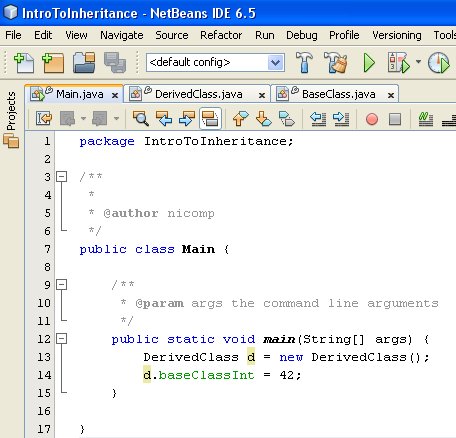
While it looks OK and it builds properly, but it's not really what we want. We can clean it up now.
One of the strengths of OOP is data hiding. In other words, variables (also called properties) that are declared in a class should be 'hidden' in that class. They shouldn't be available to derived classes.
So far, we have violated the philsophy of data hiding. We can fix that.
In Figure 04, the first change we make is to hide the variable in the base class by making it private.
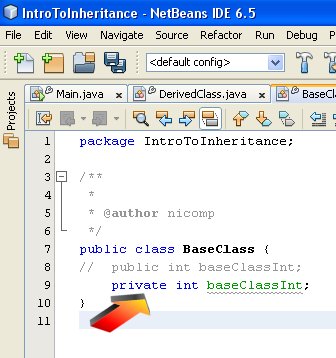
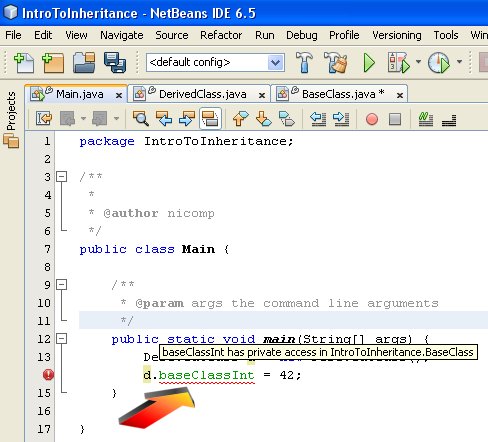
Hiding the variable in the Base Class creates a problem in the Derived Class. The project doesn't build any more; a syntax error is flagged in the main(). We changed the scope of the variable. The error is caused by the attempt to reference the base class property from the derived class object.
Figure 05 illustrates the problem.
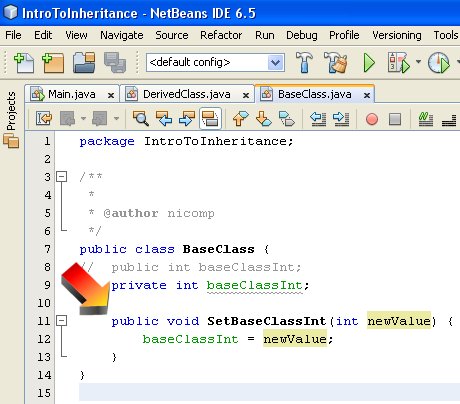
This problem is solved by adding a procedure, also called a method, to the base class. This method will provide controlled access to the private variable.
The name of our method isn't special to the Java language, but it's a general convention to preface it with the word "Set" and follow that with the name of the variable.
Figure 06 includes the new code.
FInally, the main is modified to make use of the code we added to the base class. Figure 07 illustrates the modifications.
This tutorial is a very simple introduction to inheritance in Java. The concept applies to all OOP languages and this code can be used as a basis for learning how to implement inheritance.
Related

A Simple Introduction to Tissue Identification in Preparation for the USMLE
Java 2D Tutorial II--JFrame, JPanel, Coordinate System, Custom Colors, Gradient Paint, and Testing Code
Java 2D Tutorial I--The Basics, Creating New Package, Abstract Class, and Class that extends Abstract Class

The Anatomical Structure Of The Human Body Is A Product of Evolution