- HubPages»
- Education and Science»
- History & Archaeology»
- History of Asia
ANCIENT ROMAN TRADE WITH INDIA

ANCIENT INDO-ROMAN TRADE
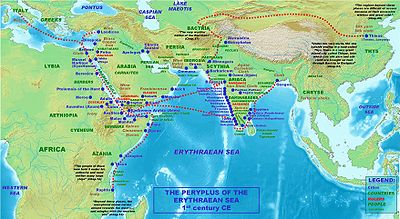
The legendary seaport of MUZIRIS, was once a bustling Indo-Roman trading center. It was situated in the KODUNGALOOR-CHETTUVA belt in the South Indian state of KERALA and many historians believe that it was through MUZIRIS, Christianity came to India.
Many ancient literary works reveal that the entire area was occupied by trading communities, like Arabs, Jews and Chettis. Historians believe the lost port of MUZIRIS was a key center of mercantile trade between India and the Roman Empire. To the local people however it was known as VANCHI, and until recently there were no archaeological records to prove that this ancient mythical port really existed. However in 1983, Roman coins were found at a site around six miles from PATTANAM, which prompted historians to look for further evidences. Many speculated that MUZIRIS must have been at the mouth of River Periyar, at a place called KODUNGALOOR - but new evidence suggests that a smaller town nearby, named PATTANAM must have the real place.
This ancient town existed during the early CHERA period, an ancient dynasty which ruled South West India. The CHERAS were seafaring people and so they established trade links with Rome. The Romans brought in gold which they traded for aromatic spices and pepper which was then called the 'black gold'.
THE ARCHAEOLOGICAL DISCOVERY
It was however Dr K.P.Shajahan and his colleagues of the National Institute of Oceanography who stumbled upon the evidence during a geological survey. Remote sensing data, provide additional evidence that a river close to PATTANAM had changed its course and the ancient port may have been buried due to earthquakes or floods.
This is the first time that tangible evidence is available in Malabar Coast. The clay that is used is very different from what was used in India during the same period and there are a lot of black minerals present.
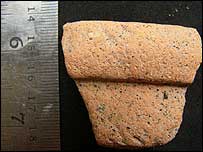
The most remarkable finds are the rim and handle of a classic Italian wine amphora from Naples .This was common during the late first century BC and 79 AD. The pottery production in the region was however disrupted by the eruption of Mt. Vesuvius. PATTANAM also provides evidences of foundation of early historic structures, pieces of Roman amphora and Rowlletted wares.
The entire site covers an area of about 1.5 sq km with deposits that are about two meters thick. Fragments of imported Roman amphora, which were mainly used for transporting wine and olive oil were found besides Yemenese and West Asian pottery. Bricks, tiles, pottery shards, beads and other artifacts found at PATTANAM are very similar to those found at ARIKAMEDU and other early historic sites in India.
As excavations are still in progress, more evidences are bound to come which will throw light on Ancient Indo-Roman trade