Adventures In EMS: Sim Lab

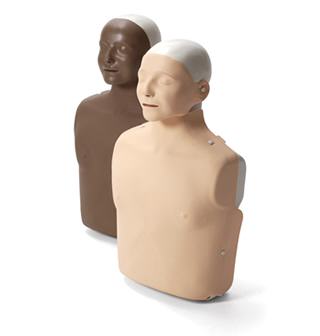
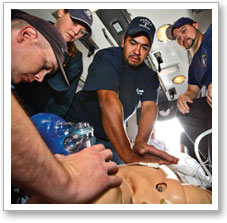
Little Anne Manikins
Training With Manikins
Half of EMS is training and practice. So while half of the medical supply industry is products, the other is training tools. One of the coolest training tools to come out is the Simulation Manikin, frequently called Sim Man. (Sim Man is kind of like Kleenex. It is actually a brand name, but the name is used to describe many different versions. In this case the brand is Laerdal, a top brand in the world of medical training supplies.)
We’ve been using manikins for a long time and most people have met Resesci Annie, the Laerdal-make gold standard of CPR manikins. From simple torso’s that click and have inflatable ‘lungs’ to full bodies with sand bag weight and pumps to replicate a pulse, she has provided a lot of necessary training from the lay person to doctors. The fault with standard manikins, however, is that their conditions are almost entirely conveyed through script. (Even the handy pulse pumps are rarely used by the instructor, because they frequently check off multiple students at a time.)
Using actual people may have the benefit of actual interaction, especially in obtaining patient histories. Adding mulage (make up designed to look like injuries and illness) can add a touch of realism to the experience, if its good mulage. Sometimes though, the strong intrusive scent of chocolate destroys all the good work. (Chocolate syrup is frequently used in making fake blood.) However, you can’t actually provide interventions; no CPR, no Heimlich, no intubation, and no meds. And the vitals are still provided via script, since, barring any wandering yogis, we can make our patient match the appropriate heart rate, blood pressure, and breathing problems associated with injuries we need to practice with.
Sim Man
Sim Man
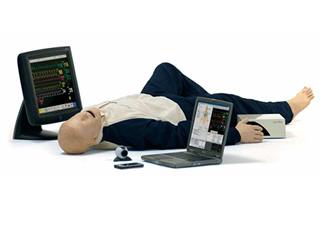
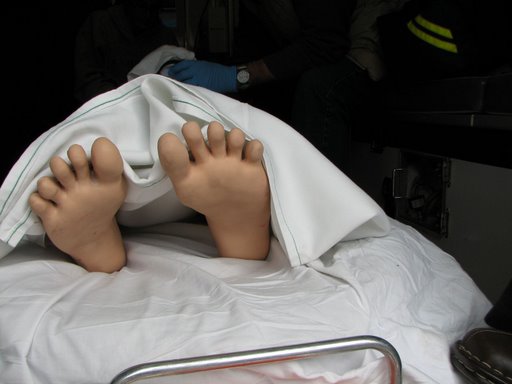
Enter the beauty of Simulation Manikin training. These guys do it all, including talk! They have pulses at all the usual pulse points (carotid, anticubital (for auscultating blood pressures), radial, femoral, and pedal). They have blood pressures and respirations. They have ECG pqrst-waves and take an AED shock—a live one! They have an IV arm for sticks and an anatomically correct airway for tubing. And when you come in and ask what’s wrong, they tell you. Okay, so for all you non-emt’s out there, what does that mean? Well, the simulation manikin has all the necessary anatomical responses to provide us the information to determine what we need to do to help him. Once we determine that, we are able to give him/her interventions, which he/she responds to. From the basic level to the paramedic level, this manikin is an invaluable tool. Infact, they use the very same manikins in medical schools. Here’s one DO program that has beefed up their department with Sim Man.
“In order to maximize the preparedness of our students to perform as skilled physicians, KCOM has acquired eight patient simulators, two METI HPS and six Laerdal SimMan mannequins. At every level of patient care, hands-on experience is the best teacher. The patient simulators are a computer-driven-model, full-sized mannequin which delivers experiences in true-to-life scenarios that swiftly change to meet the instructors’ goals. These ultra sophisticated and highly versatile simulators have voice capability and mimic chest rise and fall, have heart and lung sounds, have pulses, and accurately mirror human responses to such procedures as CPR, intravenous medication, intubation, ventilation, and catheterization.
How is this possible? Through a painstaking marriage of “high touch” with “high tech”, these dramatically functional mannequins exhibit clinical signals so lifelike that students have been known to cry when they “die”. Add to this a profound array of intricately programmed systems – cardiovascular, pulmonary, genitourinary (male and female), neurological, and the ability to respond to pharmacological interventions – and you have an easily controlled teaching laboratory where students can practice again and again, until the highest-quality patient care becomes second nature.”--- http://www.atsu.edu/kcom/academic_affairs/HSC.htm.
And it doesn’t end with Sim Man. There are simulation manikins for babies, birthing manikins, pediatric manikins, simulation neonates, and more on the way. From an integrated ambulance to a portable system to be set up in a hospital setting, they are versatile and functional.
Techonology in Training
The simulation manikin is possible because of interactive computer technology. The manikins are hooked up to a computer and a “man behind the curtain”. The wizard of oz of course is the simulation manikin. When you ask a question, he answers into a microphone and the words come out of the manikin. The operator is either in another room, or in the cab of the ambulance, depending on the setting. There are web cams hooked up so that the operator can input data on the computer to have the manikin correctly respond to your intervention. If the manikin can not read it itself. Compressions for example are measured and interpreted by the manikin by itself, able to determine if they are strong enough, to strong, and if the ratio is appropriate.
The web cams also record the session so that participants can review it in an extensive debriefing session. It is the debriefing that makes this a vital training tool. Not only are mistakes allowed, they are supposed to happen. After all, if we kill Sim Man, there’s no problem, but a mistake on a patient can be a truly bad thing. So here the leader of the training session will point out where team work breaks down, where leadership skills are flimsy, where our physical actions are wrong. It is an environment to learn from our mistakes, and to see right before us what those mistakes are, instead of trying to recall through the adrenaline and chaos of a call.
REAL
Yikes!
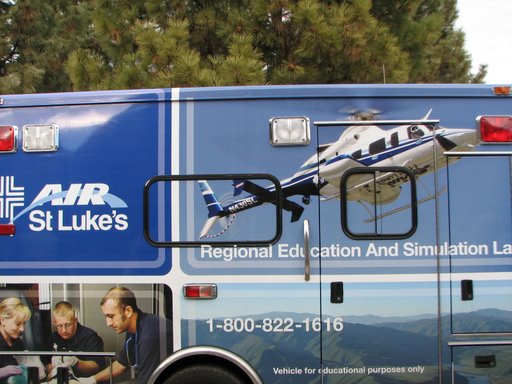
Not surprisingly these not so small treasures carry a not so small price tag, and may very well be beyond the means of your own unit (unless you ride on that mythical ambulance with no budget problems). The basic Sim Man runs in the upper 20G range, without all the nifty extras. So how did my little rural unit get to play with this great tool not once, but twice? St. Luke’s Regional Medical Center, in Idaho, has developed a traveling Sim Lab (Regional Education and Simulation Lab, or REAL) that provides free training for ambulances and hospitals. They have three simulation manikins, the standard patient, the birthing patient, and a baby. (For more information, check out http://www.stlukesonline.org/specialties_and_services/ASL/real/) The funds to do this are provided entirely by the Air St. Luke’s membership fees. (For any body who does anything outside of their local urban area, a medical helicopter membership is well worth it. The ones in Idaho, Air St. Luke’s and St. Alphonsus Life Flight, cost approximately 60$ a year, covers your entire family, and has reciprocity with each other as well as 13 other medical helicopters in the northwest. If you need to be evacuated by a helicopter for medically necessary reasons, that 60 dollars can save you thousands, since they don’t leave the ground for less than 5 grand.)
REAL Experience
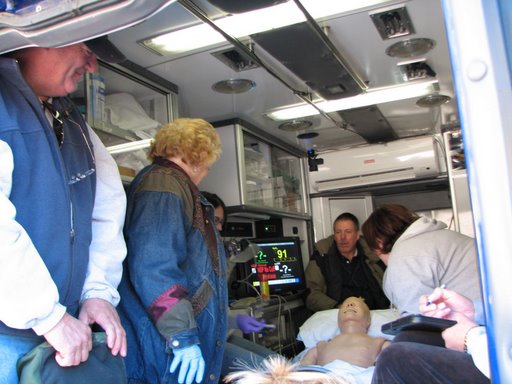
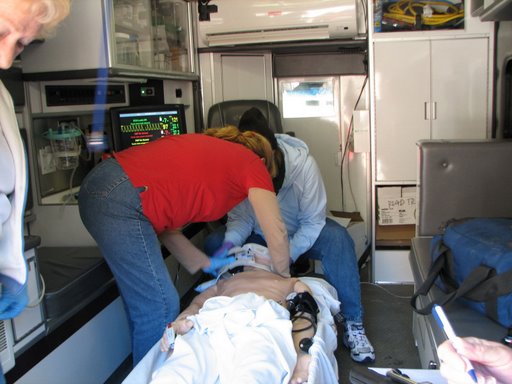
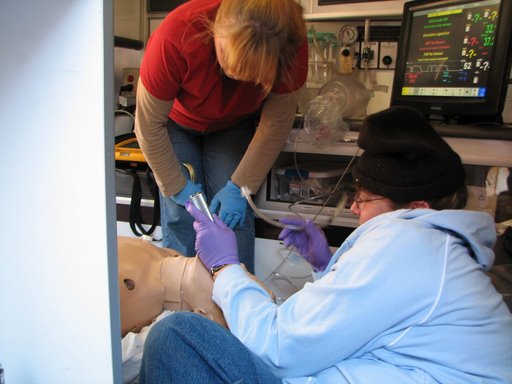
My unit, Pine/Featherville Ambulance, was lucky enough to experience Sim Man twice, and are planning on more. The sequence of events was fairly simple, but imparted a lot of learning, and lot of fun.
1. Introduction to the process. Learn about the REAL lab, what it is, what its mission statement is, and how to help it. Meet the conductors of the symphony to come.
2. Introduction to “Richard” the Sim Man. Learn what he can (and can not) do. Check out his pulses, blood pressures, respirations. Talk to him. Learn how to read the machines and what equipment of theirs to use.
3. First simulation. Teams are aligned as they would be on a call and the first volunteers head in. A medical emergency in progress (for us, they try and give you what you need most, and we get a lot of traumas but not so many medicals) and we are on our own.
4. Debriefing. With documentation from the webcams as well as computer read outs indicating times and whatever Richard measured or the Wizard of Oz input, everyone reviews the call. The conductor of the training session has made notes, points out what she saw and asks us questions about what happened, why, what could we have done differently, what did we do well.
5. Food break, decompression, and start again.
The people involved were friendly, professional, knowledgeable, and most of all, immensely helpful. They made the entire experience incredibly fun and has made sure that the next time Sim Man comes around, we will show up for more!
(For those of you in Idaho, the REAL team is planning a Sim-festival on Aug 8, 2009. Well worth a checkout!)
One last word on simulation from the Journal of Nursing Education.
“Simulation education is currently flourishing in the United States and around the world. Simulation technology has improved, and its costs have dropped. When faced with demands for more accountability for quality education and increased enrollment, disciplines and specialties are embracing the idea of simulation as a valuable tool.”-- Department of Anesthesiology and Perioperative Medicine, School of Medicine, Oregon Health and Science University, Portland, Oregon 97239, USA. seropian@ohsu.edu--J Nurs Educ. 2004 Apr; 43(4): 164-9
REAL Experience
Click thumbnail to view full-size


Related

9 Games Like Spore - Other God and Life Simulation Games
Comparing the Personal Emergency Response Systems Frequently Advertised in AARP Bulletins
American Civil War Life: Union Infantryman - Life on Campaign 15
FMLA for Doctors and Health Professionals (Medical Certifications)
Sports Coaching - Modelling & Simulation