Aryabhatta: The Indian Mathematician

71ARYABHATTA, or, as written by the Arabs, ARJABAHR, a celebrated Hindu mathematician, and the earliest known author on Algebra, is now generally believed to have lived about the beginning of our era. Nothing, however, has yet appeared that can give us the slightest information as to the place of his birth, or the time when he lived; nor is there, as far as we know, any tradition or record extent from which we can collect any of the circumstances of his life; even his period is still a matter of dispute. We must, therefore, content ourselves with whatever notices we find of Aryabhatta and his system in the various writers on astronomy and other mathematical sciences whose authority is established and cannot be called into doubt.
Aryabhatta is the first writer on astronomy to whom the Hindus do not allow the honour of a divine inspiration. Writers on mathematical science distinctly state that he was the earliest uninspired and a merely human writer on astronomy. This is a notice which sufficiently proves his being an historical character.
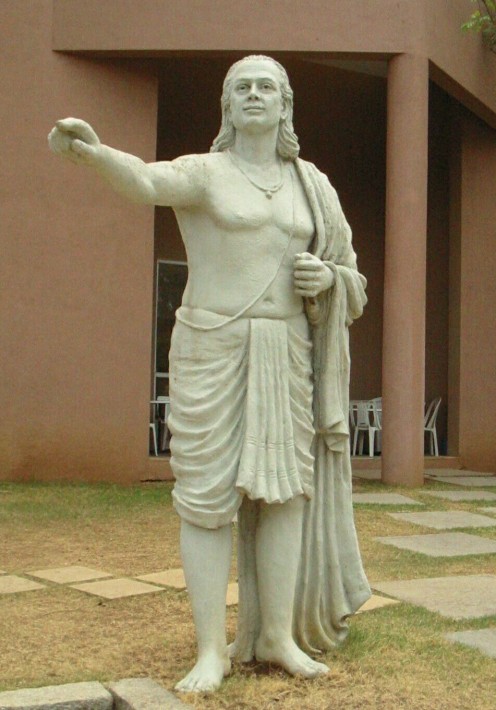
The chief doctrines which Aryabhatta (Aarya-Bhatt) professed were the following:
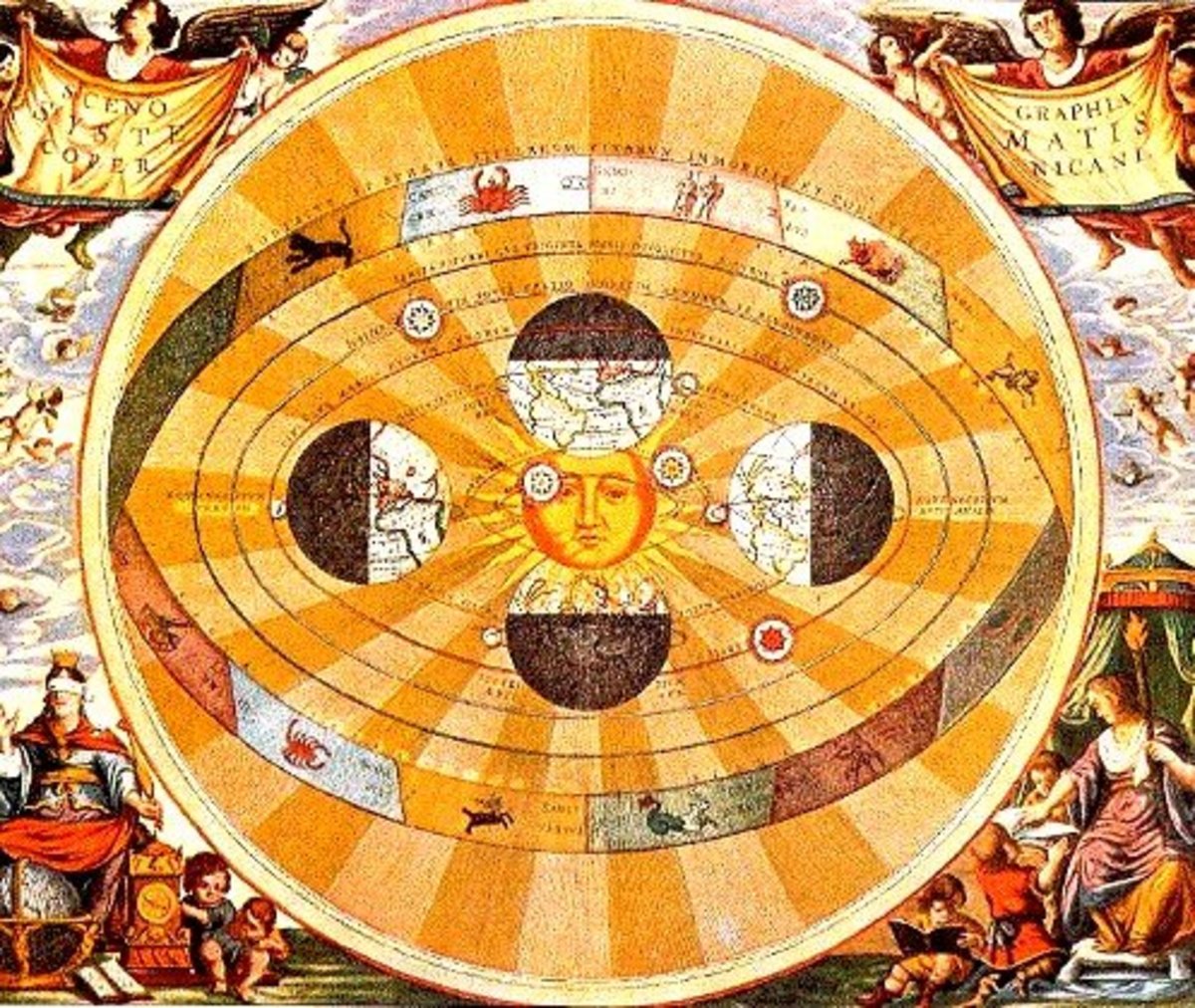
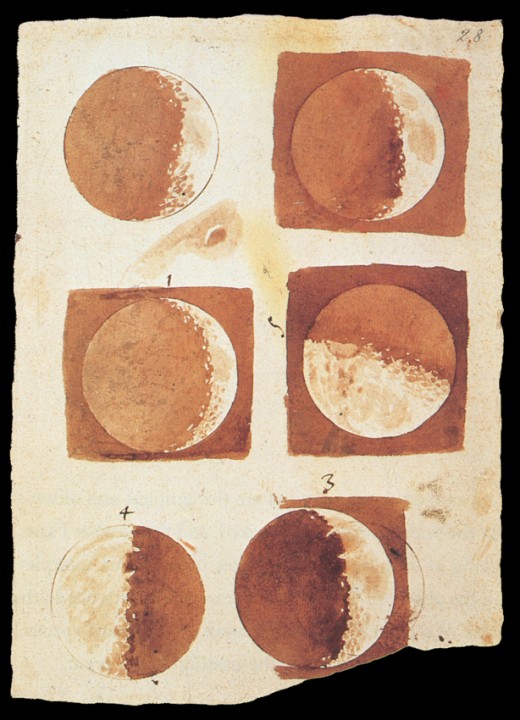
He affirmed the diurnal revolution of the earth on its axis; an assertion which is fully borne out by a quotation from one of his works, in a commentary on the "Brahmasphut'a-Siddhanta" of Brahmagupta by Prithudakaswami: "The Earth making a revolution produces a daily rising and setting of the stars and planets". At the same time he thought that this revolving of the earth was produced through the agency of a peculiar current of aerial fluid, or spiritus vector ("wind"), to which he assigned a distance of 150 yojanas (114 miles) from the surface of the earth. In opposition to the generally received opinion, he maintained that the moon, the primary planets, and the stars had no light of their own, and were only illumined by the sun; he consequently knew the true cause of solar and lunar eclipses.
Aryabhatta also ascribed to the epicycles, by which the motion of a planet is represented, a form varying from the circle and nearly elliptic. Moreover, he recognized a motion of the nodes and asides of all primary planets, as well as of the moon, and noticed the motion of the equinoctial and solstitial points, which he restricted, however, to an oscillation within the limits of twenty- four degrees, at the rate of one libration in seventy years. The length of AryabhatYa's sidereal year was 356 days 6 hours 12 minutes and 30 seconds. Aryabhatta stated the diameter of the earth at 1050 yojanas and its circumference at 3300 yojanas (25,080 miles). Hence it appears that he held the proportion of the diameter to the periphery of a circle to be seven to twenty-two, which is a nearer approximation than that of Brahmagupta and S'ridhara, who came after him.
The astronomical sects, of which Arabhatta is the reputed founder, were distinguished by the name of Audayakas, from Udaya, " rising;" implying that they fixed the beginning of the planetary motions on the meridian of Sri Lanka (Ceylon) at sun-rise, in opposition to the Arddharatrikas, who began the great astronomical cycle at midnight. Aryabhatta is the author of the " Aryasht'- as'ata" (eight hundred couplets in the Arya metre) and the "Das'agitika" (ten stanzas). The "Laghwarya-Siddhanta" is also ascribed to him: but, unfortunately, none of these works have yet been discovered; and we know them only through the numerous quotations from them, with which the works of subsequent writers abound. For an exposition of his numerical system and algebraic doctrine we refer to the article by another renowned scientist called BHASKARA.

PrintShare it! — Rate it: up down flag this hub
Comments
Great information nice hub
Thanks for that Rudra
I'm a sidereal astrologer. Nice writing.
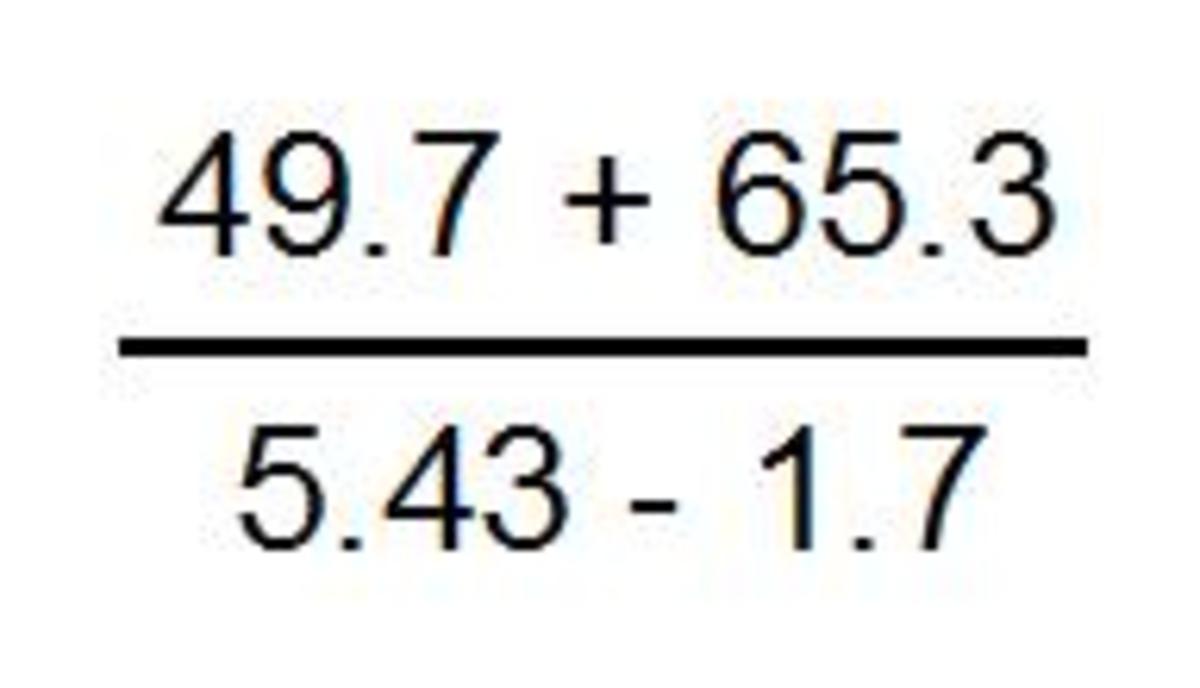
PLEASE LET ME KNOW HOW ARYABHATTA FOUND:(4+100)*8+62000/20000=PI-3.14
JAY JJJOLLY2003@yahoo.ca
IT IS VERY,VERY NICE INFORMATION.WE CAN LEARN MANY THINGS FROM IT.
Ver very good article Mrs.Rudra. You are enlightening people with good knowledge.I wonder how you find time to do this much!
The information given here is a good brief about Aryabhata and many things to learn and enjoy with it!!!!!! thanks for d information !!!!!!!!!!!!
i can just say in simple words that it was nice of uuu
NICE WRITING,MS.RUDRA.BUT YOU CAN DO WITH A LITTLE MORE INFORMATION.
More information is here
well than u so much for writing this wonder ful thing we ll realy apreciate .
thank god bless u
well than u so much for writing this wonder ful thing we ll realy apreciate .
thank god bless u
Thanks,the information was sufficient and nice.Keep it up.
Please provide me with a brief information about aryabhatta's personalhistory,His contributions to mathematics &funny incidents related to hislife
Thankyou for reading. Unfortunately not all is documented.
pouihuhkhg
nxhasbhxbbabb
very nice oh oh
very intellegent................................
gr8 information this help me a lot
My didi frantically wanted this for her project
Nice collection.
One of the best articles i have ever read . i hope you will keep on providing us with more informations on ancient scientists who have done so much research on great things
i wanted this for ma project good nice ah brilent
thanks rudra for nice collection
good work
thanks Rudra its help me in my presentation.
awsome .but can do better
hi,rudra iam pleased for your help and what can i say hmmm....good accumalation of these things aa cheer up thaaaaaaaaaaaaaaaanks..
Very very good!I hope that there will be lot of imorovement in children.Thankyou very very much!
Very nice helpful information. But more information could be added.................
THANKS RUDRA FOR GIVING SUCH INF.BUT PLEASE ADD MORE
thank uuuuuuuuuuuuuuuuuuuuuuuuuuuuuuuuuuuu
verymuch it helped me in my project.
Fantastic Keep it up
i like it and really help good in my project
Qes.1 Why did people come across the need of number?
qes2.
Qes.1 Why did people come across the need of number?
qes2.
Qes.1 Why did people come across the need of number?
qes2.
Qes.1 Why did people come across the need of number?
qes2.
Qes.2 what have people used for counting in pre-historic period?
qes3. How the numbering sustems were developed since years and years?
qes4. Today's different kinds of numbering systems ( decimal, binary Etc,)
qes5 Different devices used for calculation?
really bad rudra. i have no idea why everyone liked it so much
just kidding.. it was really good and helped my project a lot. DESI PEOPLE ROCK
nice
you could add his contributions
One of the best articles i have ever read . i hope you will keep on providing us with more informations on ancient scientists who have done so much research on great things
very hard to find information ,ect.
Really helpful for my projects, very nice
its a good site
GOD BLESS YOU
really helpful sites for projects & models
who r u
good but i don't find my project
its a very nice article
It was a very good article
good work u have done ./ thank u
cool text
gling
IT INCREASES OUR KNOLEDGE
that was a nice one
that was a nice one
faltu
dat wz really helpful....helped in my project..!!
very informative and crisp article. Could u share information about his childhood years.
nice.............................. but can u elaborate on his mathematical contribution
nice & great . Means an exellent work
maa chuda
neither a bad one nor a good one
@sushant. Please do not use bad words here. Kindly maintain some sort of decency in language.
THANK U FOR INFORMATION
More info on Aryabhatta can be found here http://www.aryabhatta.net
ITS QUITE GUD . THANX 2U 4 DA INFO
thanks for giving me a site
thankz for good information
thanks 4 th information about arya bhatta
i gain lot of information
thank u so much this really helped me in making my project
It was great..........
nice................................Thaxxxxxxxxxxxxxxxxxxxxxx.it helped in my project /.thanx again
Thanks for the information...
Its really helped me in making ma practicle file...
THANKS BUDDY
really helpful...!!
i dont find my project
it helps to complete my holiday homework with good imformation
plzzzzz add more about him and give a clear picture of him......... plzzzzzz if u dont mind.
hiiiiiiiiiii
more info on Aryabhatta can be found on http://www.aryabhatta.net
thahks very much it helps in my project a lot.please give images also.i want images also
i love this
It helped me a lot in my project. Thankssssssssssssssssssssss
I FIND MAIN CONTRIBUTION BUT DID NOT FOUND
THIS ALL ARE BULL SHIT
IT HELPED IN MY PROJECT BUT THESE ALL ARE BULL SHIT
thanks for the information.It helped me in my assignment.......keep it up...............
tnks fr infn
it hlp me lt fr my prjt
IT SAVED ME FROM MY STRICT MAM. IT WAS COOLHANK YOU
it is so nice and thankyou very much it helped me a lot in my project
VERY THANKS 4 U. BECAUSE I NEED THIS VERY URGENTLY.
YOU HAVE SPENT A LOT OF TIME FOR THIS.IT'S GREAT.
coooooooooooooooooooooooooooooooooooooooooooooooool dude
hELP IN MY PROJECT, hEY bABES WHATS UP
Diz Roxxx!!!!
It increased my ability to think
saimanoj manoj
hey! there is only little information needed! any way i got more information in wekipedia! better!
idot
it helped i9n my project very much thank u........
it helped alot on my project thanks!!!
very bad bad bad bad bad
what bad this is
it takes very time to read it
I got a nice imformation from this data.But i want more about him.
More data can be found on http://aryabhatta.net.
VERY VERY GOOD! IT GIVE US A GOOD INFORMATION.VERY GOOD RUDRA
TOO GOOD !
NICE STOCK !
very intellegent.
very nice i enjoyed reading it
very helpful in my school project..
it is very helpful in my school project
when was he born thou!??
very helpful in my school project..
Aryabhata is also known as Aryabhata I to distinguish him from the later mathematician of the same name who lived about 400 years later. Al-Biruni has not helped in understanding Aryabhata's life, for he seemed to believe that there were two different mathematicians called Aryabhata living at the same time. He therefore created a confusion of two different Aryabhatas which was not clarified until 1926 when B Datta showed that al-Biruni's two Aryabhatas were one and the same person.
We know the year of Aryabhata's birth since he tells us that he was twenty-three years of age when he wrote Aryabhatiya which he finished in 499. We have given Kusumapura, thought to be close to Pataliputra (which was refounded as Patna in Bihar in 1541), as the place of Aryabhata's birth but this is far from certain, as is even the location of Kusumapura itself. As Parameswaran writes in [26]:-
... no final verdict can be given regarding the locations of Asmakajanapada and Kusumapura.
We do know that Aryabhata wrote Aryabhatiya in Kusumapura at the time when Pataliputra was the capital of the Gupta empire and a major centre of learning, but there have been numerous other places proposed by historians as his birthplace. Some conjecture that he was born in south India, perhaps Kerala, Tamil Nadu or Andhra Pradesh, while others conjecture that he was born in the north-east of India, perhaps in Bengal. In [8] it is claimed that Aryabhata was born in the Asmaka region of the Vakataka dynasty in South India although the author accepted that he lived most of his life in Kusumapura in the Gupta empire of the north. However, giving Asmaka as Aryabhata's birthplace rests on a comment made by Nilakantha Somayaji in the late 15th century. It is now thought by most historians that Nilakantha confused Aryabhata with Bhaskara I who was a later commentator on the Aryabhatiya.
We should note that Kusumapura became one of the two major mathematical centres of India, the other being Ujjain. Both are in the north but Kusumapura (assuming it to be close to Pataliputra) is on the Ganges and is the more northerly. Pataliputra, being the capital of the Gupta empire at the time of Aryabhata, was the centre of a communications network which allowed learning from other parts of the world to reach it easily, and also allowed the mathematical and astronomical advances made by Aryabhata and his school to reach across India and also eventually into the Islamic world.
As to the texts written by Aryabhata only one has survived. However Jha claims in [21] that:-
... Aryabhata was an author of at least three astronomical texts and wrote some free stanzas as well.
The surviving text is Aryabhata's masterpiece the Aryabhatiya which is a small astronomical treatise written in 118 verses giving a summary of Hindu mathematics up to that time. Its mathematical section contains 33 verses giving 66 mathematical rules without proof. The Aryabhatiya contains an introduction of 10 verses, followed by a section on mathematics with, as we just mentioned, 33 verses, then a section of 25 verses on the reckoning of time and planetary models, with the final section of 50 verses being on the sphere and eclipses.
There is a difficulty with this layout which is discussed in detail by van der Waerden in [35]. Van der Waerden suggests that in fact the 10 verse Introduction was written later than the other three sections. One reason for believing that the two parts were not intended as a whole is that the first section has a different meter to the remaining three sections. However, the problems do not stop there. We said that the first section had ten verses and indeed Aryabhata titles the section Set of ten giti stanzas. But it in fact contains eleven giti stanzas and two arya stanzas. Van der Waerden suggests that three verses have been added and he identifies a small number of verses in the remaining sections which he argues have also been added by a member of Aryabhata's school at Kusumapura.
The mathematical part of the Aryabhatiya covers arithmetic, algebra, plane trigonometry and spherical trigonometry. It also contains continued fractions, quadratic equations, sums of power series and a table of sines. Let us examine some of these in a little more detail.
First we look at the system for representing numbers which Aryabhata invented and used in the Aryabhatiya. It consists of giving numerical values to the 33 consonants of the Indian alphabet to represent 1, 2, 3, ... , 25, 30, 40, 50, 60, 70, 80, 90, 100. The higher numbers are denoted by these consonants followed by a vowel to obtain 100, 10000, .... In fact the system allows numbers up to 1018to be represented with an alphabetical notation. Ifrah in [3] argues that Aryabhata was also familiar with numeral symbols and the place-value system. He writes in [3]:-
... it is extremely likely that Aryabhata knew the sign for zero and the numerals of the place value system. This supposition is based on the following two facts: first, the invention of his alphabetical counting system would have been impossible without zero or the place-value system; secondly, he carries out calculations on square and cubic roots which are impossible if the numbers in question are not written according to the place-value system and zero.
Next we look briefly at some algebra contained in the Aryabhatiya. This work is the first we are aware of which examines integer solutions to equations of the form by = ax + c and by = ax - c, where a, b, c are integers. The problem arose from studying the problem in astronomy of determining the periods of the planets. Aryabhata uses the kuttaka method to solve problems of this type. The word kuttaka means "to pulverise" and the method consisted of breaking the problem down into new problems where the coefficients became smaller and smaller with each step. The method here is essentially the use of the Euclidean algorithm to find the highest common factor of a and b but is also related to continued fractions.
Aryabhata gave an accurate approximation for ?. He wrote in the Aryabhatiya the following:-
Add four to one hundred, multiply by eight and then add sixty-two thousand. the result is approximately the circumference of a circle of diameter twenty thousand. By this rule the relation of the circumference to diameter is given.
This gives ? = 62832/20000 = 3.1416 which is a surprisingly accurate value. In fact ? = 3.14159265 correct to 8 places. If obtaining a value this accurate is surprising, it is perhaps even more surprising that Aryabhata does not use his accurate value for ? but prefers to use ?10 = 3.1622 in practice. Aryabhata does not explain how he found this accurate value but, for example, Ahmad [5] considers this value as an approximation to half the perimeter of a regular polygon of 256 sides inscribed in the unit circle. However, in [9] Bruins shows that this result cannot be obtained from the doubling of the number of sides. Another interesting paper discussing this accurate value of ? by Aryabhata is [22] where Jha writes:-
Aryabhata I's value of ? is a very close approximation to the modern value and the most accurate among those of the ancients. There are reasons to believe that Aryabhata devised a particular method for finding this value. It is shown with sufficient grounds that Aryabhata himself used it, and several later Indian mathematicians and even the Arabs adopted it. The conjecture that Aryabhata's value of ? is of Greek origin is critically examined and is found to be without foundation. Aryabhata discovered this value independently and also realised that ? is an irrational number. He had the Indian background, no doubt, but excelled all his predecessors in evaluating ?. Thus the credit of discovering this exact value of ? may be ascribed to the celebrated mathematician, Aryabhata I.
We now look at the trigonometry contained in Aryabhata's treatise. He gave a table of sines calculating the approximate values at intervals of 90°/24 = 3° 45'. In order to do this he used a formula for sin(n+1)x - sin nx in terms of sin nx and sin (n-1)x. He also introduced the versine (versin = 1 - cosine) into trigonometry.


Aman deep Garg says:
2 years ago
Nice hub,enjoyed reading it.