Bake better bread. Line your oven with inexpensive clay tiles.

72Cheap tiles make for great bread!
A 50$ cloche will almost mimic the effects of a 10k$ masonry oven.
|
|
Sassafras La Cloche Brick Oven
Price: $47.50
List Price: $50.00 |
|
Sassafras Superstone Covered Baker
Price: $47.50
List Price: $47.50 |
bake better bread!
This is a really easy way to start making the bread you make at home a lot closer to the bread that is coming out of really good bakeries.
The best bread is made in heavy stone or masonry ovens. You could make one of those, or you could start of with something just a little bit easier!
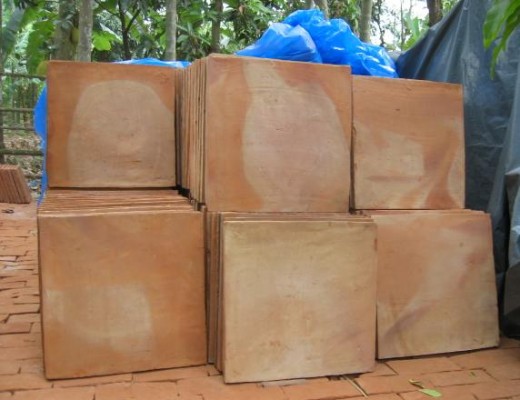
Lining the bottom rack of your oven with heavy unglazed clay pavers, is a great way to simulate the environment of a masonry oven, and you will notice a dramatic difference when you do your next batch of homemade hearth bread with the use of these tiles in your oven.
There are three kinds of heat:
- Convection
- conduction
- radiation
and these tiles help out with all three.
What happens, generally, when you open the door and place in a large mass of relatively cool bread dough into an oven, is that the oven temperature drops down dramatically. Modern ovens are designed to be well insulated, but have almost no heat storage capabilities. This heat loss is bad for bread, as the first few minutes of the baking time will determine the rise you get out of your bread.
The heavy clay tiles act as a heat sink, and will slowly absorb and reradiate all the heat from the preheating period. What this means, is that your oven temperature will stabilize much more quickly with the addition of a hot massive object, like the clay tiles. That's the convection (hot air) benefit.
The conduction benefit works on the base of the crust. By placing your loaves directly onto the hot tiles, they will get the benefit of a great, even heat, and the base of the bread will be thick and crusty and delicious.
The radiant benefit is perhaps the most important of all. Heat moves by process of radiation (the heat you feel from the sun on a spring day), at different wavelengths, and these wavelengths penetrate further into the crust. Using a massive object in the oven to create a source of radiant heat, will better reproduce the thick and crispy crusts that are the hallmark of great hearth baked bread.
This is never really going to be as good as a masonry oven for baking, but it does take a step in the right direction, and it will make your bread better. These tiles can be picked for a couple of bucks, and are much cheaper than the "pizza stones" made specifically for ovens. They also tend to be thicker, and thereby a better source of radiant heat.
You will need to ensure that you give the tiles a sufficient pre heat, 45 min. to an hour. If you put the bread in the oven before the tiles are well heated, they will actually be robbing the open and the bread of heat, and can make things worse!
Making a hearth floor out these tiles will also produce fantastic, crispy crusted pizzas (the secret to pizza is too crank the heat!)
Try adding these to your oven, and see how much better your next batch of bread will be!
hearth bread!
PrintShare it! — Rate it: up down flag this hub
Comments
Thanks for the comment, and I'm more of a cook than a writer, so it's nice to hear that my words at least make sense!
I hope you get inspired to get in the kitchen and make some great homemeade bread.
Thanks,
John
How do you use the stone for rolls? Once they rise, I don't think they are easy to move to the hot stone in the oven...or are they?? And, I couldn't preheat the stone while I am using it to hold the dough....
Thanks!
Hi Kelli,
you won't be proofing the rolls on the stones. Preheat the tiles or stones in the oven, for at least 45 minutes, and then bake on these. You can either use a bakers peel (I use a cuttting board with some corn meal on it) to transfer the bread or rolls directly onto the stones, or you can just proof the rolls on a baking tray, and then put the tray onto the tiles in the oven.
It's not as hard as it seems to slide the proofed breads or rolls onto the stones. Make sure you use lots of corn meal or flour on your peel so that the breads will slide easily. Get them to the edge of the peel, and then just sort of jerk the peel out, and the breads will slide onto the hot stones. The technique is more commonly used for breads than for rolls, but will make for some pretty good crusty rolls as well.
Good luck,
John
This IS the key to making great bread. Check out the book "The Best Bread Ever by Charles Van Over." He is a big advocate of hot ovens, stones, etc, and also promotes simple breadmaking techniquies.
Thanks for the tip Dan, I will check that book out.
Hi John, Could you tell me how to make brat buns? The ones in the store are a little bigger and chewier than the hot dog buns. I've tried the water in the bottom of the oven and a egg wash like I do for my Italian bread but this is not the answer either. Is there something to add or delete from the recipe itself. I'm at a loss. Thanx
Dude, what you say is all good, but you might warn your readers about choosing tiles that don't have air bubbles and so won't explode when heated.
Hi Euan,
I have always used baked terra cotta floor tiles, and have never had any problems (and I've been through a lot of them!) I do find that they tend to break after a while (Of course this is in daily all day use) but have never had any explosions (fingers crossed haha). I think if you stick with tiles that look like the ones in the photo above, you'll be fine.
John
Do I need to look for anything in particular in the tiles... I know that some have lime added to them, so I have been afraid to use them. Where are you buying your tiles? Thanks I have really enjoyed your info!!
Hi MG,
I've never heard of any problems with using unglazed terra cotta tiles. Glazed tiles can have some nasty stuff though. If it's something you're worried about, you can always use a little parchement paper on your stones for hearth baking.
- Holiday Pumpkin Bread Pudding RecipeBellaOnline2 hours ago
Pumpkin Bread Pudding is a perfect dessert for the holidays. Busy cooks will appreciate that it can be made ahead.
- Baking your own bread at home is on the riseseattlepi.com25 hours ago
Perhaps it's a reflection of a return to home cooking, a need for comfort food or the desire for a simpler time. Whatever the cause, cookbook authors are telling us that bread isn't nearly as difficult to make at home as we once believed.
- Two-Way Chanterelle and Pear Bread StuffingNew York Times3 days ago
A recipe for Two-Way Chanterelle and Pear Bread Stuffing.


Aphroditei says:
2 years ago
Thanks for this very well written hub John! Now I know why they end up stiff and chewy.~lol I will share this too with my mom. She will be so happy. Thank you again! (^^,)