Basic rules of soccer (football)

The sport known as soccer in North America and Australasia is argubly the world's most popular sport played between two teams (in many countries, including England, it is known as football). However, as would be expected for such a sport, there are many rules. However, there are a few key rules which are all that is necessary to get an understanding of the game so that it is posisble to enjoy it.
Rule 1. The aim of the game
The basic aim of the game is to be on the team which has scored most goals by the end of the match. A team scores a goal by getting the ball into the opposition's goal (also called the net).
Rule 2. The Pitch
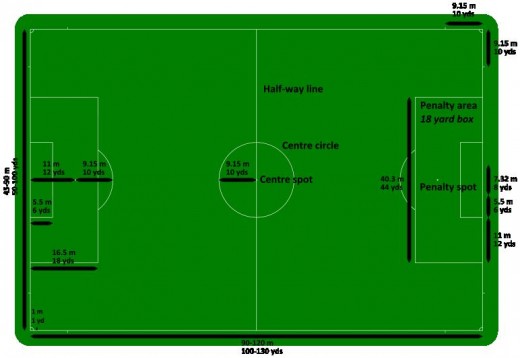
There are specific regulations surrounding the pitch. As these were first decided in the UK many years ago, all measurements are in yards. The pitch can vary in size for a regulation game. The length of the pitch can be between 100 and 130 yards, with the width being between 50 and 100 yards. The corners of the pitch are marked using corner flags. However, certain aspects of it have to be a constant size. This includes the penalty area (18 yard box) and the six yard box. The exact dimensions of all of the different aspects of a soccer pitch can be seen in the picture below.
Rule 3. The players
The first rule of a full sized soccer game is that there are eleven players on each team. Ten of these are classed as outfield players, with the remaining one classed as the goalkeeper. The goalkeeper is the only one who is allowed to touch the ball with any part of his (or her) body.
Rule 4. The officials
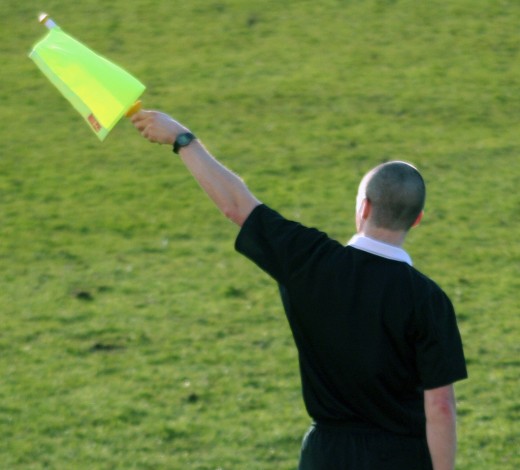
There is one referee who oversees and has control over the game, and enforces all of these basic rules of soccer, as well as many others. The referee has the final say on all major decisions, from whether goals have been scored to when a match should be called off due to climatic conditions. However, he does have some assistance. There are two assistant referees (aka linesmen) who do not enter onto the field of play but instead run along the side of the pitch (aka run the line). Each assistant has a flag, and they use this to get the referees attention and to signal to the referee their intentions (a bit like semaphore).
Rule 5. Timings
The game last 90 minutes, broken into two halves of 45 minutes each. At halftime teams swap ends for fairness to mitigate for any advantage provided by playing in one direction. The referee can however add on additional time at the end of the game. This is to make up for time lost when there was stoppages in the game. The additional time is added on after 45 minutes for additional time accrued in the first half and after 90 minutes for time accrued in the second half.
Rule 6. No hands
One of the most basic rules of soccer is aside from the goalkeeper, no other players are allowed to touch the ball with their hands when the ball is in play. They are however allowed to use any part of their body other than their hands and forearm, and as such the most common part of the body which is used is the foot (hence the name football).
Rule 7. Punishments
As this page is about the basic rules of soccer, this is a simplified explanation of the punishments. When the rules of the game are broken, there are a series of punishments.
Firstly, when the rules are contravened the opposite team to that which the person breaking the rules is situated on get a free kick. This is a situation in which the ball is stopped still (this is why free kicks can also be known as a dead ball), and the team which is taking the free kick get to kick the ball wherever they wish. Before the ball is kicked, the team which carried out the foul is made to stay away from the ball by at least 10 yards. Free kicks are given for most fouls. However, should a team concede a foul in the penalty area (aka penalty box) at the end they are defending, the opposition gets a special free kick, known as a penalty. For this the ball is placed on the penalty spot, regardless of where the foul happened. Only two players are allowed in the penalty area before the ball is kicked, the goalkeeper who tries to stop the goal and the penalty taker. Generally the penalty taker should score a goal from a penalty.
For a video of a penalty click here.
In addition, the person who commits a foul can be punished. Either he can have a verbal warning, or be shown a red or a yellow card. A red card means that particular player has to leave the game immediately, and cannot take any further part in this particular game. As a result the red card is shown for the most serious of fouls, such as those which could result in an injury. There is also the option of being shown a yellow card. Whilst a single yellow card is only really a formal warning, if a yellow card is shown to the same player twice during the same game it becomes a red card.
Rule 8. Fouls
It was previously mentioned in rule 7that punishments are levied for fouls. In the game of soccer there are many different fouls with different punishments, however as this is only the basic rules of soccer only the most common fouls will be included, along with a guide to the potential punishment:
- Stopping a goal or a goal scoring opportunity. If any player commits a foul, regardless of what it is, which prevents a goal or likely goal from happening, the player is automatically shown a red card. This supersedes the punishments listed for the fouls below.
- Using hands. If an outfield player (eg anyone apart from the goalkeeper) touches the ball deliberately with their hands then a free-kick/penalty is awarded and a yellow card is shown. There is a similar punishment if a goalkeeper uses his or her hands outside of their penalty area. A free-kick, or penalty if inside the penalty area, is given.
- Swearing. The referee can punish an individual for swearing or abusive language. The referee decides the punishment depending on the severity of the language.
- Dangerous play. Dangerous play involves any activities which can reasonably be expected to injure the opposition player such as using elbows, punching and kicking. The degree to the punishment depends on whether there was any intent, but generally a red card is shown. However, it is worth noting that not all physical contact is classed as dangerous play.
Rule 9. The kit
When playing soccer in proper matches, a specific kit (uniform) needs to be worn. The outfield players on one team wear one kit, which has to be different from the colour worn by the opposition team (this is why major teams have both home and away strips). The goalkeepers then wear a colour which is not the same as what any of the other players are wearing. In organised matches, held on grass, there is also the need to wear studded boots, shorts, and shin pads covered by long socks. Every player on each team has a unique number on the back of their shirts as well as on their shorts, this is to assist with identifying individual players.
Rule 10. Starting the game
At the beginning of each game the match is started by one player kicking the ball which has been placed on the centre circle. The player who kicks off in the second half is from the opposite team to the player which kicked off in the first half, to ensure fairness. This kick off is also used after a team has conceded a goal.
Rule 11. If the ball leaves the field
The final entry on this list of basic rules of soccer concerns what happens when the ball leaves the field of play (defined by the white lines around the edge of the pitch). If the ball goes out of the side of the pitch (on the long sides) the team which didn't touch the ball last takes a throw in. In this, they stand behind the line off of the pitch, and throw the ball over their head, using two hands and with both feet on the floor back into the field of play.
If the ball goes out behind a goal then an alternative method is used. If the team which is defending the goal at the end in which the ball went out was last to touch it, the opposition team gets to take a corner kick (like a free kick but from the corner of the pitch). However, if the attacking team was the last to touch the ball, the goalkeeper on the defending team gets to take a goal kick (like a free kick from within the penalty area).
Rule 12. The Offside Rule
In the UK there is an ongoing joke that the offside rule is hard to understand, although I personally understand it easily and don't understand why people don't understand it. However, because of this uncertainty, I missed it off of this list of the basic rules of soccer until it was requested.
Basically a player is offside if he is in the half of the pitch in which the goal which the opposition are defending with less than two opposition players between himself or herself and the goal-line when the ball is passed to him/her. Practically this generally means there is the goalkeeper and one outfield player.
More information
- FIFA.com - The Laws of the Game
If this list of the basic rules of soccer is not in depth enough, try this link for all of the rules, however obscure.
Any questions?
If you have any questions, or feel I have missed out one of the basic rules of soccer from this list, please let me know by using the comment section below.