Catastrophic Figure Paintings Reveal Cosmic Forces
Catastrophic Figure Paintings Reveal Cosmic Forces
Robert Kernodle
The same forces that produce heavenly bodies produce human bodies.
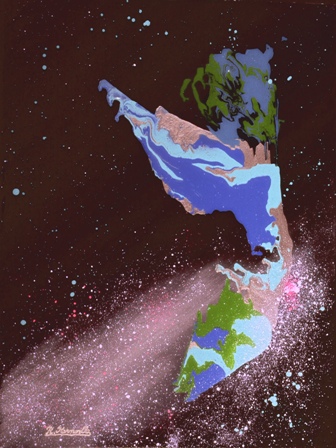
My figure paintings created from fluid catastrophes are little reflections of the universe. With these paintings, I suggest that outer space ultimately gives birth to inner spaces where liquid, living forms are born.
From Plasma To Passion
Ninety-nine percent (99%) of the visible, known universe is composed of plasma, the so-called fourth state of matter—the other three states are solid, liquid and gas. Plasma, however, is gas-like. Textbooks on fluid dynamics tell us that a gas is properly classified as a fluid—liquids and gasses are both fluids. Plasma, then, a close relative of gases, is a close relative of fluids. From this perspective, the universe is fluid-like.
Even before knowledge about plasma advanced, cosmologists (the scientists who theorize about the origin and evolution of the whole cosmos) modeled the universe as a grand dust-like fluid. These traditional cosmic thinkers might not have taken the idea of a fluid universe far enough. Their orthodox theories (such as the Big Bang Theory) seem to emphasize particles (quarks, electrons and atoms) instead of embracing a great fluid dynamic principle underlying all existence. Such a fluid principle seems to tie everything together.
Think about it: fluid-like plasma develops into hot, fluid-like stars, around which a fluid-based planet Earth (70% water) gives rise to human beings (60% water), who connect through passionate acts to create life in small liquid pools inside the womb.
Pools Are Our Proper Parents
I started developing these insights into nature and human existence during my first phase (Phase I) of making fluidism paintings. The paintings came first, of course, and their messages emerged later as inescapable truths.
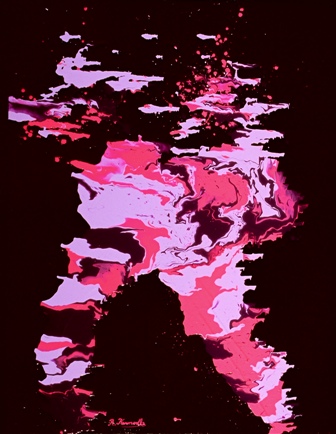
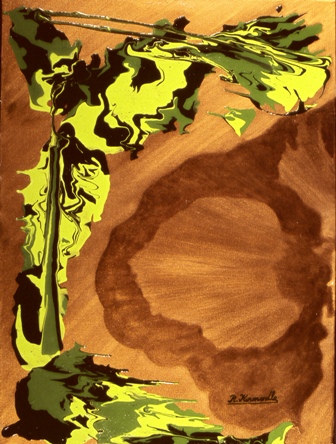
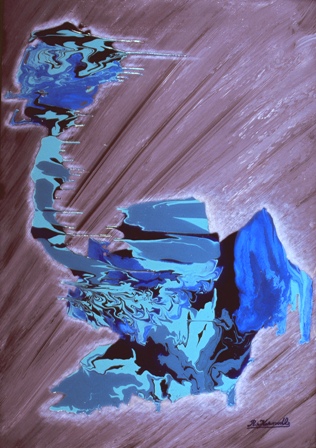
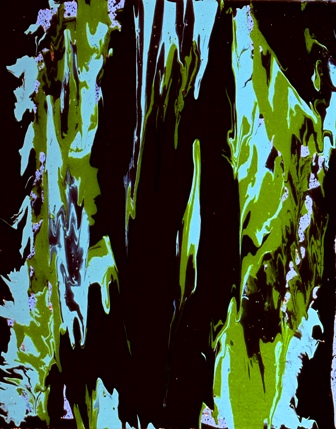
Fluidism (if you do not already know) involves colliding small puddles of liquid paint to discover fascinating fluid patterns, which dry to become lasting art works. These artworks are catastrophic formations caused by violently crashing different colored pigments into one another. While experimenting with paint flow in this manner, I routinely observed spontaneous formations that looked like wings, heads, torsos, arms, legs, mountain ranges, stars and nebulae. I gradually started entertaining the idea that we all come from fluids—not just from the fluid of sperm colliding into eggs, but also from the fluid of water crashing onto shores, where I believe life as we know it started. I now consider this point of view appealing, because it reconnects human beings to a common ground. I believe that we desperately need this common ground to relate to one another in a shared world.
Catastrophe Is Creativity
Astronomers frequently draw our attention to violent events in the heavens. Exploding stars, collapsing stars, colliding galaxies, planetary upheavals, meteorite impacts, and other cosmic catastrophes seem routine in nature. By some accounts, space and time itself are offspring of a huge explosion.
These destructive forces of nature seem as much a part of the creative process as quiet after a storm. When we open our minds to the big picture, we might realize that destruction is an extreme form of creation. In the great scheme of things, destruction is not evil, accidental, undesirable or always ugly. Destruction sometimes produces beauty—brief intervals where amazing, complex, natural events unfold and thrive in stable formations for a while. Life is such an event, and this is why life is precious—it is our creative gift in a brief interval between intense, disruptive forces. The purpose of life generally is NOT to destroy, but to inhale and savor the moment of being.
Abstract?—Not Exactly
How can I honestly consider fluidism paintings as abstract art, when they reveal the ultimate reality? Paintings that are tangible reenactments of cosmic forces in miniature seem to fit into another category.
Maybe the original concept of “abstract painting” is not quite right.
We have come to label all paintings that show no formal detail as “abstract”. No painting, however, can ever show all details or reveal the complete depth of reality, so all paintings are abstract to begin with—some show formal shapes, some show primal shapes.
“Abstract” means to extract from something bigger, to summarize, to use a little to represent a lot.
I use little pools of liquid to realize forces in the biggest pool of all—reality. In this sense, my fluidism paintings are both formal abstraction and primal realism—they show the most primitive creativity from which the most civilized creativity is born.