ArtsAutosBooksBusinessEducationEntertainmentFamilyFashionFoodGamesGenderHealthHolidaysHomeHubPagesPersonal FinancePetsPoliticsReligionSportsTechnologyTravel

Myra Bradwell & The Chicago Legal News

Updated on February 18, 2008

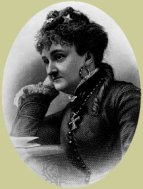
Myra Bradwell is one of the most noteworthy female lawyers in American history. She began publishing a weekly newspaper in 1868 called the Chicago Legal News—which covered news happenings in courts throughout the country. In the nineteenth century, married women were still subject to legal disabilities; however, Bradwell (who was married to a Chicago attorney) managed to get a special charter from the Illinois legislature to run the Chicago Legal News as her own business.
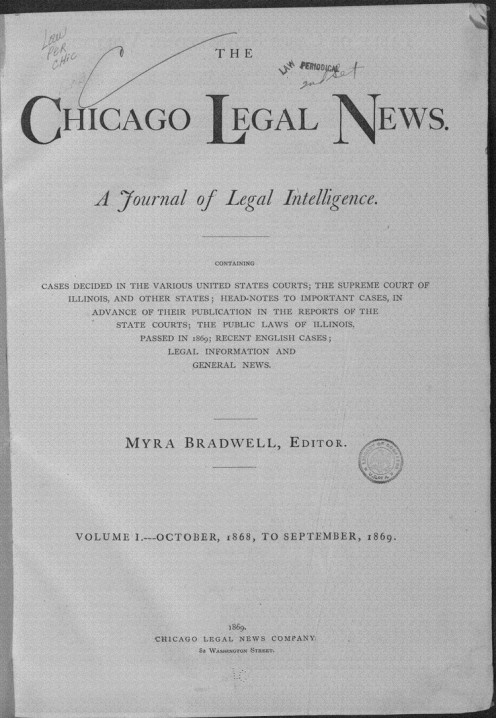
Bradwell used the News to write editorials, evaluate legal opinions and news laws, and to assess proposed legislation. She also used the paper as a platform to support progressive movements, like prison reform, the establishment of law schools, and women’s rights. Although she couldn’t legally practice law, Bradwell drafted bills to improve married women’s rights to child custody and property. She drafted and lobbied for the Illinois Married Woman’s Property Act of 1869, permitting women to own property and control their own earnings.

Myra Bradwell’s application to the bar was rejected by the Illinois Supreme Court because she was not a “truly free agent”—due to being married. Bear in mind that this rejection came although Bradwell passed the entrance tests in 1869 and there was no law explicitly prohibiting the state supreme court to license women as attorneys. She had to hire an attorney to argue her case appealing this decision. Her attorney argued that the right to pursue any honorable profession was among the “privileges and immunities” guaranteed by the Fourteenth Amendment.

Unfortunately, the Court ruled against her appeal. Justice Joseph P. Bradley offered the justification that the Court’s decision was based on the inherent differences between men and women. This judgment was subsequently used as a defense to exclude women from professional careers.

In 1872, a bill was passed that granted freedom of occupational choice to all citizens of Illinois: male and female. However, Bradwell didn’t believe she should beg for admission to the bar, so she never again formally applied for a license to practice law. She wrote in the Chicago Legal News that “having once complied with the rules and regulations of the court . . . [I] declined to . . . again ask for admission.”

Twenty years after her application, the Illinois Supreme Court admitted Myra Bradwell to the bar. This was in 1890. It wasn’t until 1894 when she was allowed to practice before the U.S. Supreme Court, but she never argued a case there. Myra Bradwell died two years later.


working

This website uses cookies

As a user in the EEA, your approval is needed on a few things. To provide a better website experience, hubpages.com uses cookies (and other similar technologies) and may collect, process, and share personal data. Please choose which areas of our service you consent to our doing so.

For more information on managing or withdrawing consents and how we handle data, visit our Privacy Policy at: https://corp.maven.io/privacy-policy

Show Details
Necessary
HubPages Device IDThis is used to identify particular browsers or devices when the access the service, and is used for security reasons.
LoginThis is necessary to sign in to the HubPages Service.
Google RecaptchaThis is used to prevent bots and spam. (Privacy Policy)
AkismetThis is used to detect comment spam. (Privacy Policy)
HubPages Google AnalyticsThis is used to provide data on traffic to our website, all personally identifyable data is anonymized. (Privacy Policy)
HubPages Traffic PixelThis is used to collect data on traffic to articles and other pages on our site. Unless you are signed in to a HubPages account, all personally identifiable information is anonymized.
Amazon Web ServicesThis is a cloud services platform that we used to host our service. (Privacy Policy)
CloudflareThis is a cloud CDN service that we use to efficiently deliver files required for our service to operate such as javascript, cascading style sheets, images, and videos. (Privacy Policy)
Google Hosted LibrariesJavascript software libraries such as jQuery are loaded at endpoints on the googleapis.com or gstatic.com domains, for performance and efficiency reasons. (Privacy Policy)
Features
Google Custom SearchThis is feature allows you to search the site. (Privacy Policy)
Google MapsSome articles have Google Maps embedded in them. (Privacy Policy)
Google ChartsThis is used to display charts and graphs on articles and the author center. (Privacy Policy)
Google AdSense Host APIThis service allows you to sign up for or associate a Google AdSense account with HubPages, so that you can earn money from ads on your articles. No data is shared unless you engage with this feature. (Privacy Policy)
Google YouTubeSome articles have YouTube videos embedded in them. (Privacy Policy)
VimeoSome articles have Vimeo videos embedded in them. (Privacy Policy)
PaypalThis is used for a registered author who enrolls in the HubPages Earnings program and requests to be paid via PayPal. No data is shared with Paypal unless you engage with this feature. (Privacy Policy)
Facebook LoginYou can use this to streamline signing up for, or signing in to your Hubpages account. No data is shared with Facebook unless you engage with this feature. (Privacy Policy)
MavenThis supports the Maven widget and search functionality. (Privacy Policy)
Marketing
Google AdSenseThis is an ad network. (Privacy Policy)
Google DoubleClickGoogle provides ad serving technology and runs an ad network. (Privacy Policy)
Index ExchangeThis is an ad network. (Privacy Policy)
SovrnThis is an ad network. (Privacy Policy)
Facebook AdsThis is an ad network. (Privacy Policy)
Amazon Unified Ad MarketplaceThis is an ad network. (Privacy Policy)
AppNexusThis is an ad network. (Privacy Policy)
OpenxThis is an ad network. (Privacy Policy)
Rubicon ProjectThis is an ad network. (Privacy Policy)
TripleLiftThis is an ad network. (Privacy Policy)
Say MediaWe partner with Say Media to deliver ad campaigns on our sites. (Privacy Policy)
Remarketing PixelsWe may use remarketing pixels from advertising networks such as Google AdWords, Bing Ads, and Facebook in order to advertise the HubPages Service to people that have visited our sites.
Conversion Tracking PixelsWe may use conversion tracking pixels from advertising networks such as Google AdWords, Bing Ads, and Facebook in order to identify when an advertisement has successfully resulted in the desired action, such as signing up for the HubPages Service or publishing an article on the HubPages Service.
Statistics
Author Google AnalyticsThis is used to provide traffic data and reports to the authors of articles on the HubPages Service. (Privacy Policy)
ComscoreComScore is a media measurement and analytics company providing marketing data and analytics to enterprises, media and advertising agencies, and publishers. Non-consent will result in ComScore only processing obfuscated personal data. (Privacy Policy)
Amazon Tracking PixelSome articles display amazon products as part of the Amazon Affiliate program, this pixel provides traffic statistics for those products (Privacy Policy)
ClickscoThis is a data management platform studying reader behavior (Privacy Policy)