Diesel Engine Technology

Rudolf Christian Karl Diesel
March 18, 1858-last seen alive September 29, 1913) was a French/German inventor and mechanical engineer, famous for the invention of Diesel Engine.
Rudolf Diesel was born in Paris in 1858. His parents were Bavarian immigrants. Rudolf Diesel was educated at Munich Polytechnic. After graduation he was employed as a refrigerator engineer. However, he true love lay in engine design. Rudolf Diesel designed many heat engines, including a solar-powered air engine. In 1893, he published a paper describing an engine with combustion within a cylinder, the internal combustion engine. In 1894, he filed for a patent for his new invention, dubbed the diesel engine. Rudolf Diesel was almost killed by his engine when it exploded. However, his engine was the first that proved that fuel could be ignited without a spark. He operated his first successful engine in 1897.
Invention Impact
His engines were used to power pipelines, electric and water plants,
automobiles and trucks, and marine craft, and soon after were used in
applications including mines, oil fields, factories, and transoceanic shipping.
Internal combustion engine
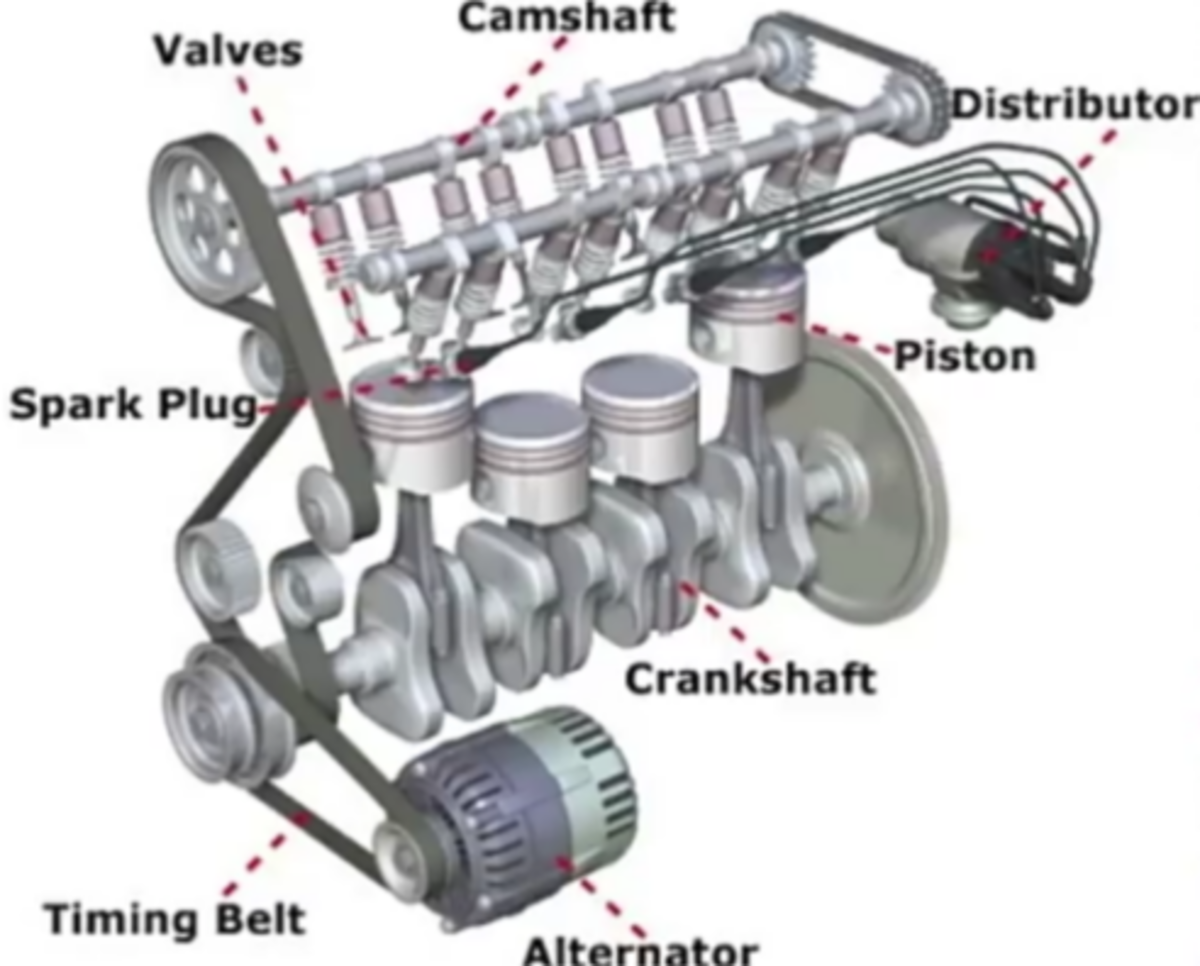
The internal combustion engine is an engine in which the combustion of a fuel occurs with an oxidiser (usually air) in a combustion chamber. In an internal combustion engine the expansion of the high temperature and pressure gases, that are produced by the combustion, directly apply force to a movable component of the engine, such as the pistons or turbine blades and by moving it over a distance, generate useful mechanical energy.
The term internal combustion engine usually refers to an engine in which combustion is intermittent, such as the more familiar four-stroke and two-stroke piston engines, along with variants, such as the Wankel rotary engine. A second class of internal combustion engines use continuous combustion: gas turbines, jet engines and most rocket engines, each of which are internal combustion engines on the same principle as previously described.
The internal combustion engine (or ICE) is quite different from external combustion engines, such as steam or Stirling engines, in which the energy is delivered to a working fluid not consisting of, mixed with or contaminated by combustion products. Working fluids can be air, hot water, pressurised water or even liquid sodium, heated in some kind of boiler by fossil fuel, wood-burning, nuclear, solar etc.
A large number of different designs for ICEs have been developed and built, with a variety of different strengths and weaknesses. While there have been and still are many stationary applications, the real strength of internal combustion engines is in mobile applications and they completely dominate as a power supply for cars, aircraft, and boats, from the smallest to the biggest. Only for hand-held power tools do they share part of the market with battery powered devices. Powered by an energy-dense fuel (nearly always liquid, derived from fossil fuels) the ICE delivers an excellent power-to-weight ratio with very few safety or other disadvantages.
Organic Fuels Biodiesel
Biodiesel is fuel made from natural vegetable oils, animal fats, and advanced non-food alternative crops. Plants produce their seed oils from little more than sunlight, soil, and air, while animal fats are produced when an animal eats plant oils. So, with careful management of these resources, keeping the total cycle of energy in mind, we can ensure the continued availability of biodiesel feedstocks, making biodiesel a truly renewable resource. What’s more, biodiesel burns clean, which keeps our skies and soil clean, which means we can keep on growing.
As for the more advanced technologies, there are some exciting things not just on the horizon, but in production today. You may have seen recent reports about algae, which can be grown in large volumes with minimal resources. It’s not just a future fantasy. As a growing technology-driven company, we’re working to bring these and other technologies to the marketplace even now.
The energy yield of biodiesel is tremendous. Biodiesel can actually return more than three times the amount of energy required to produce it. That leaves petroleum and other biofuels in the dust, some of which require more energy to make them than can be gained by burning them.
External links
mechengin
Related

The Best Diesel Truck Of 2012: A Comparison Of The 2012 Diesel Models
Working of an Engine: Internal Combustion Engine Explained

Different Types of Smartphone Storage Technologies You Should Know
All Cars With the BMW M50 Engine

Rites of Passage for a Model Railway - 17: Benchmark - Tank Loco Models, Are They up to Spec?