Don't React, Look Ahead at Problems

Rosie the Riveter

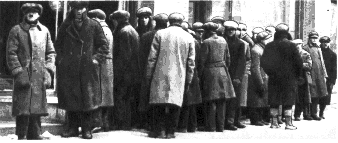
Depression Era Protest of Various Income Security Programs
Palisades Amusement Park

Arguably, the Great Depression and World War II were among history's most dreadful times. Yet, many of us who lived through those sorrowful times remember them, too, as pleasant, sometimes bittersweet.
We remember food packages left at our door by the Welfare Department, Gold Star mothers crying for their sons lost "over there," and mothers, whose husbands were fighting Hitler and Tojo around the world, leaving home to take "Rosie the Riveter" jobs to help in the war effort.
Despite all that, we look nostalgically at the close-knit families, friendly and crime-free neighborhoods, pleasant and convenient trolley cars and cheerful outings at beaches and parks.
A Better Quality of Life
Today, we have neither a world war nor a world depression; we have world peace, of sorts. We should be "happy as a clam," looking forward to a quality of life far better than our forefathers, and confident about retirement in comfort on savings and Social Security.
Alas, would that it were so!
Unfortunately, the picture isn't that rosy. We don't have a world war, but we have some of the sorriest conflicts the world has ever seen (i.e. Bosnia.) We don't have world depression, but we have hunger and poverty on a grand scale around the world -- and in the United States.
Our amusement parks are all but gone, our beaches are awash with pollution or, as in Greenwich (Conn.) all but posted with "Keep Out" signs. Our open-air, nickel-a-ride trolleys that ran every few minutes virtually anywhere you wanted to go were replaced with buses; today the buses run infrequently, on routes that are inadequate, while financially pressed communities push the fares so high that it's cheaper to take your car (if you have one.)
Rampant Crime
Sure, we had some problems decades ago -- aside from the world war and depression -- but today's troubles affect more people more directly more often; today's problems go more directly to the quality of life. What can be more pervasive than rampant crime that keeps people fearful of walking the streets?
I've often wondered over the years why we rarely tackle problems before they overwhelm us. We always seem to be reacting to, rather than forestalling, disaster.
In fact, "the system" promotes a reactionary approach to problems. Generally, after disaster strikes, the public complains; then, finally, a legislator becomes aware of the situation and, eventually, files a bill to correct the problem.
This procedure does not allow for an assessment of the problem, much less a comparison of options.
Signs of Hope
Two hopeful signs appeared on March 25 indicating that our political leaders are trying to look ahead on at least one issue: crime; not that it's all that early in the game, but, it is hoped, before the situation is aggravated beyond redemption.
In one instance, Gov. (John) Rowland created a "crime cabinet" of law enforcement officials to try to deal with problems "ahead of time." In another, Norwalk's own former Judge Nicholas Cioffi is urging that a task force be set up to study our drug laws with an eye toward changing the state's approach toward the problem.
What we really need, in my view, is a government-sponsored commission modeled after the Supreme Court to find problems before they become emergencies, look at options, and offer solutions to our legislative bodies.
I wrote this column as a "My View" for The Hour newspaper of Norwalk, Conn., on April 15, 1995.