Echinacea: Good for What Ails You
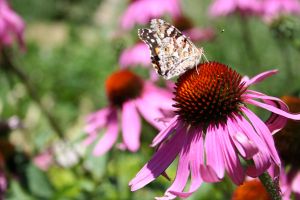
75If you've ever seen gardens with purple-pink flowers that bloom in the late summer to mid-autumn, you've seen echinacea. It's a favorite of gardeners because of its tolerance to the elements. It also attracts butterflies! But it's more than just ornamental. While you may recognize it by the common name of "purple coneflower," it's also one of America's most popular herbal treatements.
How Is It Used?
Echinacea (pronounced ECK-in-AY-zhuh) has been used for generations to treat everything from snake bites to toothaches. Nineteenth century herbalists recognized its value as an immune system booster, and also used it to help speed wound healing, reduce inflammations, treat colds and flu, and fight infections.
Did You Know?
- Echinacea is a family of nine flowering plants indigenous to North America.
- Echinacea has been used by Native Americans for hundreds of years as an antiseptic, pain killer and for the treatment of snakebites.
Books About Echinacea
|
|
Echinacea: The genus Echinacea (Medicinal and Aromatic Plants--Industrial Profiles, V 39)
Price: $91.38
List Price: $109.95 |
|
|
Herbs to Boost Immunity: Herbal Tonics to Keep You Healthy and Strong Including Echinacea, Siberian Ginseng, Astragalus, and More (Keats Good Herb Guide Series)
Price: $58.22
List Price: $4.95 |
|
|
Healing Power of Echinacea and Goldenseal and Other Immune System Herbs (The Healing Power)
Price: $3.69
List Price: $11.95 |
|
|
Echinacea: Nature's Immune Enhancer
Price: $1.93
List Price: $8.95 |
|
|
An Herbalist's Guide to Growing & Using Echinacea: A Storey Country Wisdom Bulletin
Price: $2.14
List Price: $3.95 |
|
|
Echinacea
Price: $1.49
List Price: $3.95 |
Echinacea on eBay
|
|
Echinacea & Goldenseal Herbal Supplement
Current Bid: $10.99
|
|
|
GNC Echinacea & Goldenseal Herbal Supplement 1OZ NEW
Current Bid: $3.99
|
|
|
ECHINACEA Herbal Dietary Supplement 4 floz Sealed
Current Bid: $24.95
|
|
|
ECHINACEA/GOLDENSEAL Natural Herbal Supplement 2 floz.
Current Bid: $14.95
|
During the early 20th century, echinacea was a best-seller in America and was used for a variety of maladies. But around 1930, modern medicine dismissed it as having no value and it remained largely unused until the 1980s, when there was renewed public interest in herbal remedies. Today, it's among the best-selling herbal extracts. The two most popular varieties are Echinacea purpurea, which has larger, darker purple petals; and Echinacea angustifolia, which has narrower, paler petals.
Different studies show different results, but there's evidence that echinacea helps to relieve cold and flu symptoms and aids the immune system. It's recommended that you begin taking it at the first sign of a cold or flu, as it works best as a preventative rather than a cure. Better yet, take echinacea at the beginning of cold and flu season to boost your immunity.
Echinacea is also recommend to combat seasonal spring allergies and sinus problems, but start taking it in February -- before allergens are in the air. It's important to note, however, that it shouldn't be taken continuously. To maintain a healthy immune system, it's best use it on a "three weeks on, one week off" regimen because the body seems to adjust and the herb loses its effectiveness. During the week you're not taking it, your immune system will adapt and increase in strength.
How Safe Is It?
Echinacea has an excellent safety record: After hundreds of years of use, no serious side-effects have been reported other than rare allergic reactions in sensitive individuals. Echinacea works not by destroying germs but by energizing your own immune system. And because it engages your body's natural resources, negative side-effects (such as sometimes occur with synthetic antibiotics) are not an issue.
Much of echinacea's medicinal value is found in the root, with the Augustifolia root having slightly more medicinal value than the Purpurea root, which is something to remember when purchasing. Because of its ability to boost the immunity system, echinacea may also be recommended to overcome stress, malaise, or general weakness.
There is some question, however, as to whether it's safe for people with auto-immune diseases. Because the evidence is inconclusive, it's best to avoid it if you are HIV-positive or have an autoimmune disease, such as lupus, multiple sclerosis or scleroderma. For most of us, though, echinacea is considered generally safe, although some digestive systems may need time to adjust to it. (It can cause mild nausea in rare cases.)
More Information About Herbs and Supplements
This comprehensive online herb and supplement encyclopedia offers information on a variety of herbs and natural supplements, and this source can enlighten you about a broad spectrum of Chinese herbs.
-
Like echinacea, lavender is a beneficial flower with many uses. Find wholesale lavender.
. . . . . . . . . . . . . . . . . . . . . . . . . . . . . . . . . . . . . . . . . . . . . . . . . . . . . . . . . . . . . . . .
Other WordPlay Health Hubs
Echinacea in the News
- Battling the SkepticsNew York Times28 minutes ago
Michael Specter takes on those he sees as denying science, from promoters of alternative medicines to anti-vaccine zealots.
- Mark Hyman, MD: Preventing The Swine Flu: A Comprehensive ApproachThe Huffington Post3 days ago
I will review what to consider if you are thinking about vaccination, discuss some of the risks involved, and provide you with a comprehensive 7-step plan for preventing swine flu this winter.
- Herbal remedies need real scrutinyCNN5 days ago
Did you know that there exists an all-natural remedy for memory loss? Weight gain? Macular degeneration? Prostate enlargement? These products are so successful that clinical testing has already begun! Just listen to the following testimonial from an unidentified person ...
- Barkeep, a Placebo on the Rocks, PleaseNew York Times6 days ago
Bartenders, normally dispensers of pleasure, have lately been playing doctor behind the bar.
. . . . . . . . . . . . . . . . . . . . . . . . . . . . . . . . . . . . . . . . . . . . . . . . . . . . . . . . . . . . . . . .
PrintShare it! — Rate it: up down flag this hub
Comments
Thanks, Zsuzsy! I always appreciate it when you stop by.
Great info - One question though...
How effective is Echinacea tea? Is the "dose" of Echinacea in the tea enough to make a difference?
Good question! Here are equivalent doses for adults, according to the University of Maryland Medical Center:
"For general immune system stimulation, during colds, flu, upper respiratory tract infections, or bladder infections, choose from the following forms and take three times a day:
*1 to 2 grams dried root or herb, as tea
* 2 to 3 mL of standardized tincture extract
* 300 mg of powdered extract containing 4% phenolics
* Tincture (1:5): 1 to 3 mL (20 to 90 drops)
* Stabilized fresh extract: 0.75 mL (15 to 23 drops)"
I hope that helps!
Other WordPlay Hubs
This does not appear to be a valid RSS feed.


Zsuzsy Bee says:
2 years ago
Wow! Lots of great information in this article.
great HUB
regards Zsuzsy