Factory farming chickens and eggs: appalling inhumanity or necessary evil?

81Introduction
Chickens are big business. There are far more of them in the world than any other bird - approximately 26 billion in 2008 (don't ask me who counted them, I certainly didn't....) They are a large and important source of protein in human diets across the world, both for the meat and for the eggs.
People also like eating both; they are popular foods. And in order to satisfy the demand for cheap, reliable sources of both eggs and chicken, they are mass-produced all over the world.
A natural chicken, wandering around in a flock outside, might live to be 10 or 12 years old. Standard factory-farmed chickens are killed at about 6 weeks old, having been encouraged to grow as fast as possible.
Egg-laying chickens are usually killed at 12 - 24 months old.
Chicken and egg farming until c. 1940
In terms of farming, there isn't much doubt which came first - egg farming came before chicken farming.
Until a few decades ago, chicken meat was almost a by-product of egg production.
A family might keep a few chickens, and would eat only the young male ones, and the old females past their egg-laying peaks.
Similarly, egg-farms would sell young male birds and old layers to butchers or grocers, for the meat. The eggs were, however, the primary focus.
My grandmother bought chicken for her household in the 1930s and 1940s (as a teenager, then a young married woman) in markets in Liverpool, a large port city in north west England.
It was usual to choose a live chicken, which would then be strangled and handed over. Freshness was thereby guaranteed.
Chicken was an expensive treat. It was usually more costly than mutton, pork or beef, and was eaten on special occasions. My mother remembers chicken being an occasional luxury in the 1950s and 1960s, as she grew up.
- The British Poultry Council
The British Poultry Council is the voice of the British poultry meat industry, and champions the cause of farmers and food producers. It has detailed articles on its website about various aspects of the trade.
Chicken and egg farming today
This has all changed.
Since the Second World War, in particular, the two areas of farming have separated and become agribusiness or factory-farming.
The numbers have exploded.
In the United Kingdom, for example, 5 million chickens were produced for meat in the entire year.
In 2007, the last year for which complete figures were available, that had risen to 860 million birds. Only 5% of these were organic, free-range chickens.
Chicken comes to the western consumer in plastic-wrapped portions, and is astonishingly cheap.
If I were to buy a chicken and a dozen eggs today, I would not pay very much. A quick look a few supermarket websites in the UK suggests these average prices:
- Cheapest 12 eggs £1.64 / $2.46
- Most costly 12 eggs (organic, free-range) £4.10 / $6.15
- Cheapest chicken £1.99 / $2.98 per kg / 2.2lb
- Most expensive chicken (organic, free-range) £5.50 / $8.25 per kg / 2.2lb
Sounds great, doesn't it?
But it's not all good news. There are cons, and they involve animal welfare and ethics, species manipulation, concerns over the food-chain and drugs, pollution and waste production, food poisoning, and diseases being transferred from animals to humans.
What is factory-farming?
A definition inevitably involves some generalisations.
Each country has different standards for chickens raised for food, or kept to produce eggs, and different rules about drugs and supplements.
Detailing every country's rules would be tedious beyond belief, so this is an overview, with an emphasis on UK facts.
|
Slingshot Flying Chicken With Cockadoodle Scream Sound
Price: $0.96
List Price: $9.99 |
|
Crazy Cluck Wacky Chicken
Price: $19.95
List Price: $24.99 |
|
|
Storey's Guide to Raising Chickens: Care / Feeding / Facilities
Price: $9.86
List Price: $18.95 |
|
Plush Lil' Cluck Chicken Mini Flopsie 8"
Price: $5.49
|
Chickens reared for meat
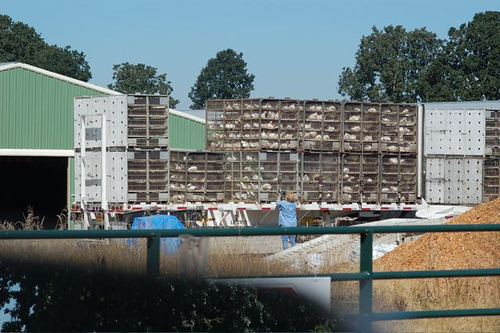
- Many hens are kept either in cages, or in a huge flock in enclosed barns. They do not go outside for their entire, short, lives;
- They are bred to gain weight as quickly as possible, and some suffer limb injuries as their bodies are too heavy to be carried by their legs, and some suffer heart failure;
- The average time from hatching to slaughter is 35 days;
- They are kept in dim lights most of the day, to encourage them to eat more and sleep less;
- Many are "de-beaked" to prevent them attacking other birds in such confined conditions;
- They are fed antibiotics and supplements to prevent illness and encourage swift growth;
- 90% of British chickens have an area the size of an A4 piece of paper, so they cannot turn round properly.
Chickens which lay eggs
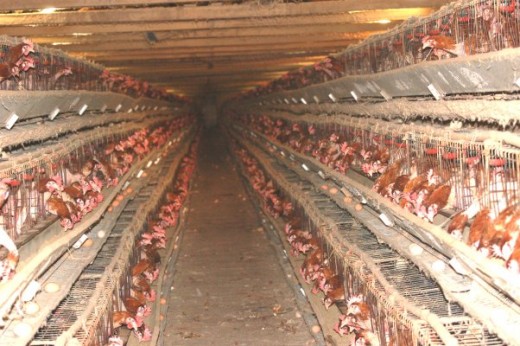
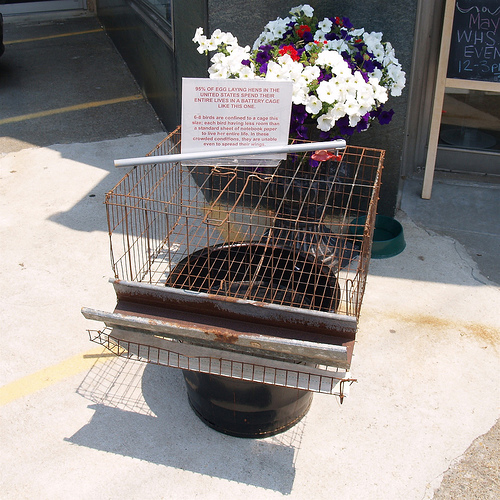
- They are mostly kept in small cages, and cannot move around or stretch their wings fully. 70% of British egg-layers are either in crowded barns or cages. A normal and legal cage is 20 inches by 20 inches, and contains 4 or 5 birds;
- Cages are made from wire, to allow droppings to go through the cage, and they are sloped so that the eggs roll out for collection;
- On average, a layer produced 340 eggs per year;
- The cages are stacked on top of each other in sheds, and many contain tens of thousands of chickens. 70% of battery layers are in sheds containing 20,000 to 100,000 birds, and they are incredibly noisy;
- Hens are often over-fed and given drugs and supplements, as with meat chickens
- The Battery Hen | Down the Lane
About Battery Hens, their farming and welfare - Inside the battery chicken sheds
Poultry farmers respond to a campaign by celebrity chefs to raise standards of chicken production. - Battery Farming
Inside Out South West meets one woman who is determined to give battery hens a new life in the open air.
Animal welfare concerns - illness
Many birds suffer serious and painful conditions.
Meat chickens
An entire batch is raised at once, usually in a shed together. The floors are not cleaned except between batches.
- Up to 80% of chickens suffer from either rickety legs or heart-failure;
- Because of the lack of cleaning, about half develop sores from urine and fecal contamination;
- Approx. 6% die before slaughter, from respiratory disease, fatty liver, and heart failure;
- The de-beaking is painful;
- Aggression between birds is common;
Egg-laying chickens
- By the end of their lives, approx. 80% of chickens have injuries to their legs and feet from the wires floors of the cages;
- the breeding and feeding to maximise egg-production, coupled with the lack of exercise, causes fatty liver hemorrhagic syndrome, calcium deficiency and broken bones, prolapses of the reproductive system, bits of large eggs stuck inside the ducts, and dimming of the eyes;
- aggression between birds is common;
- de-beaking is painful.
- The RSPCA's campaign
The Royal Society for the Prevention of Cruelty to Animals (the RSPCA) has a campaign here against what it sees a cruel conditions for chickens. - Egg Production
An insightful look into how eggs come to be in our markets.
Animal welfare concerns - stress and deprivation
The animals never, in their entire lives, see the outdoors, natural light, or fresh air.
Chickens are mobile birds which live in flocks. Left to themselves, they potter about, stretch, fluff their wings, and scratch in the dirt.
None of this is possible in battery or shed conditions. They are too crowded for any form of natural behaviour.
As a result, they are bored and frustrated.
Human health concerns
Many egg-layers (in particular) but also meat chickens suffer from e-coli and salmonella, both very serious illnesses which can be caught by humans. The crowding in sheds and cages makes such diseases impossible to minimise or eradicate.
The drugs and supplements in the meat and eggs may cause long-term adverse effects when introduced into the human food chain.
|
Unassembled Plastic Easter eggs - assorted colors (12/PKG)
Price: $6.99
|
|
Plastic Easter Eggs Assorted Colors (2 dozen)
Price: $7.99
|
|
Value Pack Fillable Eggs 48ct
Price: $9.99
|
|
Easter Treats 12 Jumbo Eggs
Price: $0.99
|
Possible epidemics
We've all heard of "bird 'flu" or "Avian 'flu". This is a pandemic which many experts fear is on its way. Influenza is an illness which can jump the species barrier, and there is a real and serious risk of a world-wide epidemic if the particular virus of current concern (H5N1) is passed to humans.
Massive concentrations of birds, reared for meat or eggs, makes it more likely that disease goes un-noticed, and that wild birds can also be infected.
Conclusion
There is absolutely nothing which would lead me to eat anything other than free-range eggs or chicken. I don't eat much meat anyway, but that I do buy is always both free-range and organic.
The factory-farming method does produce vast quantities of cheap protein, and I can't deny this. But we can, if we choose, get protein either from ethically-reared birds, or non-animal sources.
I can't see factory-farming as justifiable on any ethical level. The sheer cruelty, pain, boredom and frustration is just horrifying beyond belief.
Poll on your own habits
Do you eat free-range, organic chicken and eggs?
See results without votingPrintShare it! — Rate it: up down flag this hub
Comments
Thanks Suzanne - I think we agree!
I don't keep chickens (they wouldn't like a third floor flat in the centre of town) but we only have free-range, organic stuff here.
Greed is the driving force behind most inhumane practices and always has been. If more people were aware of where their food comes from, the conditions you describe, LG, might stop, or at least get better for these poor chickens.
I think so - well, I hope so, at the very least.
I'm with you all the way on this one LG. I don't buy supermarket chicken and I get my eggs from the son of a friend of mine who is raising about 25 of them on a farmette just outside of town. His chickens run around and scratch for a living so the eggs taste wonderful, with deep yellow yolks. I can't believe that eating the flesh and eggs of animals who have lived miserable lives under such horrible stress, and who have been filled with anti biotics and hormones, can be good for human beings. Thre has to be a balance between cheap food production and morality. Another great job, LG
Yes-- we eat the eggs. We have our own free range chickens.
I found out how they kept the chickens and now when I buy, I buy organic free-range. It makes me sick to think I helped to support that system for so many years. I cannot find factory-farming justifiable either! I agree with Jama, greed is the driving force.
In NM, I would drive by feed lots. They pack the cattle in so tight, they are wall-to-wall! I've seen cattle standing on cattle. The smell is horrific! (This is the "smell of money" that I referred to in my NM hub, answering the comment of my sister, Gail S.)
It makes me so angry that people can be so cruel!
This are amazing facts, appalling somehow but informative and for sure I won't be eating checken today for lunch :)
Ok, I agree that this stuff is beyond contempt but here's a question:
Since this thing is going on such a large scale, it means that there are people on that scale who want them. So if we do end the practice, is there any other option which can keep up with the huge demand ??
Factory farming is an horrific business and it does not say much for the race of beings (ie: us humans) who designed the system. A great Hub here - well researched and well written and tackling an important issue.
Hi Robie - given a choice between factory chicken and no chicken, I'd give it up in a New York minute. It's an easy decision for me.
Rochelle, do you eat your chickens, or just the eggs?
Kari, sorry to be thick, but what is NM?
shame - glad you found it interesting, and please do have free-range chicken sandwiches for lunch (-:
Abhishek87 - interesting question. I think that, firstly, too many people are unware of how their food is produced. SEcondly, there has to be room for improving minimum battery standards, even if its not abolished altogether.
Iphigenia - I agree with you, and thank you for the compliment!
Well researched Hub, as always :)
Battery farming is a disgrace - I have a sneaking feeling that future generations are going to look back at us and ask how we could treat animals this way.
Hopefully we are buying our own chickens soon - have to finish building them a little house, first!
Hi Sufi - glad you liked it! I agree, it's going to be one of those things people look back on with horror, just how did we let it happen?
Do you have foxes? If so, build a nice secure house (-:
lol - Foxes and Kunavi, a type of polecat. They are a real problem here!
strong building required, then (-:
I'll eat my chicken burger while watching those yummy looking caged chickens
Thank you for writing this well researched hub on such an important topic! Factory farming is so disgusting but most people are not aware of the realities and consequences of these "farms." I don't eat animal products at all at this point - for a multitude of reasons!
Again, excellent hub. :)
Another very good hub. I always have organic/free range chickens. In additon I try and keep food miles down for environmental reasons and so I always have relatively local chicken/eggs from within 5 miles of where I live (I appreciate that many people are unable to do this due to their place of living and I realise it is not as local as some people who keep chickens in their garden).
Riaan - enjoy it! Rather you than me (-:
Amy, thanks for reading, glad you found it interesting. Are you vegan or veggie?
Bristolboy - I agree with you about food miles, it's something we pay attention to as well. With the exception of Israeli pickled gherkins. My other half can't live without them.
Excellent lens. I live in a farming area and am appalled to see how pigs are raised. They seemed to spend their entire lives in an enclosed building in cramped quarters until they are shipped off for slaughter. I assume it's the same for chickens. Cows seem to have it best, but those are the dairy cows.
I think lambs are the best off, perhaps?
I eat less and less organic chicken and eggs because it's hard to find.
oh I think I'm never eating chicken again. . . and it's about the only meat I do eat, at this point. I do like lamb, occasionally, and I understand that we need protein; but I've been in Virginia and Pennsylvania, and seen huge chicken factories. . . .bleuch!
MandM - it's available in pretty much all supermarkets and butchers in the UK. Is that not the case where you are?
Teresa - go organic, or eat fish (-:
I grew up on a chicken farm and we had our own poultry abbatoir in the city. I disagree that it's greed that makes people keep chickens like that as someone mentioned. It's a business like any other business. The chickens are slaughtered at 6 weeks old and are not force fed. Food is always available and it's their choice whether or not to eat it. The chickens used for meat are a special breed of chicken that grow very fast, without steroids. It's just that breed of chicken. We let some grow to full size and they are easily 3 or more times bigger than the chickens you know. Hens used for egg-laying are a different breed and do not grow very big. We would buy the chickens as day olds and they would go into a special area in the chicken house which had a hanging incubator to keep them warm and masonite boards put in a shape of a circle to enclose them. They had fresh wood shaving bedding. We never de-beaked. After a week or so, two of the incubated areas would be made into one and the incubator would be lifted, but would still be on. Fresh wood shavings would be put into the new area. When the chickens no longer needed the incubators, they'd be lifted to the roof and fresh empty sunflower husks would be put in as bedding. Each chicken house had two men assigned to care for them. This included putting in a bag of fresh bedding over an area that might need changing. Although there were many chickens in a chicken house, they still had room to run and jump and do what chickens do. The chickens were given medication in their drinking water to prevent them from getting Newcastle disease. When chickens went to the abattoir, all bedding was removed, the chicken house would be sprayed down with disinfectant and left standing for about 2 weeks before the next batch of chickens would be brought in. The lights were always on. The chickens are very skittish and if they hear a sudden noise and don't know what it is, then they all run to the other side of the chicken house and stand on each other and the bottom ones get suffocated. Leaving the lights on helps to prevent this happening. I have no problem at all with the way chickens are kept for meat. Egg layers, yes, I don't condone those cages. But far worse off are the way they keep pigs, which is why it's only here in China I've started to eat pork as the other meat is not always available. Just an interesting aside - any dead chickens picked up in the chicken houses each morning, were given to the pig farm down the road. The pigs used to eat them feathers and all!
Pork isn't big in our household - Kosher pork is a bit hard to come by (-:
Standards for meat-chickens can be an awful lot worse than those you describe, sadly.
Yep, maybe, but my Dad was very strict that things should be done right, and that's why the chickens he produced were so good.
LondonGirl - very good hub. Here (in Doha) there is a Chicken Street with lots of chicken shops where you can go and buy a live chicken or some eggs. Not exactly free range, but certainly better than the factory farms. The birds are at least in natural light, on sawdust, grain-fed, and with plenty of space to move around.
Sounds a lot like what my Granny said about Liverpool markets in the 1920s and 30s
It is very appalling but there are those out there who do not want to pay the higher price for truly farm raised chickens. I recently started raising my own and I sell some eggs and chicken (but not much, I keep most of it) and though my eggs compete with store prices my chickens do not due to feed prices. To feed the masses it is a tough balance between efficiency, quality, and affordability.
LondonGirl, I share your concerns. At the moment, I am looking into getting a few chicks to raise as laying hens. (I went into town on Monday, hoping to purchase some, but all they had was ducklings -- and I'm not sure how to raise laying ducks. They said there would be new chicks in on Thursday.)
The factory farms are a business and they are profitable precisely because we have an ever growing urban population to feed. I think that if we reduced our own population, conditions for chickens would improve, too.
Camping Dan - I agree. But I think the balance can swing further towards ethic animal treatment, without starving us all.
Actually raising your own chickens is fairly easy. Plus is is not a rural thing like most people think it is. There is a small piece in this months National Geographic about more people having chickens on the roofs in NYC.
LondonGirl, I now have four chicks. My daughter is thrilled with them, and I had to explain to her that they are not pets. Their job will be to lay eggs. We will be kind to them, but if they don't pay for themselves, then we may have to sell them.
It's very hard for those of us who were not raised on a farm to appreciate a practical approach to animal husbandry that is not unduly sentimental. I will allow my chickens to free range, as I think this the best method. I think the eggs will better and I do want the hens to be happy. However, the economic concerns have to be paramount, even in this small experiment in self-sufficiency.
There is a real problem, though, in trying to regulate what other people do, when they are raising hens. I can control what I do. I understand my circumstances. It is impractical for people who don't own chickens to try to pass laws to tell people who do own chickens what to do. This is true in the case of all animals.
The best way to change another's attitude is to set a good example -- not to meddle in his business.
LG-- we eat only the eggs-- you can't eat chickens your grandchildren have named.
Also I'm not too keen on the process of slaughtering, plucking and dressing my own chickens. There are some people down the road a way who do it, and sell them at the farmers market.
Great hub.
I think until organic becomes more affordable, people will opt for the cruel, chicken farm eggs. I know I wish I could buy more free range than I do. Mass animal production is vile and disgusting, and we are trying to revise some of the common practices that go on in the U.S., but we have a ways to go. For the animals it isn't soon enough.
We love our 3 chickens (our hippy chicks; Janice, Dusty, and Cher) and our rooster (the Yard Boss :), they lay for us everyday and get lots of love! We will never buy store eggs again, ever! It is too much for my heart to take seeing how these lovely animals are treated and tossed away like garbage...yuck!
amazing hub!
its unbeleivable that chickens arent covered properly in animal rights legislation, neither are humans, i saw a doco showing how workers dont get any protection either.
i have 6 ex-battery chickens that i rescued from the slaughter, they now live happy lives and can roam around the garden which is so much better than thier previous 1foot square accommodation!!!!
I find free range eggs and chicken not absurdly expensive; there is no reason why all chicken products should not be free range. I stretch my chicken by using one breast for two people and using the meat in a salad or pasta. People just need to stretch their resources more. You know the situation is horrible when I feel bad for chicken, because I really don't even like them:)
Factory farming chickens and eggs: appalling inhumanity or necessary evil? in the News
- Govt rejects 'factory farming' proposalThe New Zealand Herald16 hours ago
The Government is against factory farming as it could have a negative impact on New Zealand's international free-range brand.
- Govt against factory farmingOtago Daily Times18 hours ago
The Government is against "factory farming" as it could have a negative impact on New Zealand's international free-range brand. read more
- 'Factory farming' would harm NZ's clean image - GreensOtago Daily Times2 days ago
Introducing "factory farming" of dairy cows would harm New Zealand's clean, green international brand, says the Green Party.
- Dutch scientists grow meat, see end to factory farmingToronto Star4 days ago
Scientists who have grown meat in a Dutch laboratory are hopeful that their breakthrough could eliminate the need for factory farming within a decade.
- Feds contradict themselves on factory-farmingScoop.co.nz2 days ago
The response today from Federated Farmers’ leadership to the spectre of factory-farm dairying contradicts the line they took just six months ago, said Green Party co-leader Russel Norman.


justmesuzanne says:
8 months ago
Factory farming of chickens and other animals is horrific. It is so absurd. There is no reason to torture a chicken to make it lay eggs! I used to have a flock of 6 hens, and they each laid an egg every single day, rain or shine, year round for years and years! Greed is the only motivation behind people who will subject other living creatures to the misery factory farmed animals are forced to endure.
Excellent article! :) Thanks!