Fun Facts about the United States Census

The United States of America keeps track of its' own. Every 10 years an army of citizens fans out across the fruited plain to enumerate their peers. Everybody counts. Every man, woman, and child must appear on a census form, else legal consequences may be meted out by the federal government.
"The Census" has grown far beyond the original intent and vision of the Founding Fathers. A simple head count is useful for defining representative boundaries, but additional fields and check boxes beyond simply asking "how many folks live here" now fill out the official census form. An interesting universe of facts surrounds the form that all Americans are legally obligated to complete.
The United States Census is mandated by the US Constitution
"Representation and direct Taxes shall be apportioned among the several States which may be included within this Union, according to their respective Numbers ... . The actual Enumeration shall be made within three Years after the first Meeting of the Congress of the United States, and within every subsequent Term of ten Years, in such Manner as they shall by Law direct."-- Article I, Section 2 of the Constitution of the United States
The original census bill was passed in 1790
- Census takers were directed to count the number of heads of households, the number of free males under/over 16, the number of white females, and the number of slaves. Virginia had about 200,000 slaves in 1790.
- Anyone not cooperating with a census taker was subject to a fine of $20.
- The total population of the United States was calculated to be 3,929,000.
Today, fines are levied for failure to comply
- A fine of up to $100 may be accessed for failure to respond to the census
- A fine of up to $500 may be assessed for willfully supplying an incorrect response.
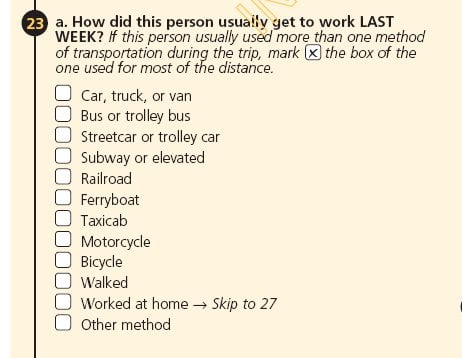
A sample question from the 2000 Census Long Form
Two different census forms are distributed
- The current census includes 2 different forms; the long form and the short form.
- The long form is 12 pages long and asks such questions as:
monthly mortgage payment,
real estate taxes,
whether or not the dwelling has a kitchen, and
how the primary income earner got to work last week.
The last census was in 2000
- Total population was calculated at 281,421,906, a 13% increase over the 1990 census.
The United States Census determines the structure of the US House of Representatives
- Every 10 years the federal government uses census population data to determine how many representatives from each state should be sent to the House of Representatives. The Senate is limited to 2 representatives per state; that does not vary with population.
- Elbridge Gerry, the governor of Massachusetts from 1810 to 1812, used census population data to rearrange election districts his state to the advantage of his political party. The term gerrymandering is used to this day when describing such activity.
A huge advertising campaign was launched in 2000 to encourage participation
- The US government ran ads including the catch-phrase "Answer the census, we're counting on you!"
- The final overall response rate, as reported by the US Census Bureau, was 67%.
- Nebraska and Wisconsin achieved the highest response rates, at 75%.
- Puerto Rico observed the lowest response rate, at 53%.
US Census Data can be surprising
- After the 2000 census, the City of San Francisco learned that the highest concentration of homeowners was in the election district with the lowest per capita income.
Census errors have been reported
- In 2007 the US Census Bureau admitted that it miscalculated the population of uninsured people for at least a decade. They announced plans to reissue totals all the way back to 1995. They estimated that 1.8 million had reported coverage, but somehow they were added to the roles of the uninsured.
Fun Facts Links
- US Census Long Form
- U.S. uninsured figures found to be overstated - Los Angeles Times
The government's estimate of the number of people in the U.S. without health insurance fell by nearly 2 million Friday, but not because anyone got health coverage.The Census Bureau said it had been - Census 2000 Gateway
- Constitutional Topic: The Census - The U.S. Constitution Online - USConstitution.net
A discussion of the Constitutional Topic of the Census