Gleaning in America - Green Living and Preventing Waste

American Gleaning - More Than a Bible Verse
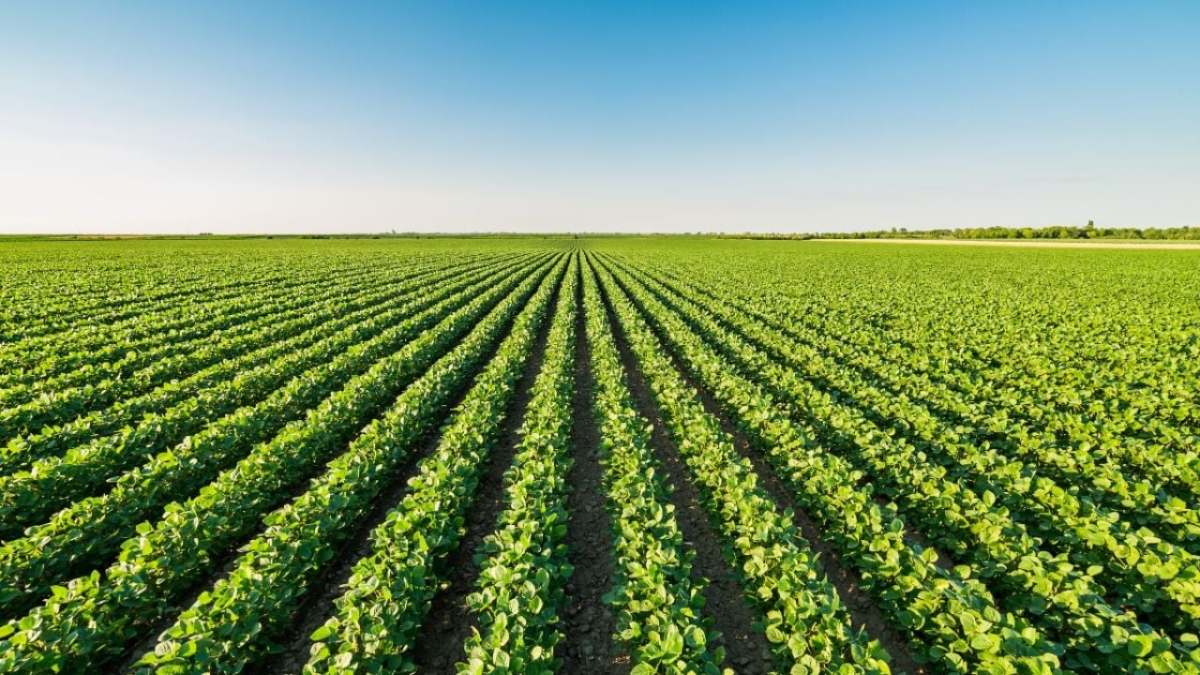
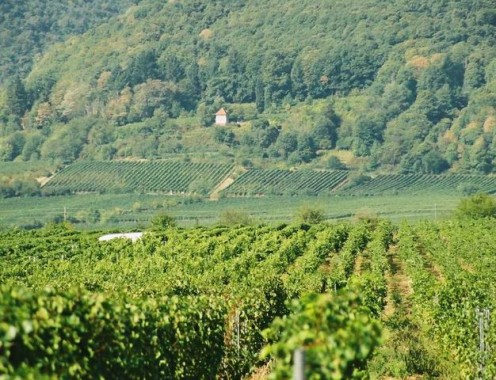
Gleaning is a Middle Eastern and Old Testament law and custom in which harvesters leave the corners of their crop fields untouched so that the poor and the foreigner have access and gather food. Gleaning is a thoughtful tradition still practiced in some part of the Middle East even in the 21st Century. It may not be practical in all parts of America, but ways of accomplishing the same ends are available through organized avenues discussed below.
Now, taking a few ears of corn from a farmer's field located conveniently next door is not gleaning - it's theft. A family I know lives next to a cornfield and enjoy telling their story to warn others. The mom and dad had planned corn for dinner and found that they had none. Having no time to go to the store, the mom walked over to the tall corn stalks next door and took a few ears, thinking the farmer would not mind. She cooked the corn and she and her husband and kids buttered it well at the table.
As they all took their first bite together, they discovered that it was livestock feed corn, not appetizing to humans at all. They felt their dinner was ruined. However, the mom and dad have laughed about it ever since and say they learned a good lesson. I remember it every time I drive past a field of corn, wondering if it is people corn or horse corn. At any rate, pre-harvest gleaning was not successful for my friends.
Dumpster Diving
Gleaning For Modern Times
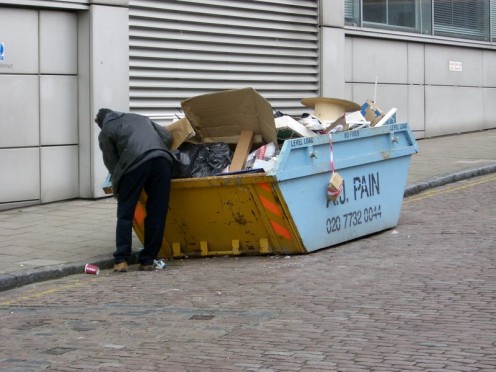
There is much waste in America. That is one reason that we have a new culture and generation of dumpster diving in the 2000s and beyond. Some pretty good stuff is discarded, including brand news clothing, equipment, and food. College students in some towns throw everything out rather than to move it home for the summer and other people benefit from their discards.
I’ve also noticed that around the first of every month, increasing numbers of people move and throw out much of their belongings rather than to pack and move them. Sometimes they’ve been evicted, but sometimes that can’t afford to move the things or don’t have time, having to be elsewhere quickly to accept employment during a recession.
Businesses often throw out mass quantities of supplies and equipment as well. Supermarkets discard food every day. Thus, a lot of material is thrown out in America. At the same time, it’s illegal to remove anything from in or around the outside of a dumpster in some cities. Surely something can be done to stop excessive waste.
I remember when an acquaintance asked her boss at a fast food restaurant if she could give thrown-out hamburgers to the poor and he told her it was against company policy and that he would prosecute her if she did so. Taking waste products was considered theft by that company. In addition, the company forbade their food to be passed to anyone at a temperature or condition less than that that required by the official operations manual. This was for health and safety regulations as well as public image reasons. In fact, this and other companies in various fields of business have begun to place locks on their dumpsters to prevent the activities of the new dumpster diving culture. This generation of scavengers is not made up of hobos and the homeless alone. It includes college students, middle class families hit hard by recession, recyclers, and others.
Some grocery stores and bakeries in our area curtailed the donation of day-old bread and other food discards to the less fortunate, fearing lawsuits over illness resulting from consuming these products. One bakery chain continues to donate to churches each evening at closing time, provided they call ahead and place themselves on a related appointment calendar. Still, tons of waste food is tossed for cosmetic reasons - crumpled packaging and such. We know that a dented can of green beans or tomatoes can lead to botulism poisoning, but much safe, good food is discarded – into locked dumpsters in some towns.
Organized and charitable gleaning performed by recognized associations since about 1980 is one effective method of securing and distributing good food that industry discards.
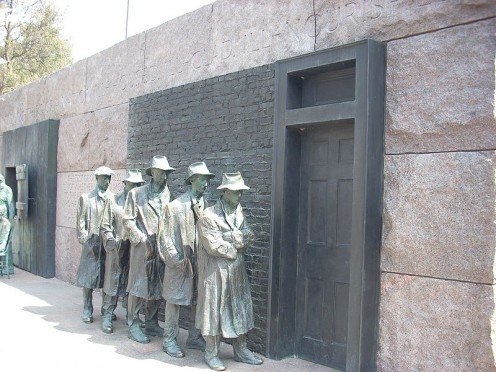
FDR Bread Line Memorial
Gleaning Began as an Agricultural Law
Gleaning is described in the Old Testament in the Book of Ruth (Ruth 2:2-23).
The early Hebrew agricultural laws were responsible for the custom of gleaning, outlined in the Old Testament or Torah in Leviticus 19:9-10 and 23:22; and Deuteronomy 24:19-21. During this era, it was a crime to ignore this law and failure to uphold it in the fields was legally punished.
While no longer a law in the Middle East, the custom of gleaning has continued. The poor may glean in the wheat and other grain fields as well as in the vineyards, particularly in parts of Syria, following the harvesters and cleaning up what is left.
Leviticus 9:9-10, New Living Translation:
"9 When you harvest the crops of your land, do not harvest the grain along the edges of your fields, and do not pick up what the harvesters drop. 10 It is the same with your grape crop—do not strip every last bunch of grapes from the vines, and do not pick up the grapes that fall to the ground. Leave them for the poor and the foreigners living among you. I am the Lord your God."
Ruth in the Fields with Boaz

Adopted in the United States
The National Association of State Departments of Agriculture (NASDA) has adopted policies about waste recover in agriculture. Under their policies on nutrition and food assistance, they state in official policies:
“5.5 Gleaning and Food Recovery
No one should ever go hungry in America. But, yet, millions of pounds of food each year goes to waste and many poor and needy people go hungry. Efforts to recover millions of pounds of food before going to waste and to redirect it to the poor and the needy is important to agriculture and the American people.”
National Association of State Departments of Agriculture
1156 15th Street, NW Suite 1020
Washington, DC 20005
PH: 202-296-9680 ; FAX: 202-296-9686
Urban Fruit Gleaning
Preventing Food Waste

Getting Involved -- Some Gleaning Organizations in America
- Gleaning For the World
One of the Forbes.com 200 Largest Charities in America. - Gleaning Network: Society of St. Andrew
The Gleaning Network coordinates volunteers, growers, and distribution agencies to salvage food for the needy. Tens of thousands of volunteers from churches, synagogues, scout troops, senior citizen groups, and other organizations participate... - SMALL POTATO GLEANING
- Welcome to the Mid-Atlantic Gleaning Network
The Gleaning Network links farmers who have crops that are edible but not marketable with those who distribute food to the needy through the work of volunteer gleaners. Our staff organized teams of people to go to local farms to harvest fresh nutriti
© 2009 Patty Inglish MS MPH