How to Make Penicillin and Other Homemade Experiments

vinegar battery
Home School Chemistry
scientific method
- Steps of the Scientific Method
An introduction to the steps of the scientific method
grow your own
- Save Lives and Make Money With Home Grown Penicillin
A guide to growing your own penicillin. Treat illness, save lives, and make oodles and boodles of money. No more running to the doctor's office everytime someone gets sick. A spoonful of penicillan works miracles!
home made
Let food be your medicine and medicine your food is a saying that we would do well to give some deep thought. Hippocrates was certainly onto something.
A saying that I use is “Let Nature Be Your Guide”. Whether it was due to intentionally watching Nature or due to pursuing other goals there are many medicines we use today that have their roots in Nature.
Take aspirin for example. The well known Bayer Group, the producers of the aspirin many of us are aware of, and often thankful for, began life as a company that made dyes.
Felix Hoffmann who took over the company when Friedrich Bayer died discovered aspiring while he was experimenting with a waste product of one of the dye components in an attempt to find relieve for his father's rheumatism.
During this search he chemically synthesized a stable form of salicylic acid powder. This compound went on to become the active ingredient in: Aspirin.
Aspirin’s name was derived as follows: "a" from acetyl, and "spir" from the spirea plant, meadowsweet (Filipendula ulmaria, also known as Spiraea ulmaria), and the source of salicin.
Since the time of Hippocrates white willow bark has been used to treat pain (particularly low back pain and osteoarthritis), headache, and inflammatory conditions such as bursitis and tendonitis.
White willow bark is also know as pussy willow; Salix alba; Salix nigra and is a fairly common tree throughout many parts of the world. You can boil 2 grams of willow bark in about 200 mls of water and create an infusion that is alleged to relieve pain.
I would not do this unless it was in a survival situation.
If you are planning to use a natural supplement or medicine it is wise to consult with your family doctor before doing so; especially if you are taking any prescribed medication.
Penicillin
Penicillin is any antibiotic drug that is taken from molds or made synthetically to treat different diseases and/or infections. More specifically, penicillin is the liquid which is secreted from penicillium notatum, which is the mold.
Alexander Fleming stumped upon penicillin accidentally.
You can do a simple experiment and make your own penicillin.
What is Science?
The word science is derived from the Latin "scientia," which means knowledge.
Webster's New Collegiate Dictionary, defines science as "knowledge attained through study or practice," or "knowledge covering general truths of the operation of general laws, esp. as obtained and tested through scientific method [and] concerned with the physical world."
So what does this mean? Science is a means by which we acquire knowledge; a system that uses observation and experimentation to describe and explain natural phenomena.
Science is about discovery but it is also about the search. As you have just read both aspirin and penicillin came into being because people were employing the scientific method to find something and during that process found something else.
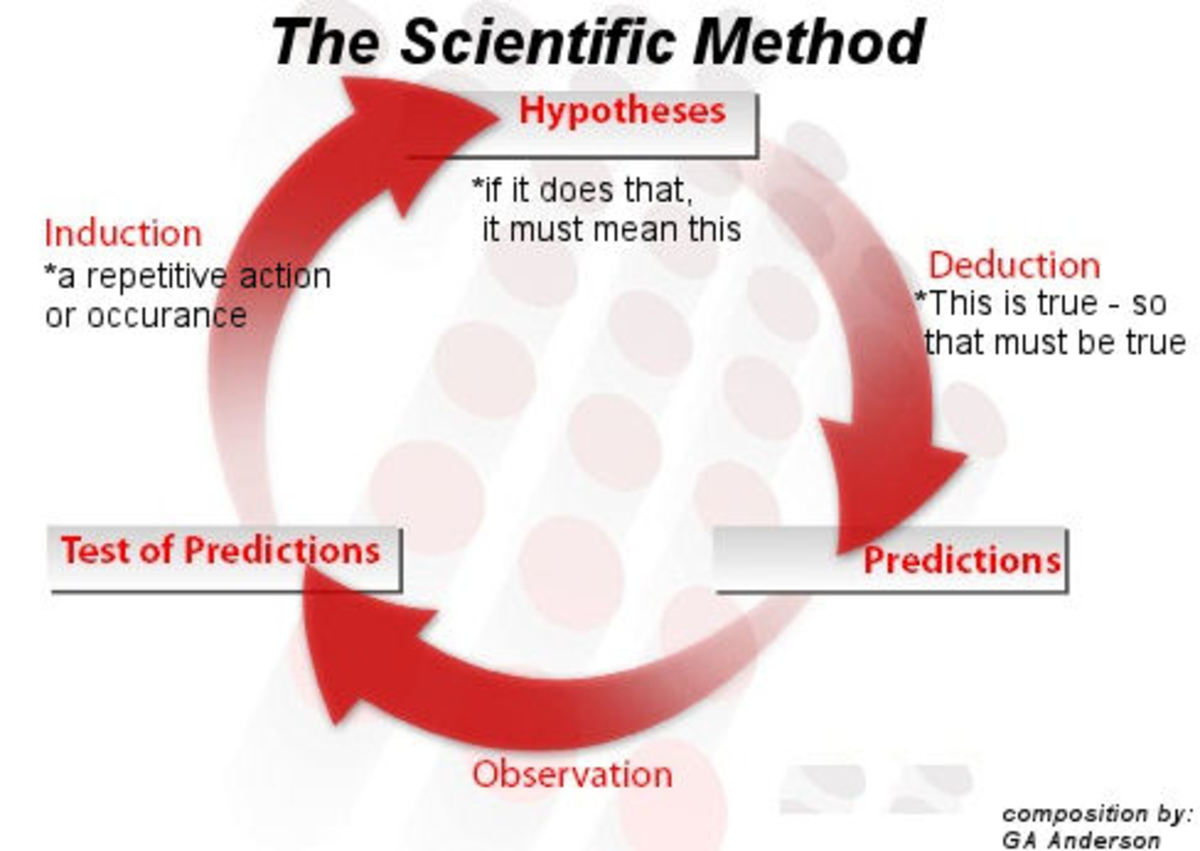
- The scientific method is a way to ask and answer scientific questions by making observations and doing experiments.
- The steps of the scientific method are to:
- Ask a Question
- Do Background Research
- Construct a Hypothesis
- Test Your Hypothesis by Doing an Experiment
- Analyze Your Data and Draw a Conclusion
- Communicate Your Results
- It is important for your experiment to be a fair test. A "fair test" occurs when you change only one factor (variable) and keep all other conditions the same.
If you want to learn how plants grow there is a very simple experiment that you can do. All you need is a bean seed, a small clear container, soil, and some water.
Put the soil in the clear container, plant the bean seed near a side of the container and about ¼ inch deep, cover lightly, water and place in the sun (needs at least 4 hours per day).
You can watch the seed develop a root system and become a bean plant. When the bean appears you can eat it or save the seeds inside and grow more beans.
Learning is meant to be fun and an active experience; science experiments are both. Just remember to follow the instructions and wear goggles or gloves if required.