How to Return Anything for a Refund

Let the buyer beware?
How many times have you made a decision to purchase a product from a store based on their returns policies? Are you hesitant to shop because you’re reluctant to deal with uncooperative clerks, boorish managers and endless red tape if the item is damaged, or if you decide you don’t really want your purchase? Have you been burned by the fine-print that requires ridiculous criteria be met before a return is allowed? All of us have been frustrated with the inability to return a product at one time or another and policies are now more convoluted than ever.
Online competition has forced brick-and-mortar businesses to reexamine and update their returns policies for these reasons: 1.) to discourage “short term” buying, when an item is needed only until the customer’s online purchase arrives, and 2.) no-hassle, customer-friendly returns represent value and are a hedge against shopping online. These dual motivations unfortunately keep patrons guessing. Are you in the store that cheerfully accepts all returns to keep you as a customer? Beware if you went to the business that tows away your car while you’re negotiating in vain with Ricky-the-hapless-trainee or Bob, the world-weary store manager that has “heard every excuse in the book.”
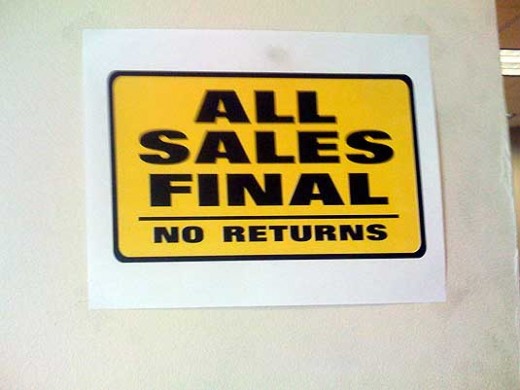
Businesses with inflexible returns policies will post them somewhere in the store. The notice may be a sign taped to a shelf, wall or pillar. It might be printed on your proof of purchase, or a policy page stapled to your receipt. The basic message is usually: No return without a receipt! Keeping the receipt might be only the beginning of the hoops you will jump through to get your money back if there is a problem, however. Posted signs often display a laundry list of criteria to be met: No returns after seven days; all items must be in original condition; must have shrink-wrap intact; must have all labels and tags; or, your check must clear the bank before a cash refund can be made. These are just some of the conditions that make returns an unsavory experience.
Most shoppers would like to return more purchases than they do, but don’t want to be turned down or can’t muster the persuasiveness required to challenge a hardened staff. Your hard-earned cash isn’t gone for good, however! “Let the buyer beware” doesn’t have to be the shopper’s mantra. Common sense and good judgment can help prevent you from getting stuck with purchases you don’t want.
Satisfaction guaranteed!






How can I get my money back for this stuff I bought?
Stringent returns policies are not designed to make your life miserable. They are in place to protect stores from the abusive consumer—shoppers continually trading items for another product, ardent readers that finish books in a day, or social butterflies needing a new coat or dress for just one evening. Businesses hope to discourage these folks from such antics while being fair to the average patron. Remember, stores want to keep good customers. With this in mind, here’s how to take back nearly any purchase for a refund, even if rude employees claim all sales are final.
1. Don’t assume an item can’t be returned. Some products must be used to determine they’re defective. Wearing a shirt or washing it might be necessary to expose its flaws. Food that is spoiled can be returned to grocery stores. You’ve lost nothing by asking if a product can be brought back.
2. Have a good reason for returning the item. Your reason should be simple, not a detailed story casting you as the victim of improbable circumstances. You can say the item is defective, the wrong size or color, an unwanted gift, or you just don’t like it. Multiple reasons sound like excuses, so don’t oversell your case with fifteen reasons the store should accept your return.
3. Keep your receipt. Nearly every store requires proof of purchase before allowing merchandise to be returned, but many people fail to abide by this one simple rule. You must be able to prove you bought the product in the store you’re trying to return it to. If you can’t, the chance for successfully returning it drops 95%. It might be possible for stores to check an electronic journal to verify your purchase, but you are asking a manager to jump through unnecessary hoops just to take money from the register and put it in your hand--a scenario that won't seem very worthwhile. Let me repeat: keep your receipt.
4. Shop at stores with favorable policies. Learn which businesses have customer friendly policies and visit them first. Large retailers such as Wal-Mart, Best Buy and Target tend to have simpler, more straightforward policies. Be particularly cautious with small, privately owned stores—they make protecting their assets a top priority and are more apt to implement unusual conditions for returns.
5. Return merchandise promptly. No business offers unlimited returns privileges. As soon as you realize you don’t want your purchase, take it back. The longer you wait, the less credence the reasons for your return will be given. Don’t give a store manager cause to chide you by asking why it took three months to decide your shirt was the wrong color.
6. Return your purchase in good condition. If a store can re-sell your merchandise, they are more likely to accept its return. Water-damaged books, dirty clothing and ripped, battered packages cannot be resold and the store will be reluctant to take a loss on a product you destroyed.
7. You must be willing to compromise. A partial refund, an exchange or a store credit are all tools a business uses to keep your good will while protecting themselves from customers that abuse returns privileges. Accept an exchange or credit if it is offered—there must be something else in the store you wouldn’t mind owning.
8. Don’t act angry. Causing a scene usually won’t encourage a store to give in to your demands. Store managers recognize this ploy and will often become even more unwilling to see things your way. A polite, respectful interaction is the best way to gain the sympathy of the person authorizing your return.
9. Don’t act guilty. Wanting to return a product for a refund is not a crime. Don’t act like you did something wrong or become apologetic. Occasionally an employee will try to assign blame to a returns request, but there is nothing legally or ethically wrong with wanting a refund.
10. Don’t look for loopholes in returns policies. Businesses reserve the right to refuse returns for any reason, and if you scan their policies with the intention of finding omissions or poorly worded phrases, you will be ignored. You might win such an argument once, but the wording will be changed before you can benefit from this tactic again.
See how easy it is?
If you follow these suggestions, store managers and their staff will be happy to help you. Ricky the trainee and Bob the cynical manager will be only vague memories. You will be the type of customer they want to help—reasonable, logical, aware and considerate of the store’s position. You will have done everything to make it easy for them to give you your money back for that unwanted purchase. They will put that cash back in your hand and remind you to come back soon.
Isn’t that what you wanted in the first place?
Read more hubs about business
- Telephone Skills and Techniques: The Art of Successful Communication
We live in a very different world now. Thirty years ago we wrote a letter or telephoned when we wanted to contact someone we couldn't meet face-to-face. In this new age we tweet, instant message,... - Working as an Independent Contractor: How to Earn More Money
Have you recently lost your job, or have you taken a pay cut to keep the position you have? You are certainly not alone. The United States economy is in a state most of us have never seen before,... - Using the Job Interview to Hire the Right Person
Its stating the obvious to tell you a company loses money when it is forced to replace employees. Some costs from personnel attrition are apparent, such as paying accrued vacation time and... - Time Management Tools: A Convenience or Trap?
There are numerous books and articles devoted to time management, but we still seem to have very little free time. We make lists and group tasks. We organize, categorize, prioritize and analyze. We... - How to Shop for Textbooks in Your College Bookstore
It should be simple to buy textbooks for college classes, right? The instructor distributes or posts a syllabus; you head to the college bookstore on your campus and buy the books from your list. ...