- HubPages»
- Business and Employment»
- Marketing & Sales»
- Sales & Selling
How to Sell Almost Anything to Almost Anyone

Motivational Links
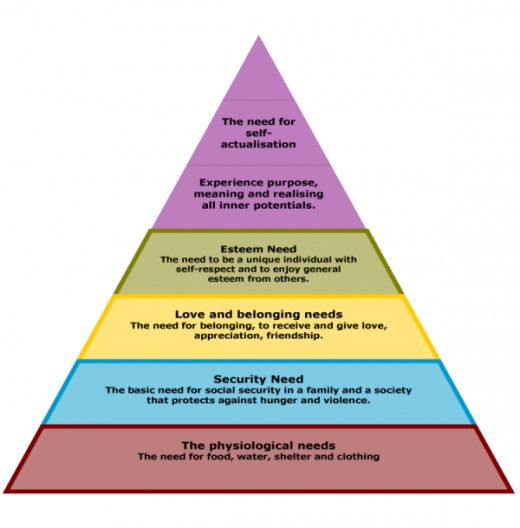
- Maslow's Hierarchy
Abraham Maslow's Hierarchy of Needs based on his paper "A theory of human motivation" - Intrinsic Motivation
Several articles and links on motivation
"Selling" is not a four-letter word. Everything in life revolves around our ability to sell. Whether it's products, services, or ideas...we are all salespeople in one respect or another. Want your spouse to watch a movie you want to watch? Trying to get your kids to eat their vegetables? Like it or not, you're in a "selling" situation...you're going to have to sell your spouse on the movie and your kids on eating vegetables.
Selling is just "decision making"...helping someone (or getting someone) to make a decision. So how can you sell almost anything to almost anyone? By using a simple step-by-step formula I "discovered" a long time ago for turning motion into motivation. I call it The IVAT Principle, and it has helped me make a lot of people very wealthy over the last twenty-years.
Decisions...Decisions...Decisions
We all make hundreds, maybe thousands of decisions everyday. Most take less than a nano-second, but every decision has the same four basic elements. Those elements make up the IVAT Principle. The IVAT Principle is not some scientifically researched natural law like gravity; and I seriously doubt that it will be given the prominence of Einstein's Theory of Relativity...but it is real and it does work. It is simply the process everyone goes through when they make a decision. It is basic human nature.
You can use The IVAT Principle to determine how to sell your product, service, or idea...or you can use it to determine if your product, service, or idea will sell. You can also use it to find out why your product, service, or idea isn't selling, or what you need to do different to get your product, service, or idea to sell. Interested in knowing more? Then read on.
Turning Motion into Motivation
Motivation is probably the most misunderstood word in the dictionary. When sales are falling (or your kids won't eat their vegetables) out come the "spiffs". Most sales managers (and I suspect a few parents) will try to "motivate" with some sort of incentive...positive or negative. When you offer an incentive to get someone to do something you are not "motivating" them, you are "moving" them. What's the difference? Motivation is internal...movement is external.
You can get a dog to move from one place to another (or your kids to eat their vegetables) by offering an incentive to do what you want them to do. On the positive side you offer a dog biscuit (not to your kids...well maybe, I don't know your kids). On the negative side, you swat their backside with a newspaper. Unfortunately to get the dog to move back...you have to offer another "biscuit" or another whack on the butt. That's movement, not motivation. Motivation is when someone does something to fulfill a psychological or physiological need...they do it because they want to do it, not because you want them to do it. Why does it matter? Because "movement" is a very expensive way (physically, mentally, or emotionally) to get people to do something...it's always better to "motivate" them to do what you want them to do.
So how do you sell almost anything to almost anyone?
The IVAT Principle
I is for Interest
It doesn't matter what you're selling, the first and most important element is "Interest." If the prospect is not "interested" in your product, service, or idea, the rest of the steps are academic. It's why most businesses (and I'm reasonably sure a lot of parents) fail. "Interest" is simply another word for "problem" and "sales" is simply another word for "problem-solving." If your product, service, or idea doesn't solve a problem or the prospect perceives there is no problem to solve, you will find very little "interest" in your product, service, or idea. If your kids won't eat their vegetables it's not their problem, it's yours.
I'm sure you've heard the old saw that the best way to succeed in business is to "Find a need and fill it." After forty-years in sales, other than the basic human needs of food, clothing, and shelter, people don't buy what they need (how many televisions do you really "need" anyway?)...they buy what they want. A better corollary would be, "Find a problem and solve it." Problem-solvers are the highest paid individuals on the planet...a Doctor solves medical problems; a Lawyer solves legal problems. A successful car salesperson doesn't sell cars; he/she solves transportation (or perhaps ego) problems...likewise for any profession. What problem does your product, service or idea solve? If it doesn't solve a problem or if the prospect perceives there is no problem to solve...they won't buy; and there's no need to move to step two.
V is for Value
"Value is not what you ‘pay' for something...it's what you get for what you pay." Once you have an "interested" prospect (mildly or wildly) the next step is value. Knowingly or unknowingly everyone places a "value" on everything...even if that value is nothing (nothing is still something). Value has little to do with price. People do not buy a product, service, or idea based on price. They buy because the product, service, or idea, provides the best "value" in solving their problem. It could be the "cheaper" alternative, but only if they perceive the product will solve the problem. If it was just about price...everyone would be driving a Yugo. Why do people buy generic drugs? They perceive them to be the same quality for less money. Why do people buy brand name drugs? They perceive them to be higher quality and worth the extra money...or they think anyone who buys generic drugs is either poor or cheap; and they don't want to be perceived as poor or cheap. Which one is right? They both are...because perception is reality. Why do people buy Rolex instead of Timex; or Timex instead of Rolex? If the prospect perceives that your product, service, or idea represents a good value for solving their problem (whether it's psychological or physiological), you can move to step three.
A is for Affordability
It doesn't matter how interested or how much value you build into your product, service, or idea...if the prospect can't "afford" it, they can't buy it. Think of it this way...if everyone had to pay cash for a home or car, most people would be walking the streets homeless. The only reason most people have cars and houses today, is because lenders make them "affordable." Is your product, service, or idea affordable? If not, you need to examine your options. If you have an "interested" prospect who perceives a value in your product, service, or idea; and they can afford it, you can move on the final step.
T is for Trust
This is where most salespeople (and parents) lose the "sale." If the prospect doesn't "trust" you or your product or trust that you or your product will solve their problem...you can forget it. How do you establish trust? First and foremost, you have to be honest and upfront with the prospect. The quickest way to lose a sale is to "lie" to the prospect. Once you've been caught in a lie it is nearly impossible to recover (ever promise something to your kids and then not follow through, or worse yet, break that promise?). It's why companies are quick to react to attacks on their credibility. Remember the Tylenol scare a few years back? It took a long time and a lot of money for people to trust and start buying Tylenol again (I'm sure there are a lot of older people who still won't buy it). How about Mad Cow Disease? Aren't you just a little queasy when you buy meat today? How do feel about toys from China? And what about salespeople...any salespeople...do you trust them? Nothing will hurt sales more than a breach of trust...real or imagined.
Applying the IVAT Principle
Obviously there is a lot more than this post will allow (the book is over 10,000 words and I'm still not finished). Look at your product, service, or idea. Are people interested in your product, service, or idea? Does it solve their problem? Does it have a perceived value to the prospect? Can they afford it? Do they trust that you and/or your product will solve their problem? If you answer "yes" to these questions (be honest) then you should have a very successful product, service, or idea. If the answer is "no," then The IVAT Principle will help you determine the problem with your product, service or idea, so you can correct it.
You can sell almost anything to almost anyone...if you understand what "motivates" the person to buy what you're selling. You couldn't pay me enough money to work in Dallas; the stress of driving in that traffic twice a day just isn't worth it to me. However, provide me with a chauffeured limo to and from work and you've got my attention. Before you can solve a problem, you first have to identify the problem that needs to be solved. How do you do that? Just ask. Most people will tell you how to sell them if you will ask enough questions and listen to the answers. So how do you get kids to eat vegetables? Try asking them why they're not eating them.
Ray Evans