Jefferson's bible: Most sublime and benevolent

77Using shears and a jar of paste, Thomas Jefferson revised the long-standing text that had shaped cultures, societies, and governments alike. He edited the one of the oldest books mankind has known.
Not satisfied with ancient teachings, he altered the writings to reflect the ideals he shared with his contemporaries...
Thomas Jefferson cut god right out of the bible.
Jefferson had fundamental disagreements with King James on more than one battlefront.
As to his purpose, he wrote “...I am a real Christian, that is to say, a disciple of the doctrines of Jesus."
Jefferson viewed Christianity not as a religion, but a philosophy. He had no belief in the supernatural references that pepper the bible. Removing all passages that relate to divinity, prophecy, the trinity, and miracles, he trimmed the King James Bible from 773,000 words all the way down to 25,000. In 1804, he completed The Philosophy of Jesus of Nazareth.
Unsatisfied with his first effort, he reworked and revised his text until The Life and Morals of Jesus of Nazareth was completed in 1820. Jefferson’s bible ends not with the resurrection story, but with the a simple and final statement: “There laid they Jesus. And rolled a great stone to the door of the sepulchre, and departed.”
In a letter to John Adams in 1813, Jefferson described his intentions. “In extracting the pure principles which he taught, we should have to strip off the artificial vestments in which they have been muffled by priests, who have travestied them into various forms, as instruments of riches and power to themselves... There will be found remaining the most sublime and benevolent code of morals which has ever been offered to man.”
Jefferson shared the completed work with his friends and peers. But he was cautious.
He refused to allow his book to be published.
Although he was a man of great conviction, he did not wish to be "exposed to the malignant perversions of those who make every word from me a text for new misrepresentations and calumnies."
He had no desire to preach or to debate his personal religious views in a public forum. His passion was private. Further, he understood that the conflict his views would create could only distract from his political issues. Jefferson made the decision to protect his profession at the expense of his faith.
Like all of the founding fathers, Jefferson felt strongly about separation of church and state. The U.S. Constitution contains only a single reference to god: “Seventeenth Day of September in the Year of our Lord One Thousand Seven Hundred and Eighty Seven”. One mention, and secular at that.
"Religion is a subject on which I have ever been most scrupulously reserved," he wrote. "I have considered it as a matter between every man and his maker, in which no other, and far less the public, had a right to intermeddle."
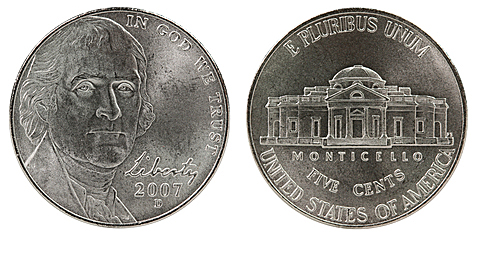
Speak now... or forever have the wrong motto on your nickel.
Was Thomas Jefferson an atheist?
He referred to himself, as did many founding fathers, as a deist. Jefferson and Abraham Lincoln are the only two presidents who did not affiliate with a church.
There is a school of thought that holds Charles Darwin responsible for two theories of evolution. The first is his stated theory of evolution of species through natural selection. The second theory of evolution can be found in the philosophical debate that “natural selection” created. By providing a plausible scientific explanation for something that had previously been attributed to divine forces, Darwin opened a door for religious skeptics.
Explore further:
- The Jefferson Bible (The Life and Morals of Jesus of Nazareth)
Read the complete bible here. - Things That Are Not In the U.S. Constitution
There are some common misconceptions about some of the things that are in the U.S. Constitution - this page debunks some of those myths
Armed with the concept that there may be practical scientific answers to life’s mysteries, many who defined themselves as deists evolved their philosophies to atheism.
In 1799, Jefferson wrote, “It is impossible for a man who takes a survey of what is already known, not to see what an immensity in every branch of science yet remains to be discovered.” The more we learn, the less we know. Every answer in turn asks more questions.
Had Jefferson been able to study The Origin of Species, what would his thoughts have been? Darwin himself was ambiguous about his own conclusions. We are left only to analyze and debate what Jefferson’s stance may have been.
The Life and Morals of Jesus of Nazareth was officially published in 1904 – 100 years after his first draft was completed. After years of passing quietly through Jefferson’s family, the original cut and paste manuscript was discovered around 1895 by a librarian at the Smithsonian. It resides there safely to this day.
|
|
Bumper Sticker: "When the government fears the people, there is liberty; when the people fear the government, there is tyranny." -Thomas Jefferson
Price: $2.99
List Price: $4.99 |
|
Thomas Jefferson - A Film by Ken Burns
Price: $14.58
List Price: $24.99 |
Recently published by wyanjen:
- The four-way-stop | Humanism explained
Secular humanism places faith in mankind. Reliance is on reason, knowledge, community, and self. It is a source of spirituality, encouraging a search for the beautiful things to be found in nature and in human art. - 3 days ago
- Plastic or paper? Paper is best for the environment
Choose paper over plastic for the best environmental product. Plastics that contain phthalates are highly toxic. Sustainable forestry protects and improves the environment. Plastic recycling needs more emphasis. - 4 days ago
- Pink Floyd's greatest album | The Dark Side of the Moon, analyzed
The Dark Side of the Moon is one of the greatest music albums ever recorded. Pink Floyd created a masterpiece of sound and lyrics. Here are videos and lyrics to The Dark Side of the Moon. - 3 weeks ago
PrintShare it! — Rate it: up down flag this hub
Comments
There is so much to learn and so little time.
Hi Beata. I was a little concerned that this article got too heavy, but you picked up on what I was trying to say with it. Thanks for checking it out. I feel much better now ;-)
I am also passionate about all of these things, and by studying Thomas you get it all.
Jen
What a powerful hub this is, and how eloquently you have written it. Thanks so very much for this. Having been raised in a very religious family, I pretty much take a similar attitude as Mr. Jefferson and others. The simple truth is, the more I know the more questions I have. Again, thanks for a terrific hub!
No need to worry wyanjen. Very well written. And thanks for the link to the entire work. It is one of those things I heard about, but never remember to look for. It is because of the actions of men like Jefferson that the "spirit of the law" will always outlive the "letter of the law." Something that infuriates all people resistant to change.
@ Daniel: Thanks for your input my friend. I think the only that any of us can do wrong, in terms of faith and religion, is to stop asking our questions.
@twalker: I'm happy you like the link. It is from Beliefnet.com which is an awesome site for all things faith related. They did a great job analyzing TJ's bible.
For the record: with this much quoting, I'd have to say it was a wyanjen/TJ joint publication. LOL His words deserve more than paraphrasing.
Thanks for stopping by guys :-)
A great hub, Jen. I give it a thumbs up!
Q.
Thank you Q!
Are you ok with this... If it is the word of God how or why would you change it. I agree we all grow and learn and things Change. And that is why I know the Bible is the word of man not God. Look in your heart for the word of god. It never changes. Thank you, for the history lesson.
I just finished writing a pretty serious hub. I hope you will take a look. I need everyones help on this.
http://hubpages.com/_1hkrq7dndiwfj/hub/Why-do-Blac
Friendlyword
Such an interesting post. I've seen the online version, but I recently bought a bound copy to argue over with my son (17). Such fun.
Friendly- Hi! Thanks for stopping by.
I'm completely ok with this. In my former Catholic life (although I have always been atheist-leaning) I did not have a problem either. What Jefferson did was to extract the morals and philosophies from the book, which as you mentioned, is the work of man.
He exercised the very principles that he fought for when founding our nation. Freedom of religion. Freedom of speech.
If god is in your heart, he is safe from Thomas Jefferson ;-)
By that, I mean ink and paper cannot possibly be as sacred as what one keeps in his own heart. Also, there is no intention here to affect other's beliefs. He kept his book secret.
We have no "right to intermeddle". Except when you're on a forum, which is where people go to intermeddle.
Thanks for your comments, I am on my way to your hub right now my friend.
Peace
Jen
Hello Atheist Classical. You and I would have a great time discussing this over coffee ;-)
Have fun arguing! It's fascinating, isn't it?
Jen
Hi.Interesting hub. You might want to check this out too:
Just starting to read Jefferson's amended bible, thanks for writing this hub, it's a real treat!
When I first came to faith, I ONLY wanted to read the 'red letter' bits of the bible, then over the years I extended it to all of it and have found that this led me to understand more readily how the whole book forms a picture of history past, present and future.
But it will be good to read such an intelligent man's version and see what different conclusions can be formed, if any!
Once again I thank you for your hub!
Thank you, aguasilver.
As I mentioned before, this is a passionate subject for me.
I'm a non-believer, so I am naturally attracted to this edited version.
It's so interesting that we each can find value in this. I hope you enjoy your studies as much as I have.
Jen
Thanks...the fact that Jefferson cut out anything that was not contextual to Jesus in the flesh actually makes it easier to see what Christ was stating.
But I'm not sure why as a non believer you are "naturally attracted to this edited version" because leaving aside the edited out sections, Jesus still makes some pretty challenging statements on his own!
Anyhow it's bookmarked for my reference and I hope to spend some time in it studying, though time is short!
Thanks again for the hub!
John
Hi John
Thanks for stopping back :-)
The natural attraction for a non-believer to this bible is that the divinity has been removed. As you said, it makes Jesus' message clear.
More importantly from my point of view, this work allows the philosophy to be presented in a credible way. An atheist will not necessarily discredit the King James bible on principle. Without a belief in the divinity, the book simply holds no meaning.
I'm happy you are enjoying it!
Take good care
Jen
Just dropping in to thank you for answering one of my questions.Enjoyed reading your hub.
Your subject is beautifully presented. Jefferson was a true genius and a very complex personality. The founders of the US were quite an extraordinary mob. Would they recognize us today?
Rochelle, I'm so happy you stopped by. I respect you on HP, and your comment means a lot to me. Thank you :-)
Would they recognize us? I would think not in broad terms. But, I like to think they would get a kick out of what we are doing with their concepts of Freedom of Speech and Religion. We may ourselves not be an extraordinary mob, but we are an extraordinary gaggle hanging around on the fringe. :-D
TJ would surely NOT recognize his own nickel.
The nation as a whole is not what they envisioned. But those nifty freedoms they proposed give us lots of fun ways to play, don't you think?
The beauty is in the framing. They understood that what is "relevant" would be changing with each generation. Therefore, the constitution is alive, as they say. It's wonderful, to me :)
Peace
Jen
I love these kinds of revealed facts...hope it don't stun any believers that think all the founding fathers were christians. Cus it just ain't so. It's like you mentioned...most were Deist.
I think "separation of church and state" worked so well in the founding years that we don't get an accurate picture of the religious philosophy of that time.
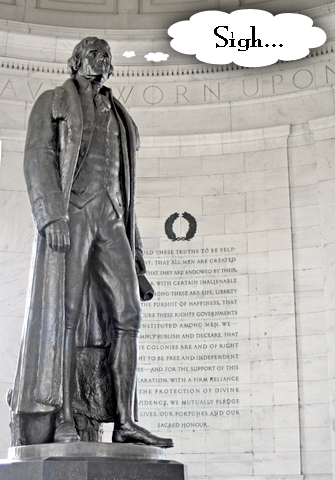
There are so many assumptions that are just wrong. It doesn't help when folks do things like put "In God We Trust" on a coin featuring a founding father who had no "trust" to speak of.
Sigh.
I enjoyed the image of this very thoughtful man labouring over his work with shears and a jar of paste. I can barely hold my thoughts long enough to cut and paste with a text editor! You've done an excellent job here.
scissors and a bottle of Elmer's glue...
razor blade and a can of rubber cement...
Exacto knife and a pan of melted wax...
command C and command V.
The evolution of Cut and Paste.
I have been known to type command Z on my light table, then have a split second of confusion when what I just pasted up crooked doesn't revert back one step.
Thanks for stopping by Niteriter (best name EVER)
Jen
I don't suppose it is a bad thing to adhere to at least part of Jesus' teachings. And you are right in your comment above that most people have no idea what the Founding Fathers really stood for. You can read their own words here.
http://hubpages.com/hub/Founding-Fathers
It is well known that Jefferson and Franklin, brilliant men who fancied themselves intellectuals, were the least Christian of all the FFs.
I would say Jefferson was a founder of the Social Gospel movement, that claims Jesus was a nice feller who was really smart. It is important for people to understand, though, that this is not who Jesus said He was. The Social Gospel makes Jesus out to be a liar or a lunatic. In which case I would wonder why they would want to follow his teachings.
Hello James
The phrase that comes to my mind is "Throwing the baby out with the bath water."
My interest in this subject, and others as well I believe, lies in the idea that there is value to be found here regardless of one's beliefs or inclinations.
This is a obviously secular interpretation. Being a non-believer, I appreciate this point of view. I also appreciate the attempt to make sense of the philosophy from a different point of view, rather than to simply toss the whole thing out.
Thanks for the link!
Jen


Beata Stasak says:
6 weeks ago
Your great article combined all my passions: history, philosophy, biography, science, politics, reading and writing,
I really enjoyed it very much and learnt heaps. I also believe, that more we explore scientifically more we realize how little we know and there is only so much we can explore, learn and absorb. Our brain capacity is huge but still limited. Science and religion can coexist together but religion and politics should not. Thank you for your great article.