Managing Woodlots for Wildlife: Mast

Mast is the reproductive fruit of trees, shrubs, and other woody plants. There are two basic kinds: hard mast and soft mast. Hard mast is hard shelled mast such as acorns, walnuts, pecans, and other nuts. Soft mast includes pine nuts, fruits, berries, and other soft-bodied seeds.
Mast is a tremendously important source of food for many woodland wildlife, including deer, game birds, squirrels, songbirds, and many more. Mast is also commonly used to fatten domestic livestock, especially pigs and chickens, and many types of mast are also edible for humans.
Hunters and wildlife enthusiasts lucky enough to own a woodlot can improve wildlife habitat dramatically by managing the woodlot to maximize production of mast.
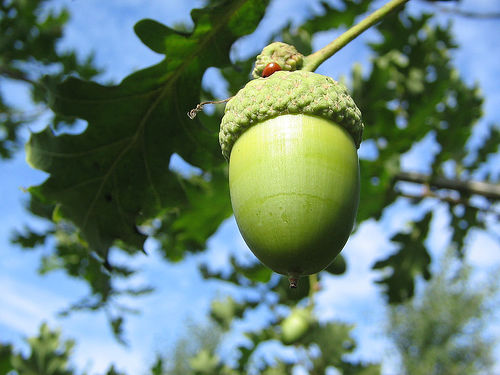
Acorn Mast
The single most important type of mast is acorns. In autumn, the diets of white tailed deer and wild turkey may consist of up to 70% acorns. Over 100 other species also rely on acorns to prepare for winter.
There are more than 30 species of oak (Quercus) native to North America and nearly every region of the United States has at least one native variety.
When planting oaks, choose a mix of several species, as different types of oaks have good crops on different cycles. For example, black oaks typically produce a good crop every two years, white oaks every three, and red oaks every four. Different types of acorns also have different nutritional value. White oak acorns are the favorite variety of many wildlife species because of their sweeter flavor, and are often consumed as soon as they fall. The more bitter red oak acorns, however, store better and are higher in fat, so they are an important food source for many species during the long, cold winter.
Every now and then all oak species manage to have a bumper crop at once, and these years are exceptionally good years for wildlife. These are known as mast years, or good mast years.
Acorns as Human Food
Other Hard Mast Species
When managing woodlots for wildlife, aim to have at least 20 large hard mast trees per acre, including a mix of several different types of oak and a variety of other hard mast producing species.
Trees and shrubs native to your area are best. A sampling of good mast species native or naturalized to various areas of the United States include:
- hickory
- black walnut
- pecan
- hazelnut
- buckeye
- American beech
- chestnuts
- butternut
Soft Mast Species
Most hard mast producing trees and shrubs are most important in autumn and winter. However, when managing for wildlife habitat, it is important to provide food year-round. Many soft mast species fruit in spring and summer, so it is important to include a selection of soft mast species as well as hard mast species.
A sampling of good soft mast species includes:
- wild plum
- blackberry
- poplar
- mulberry
- chokecherry
- black cherry
- dogwood
- grape
- hawthorn
- hackberry
- pawpaw
- American persimmon
- elderberry
- serviceberry
- grape
- black gum
- huckleberry
- sumac
- viburnum
- Virginia Creeper
Other Considerations
When managing woodlots for wildlife, another extremely important consideration is what is known as the "edge effect." The edge effect refers to the tendency of spots where two separate habitats meet to be more biologically diverse than either habitat by itself. In woodlots, the edge effect can be found both around the edges of the woodlot and surrounding small clearings in the forest, as well as areas of mixed mature forest and young forest.
A stand of trees of uniform size and height, no matter how much species diversity among them, is not an effective wildlife habitat. In particular, a dense planting of pole trees tends to smother development of a diverse understory, Understory trees and shrubs are extremely important sources of shelter and nesting habitat for many wildlife species, and the existence of a healthy and diverse understory also increases the diversity of mast species available. If you have a relatively uniform woodlot, consider cutting down some trees to create small clearings to allow sunlight to fall unevenly in different parts of the forest. This will encourage development of a healthy understory level.
When possible, stagger the ages of trees in your woodlot, allowing mature (and even a few dead trees, which are important nesting habitat for many species and provide and all-you-can-eat buffet for insect-eating species, including woodpeckers and many songbirds) to intermingle with a mix of young and baby trees.