Noetics-The Science of Consciousness

The best answer to the question, what are the Noetic Sciences?, comes from "A Proposal for a Theoretical Approach to Consciousness," by George Zarkadakis. His contribution to the new science of Noetics and the study of consciousness is unparalled. Dr. Karkadakis also has worked very hard to let the general public in on the secrets of consciousness and the science of Noetics. Dr. Zaradakis received his Phd in Artificial Intelligence from London University at the age of 24 and has worked as a scientific researcher. He launched the science magazine "Focus" and is heavily involved in getting recent developments in science across to the lay public. He says:
"The study of consciousness has intensified of the past few years. New technological developments in measurement and computer simulation have enabled the closer investigation of one of the most mysterious phenomena in nature, namely, the subjective experience of human awareness...
Consciousness may be a fundamental property of nature."
Noetics studies consciousness, apart from the brain. Noetics is the study of the non-anatomical part of consciousness. Science has previously studied the human brain, it's anatomical properties and neurochemical functions. Science has studied this subject with the same quantitative, objective approach used consistently for a century in scientific testing, but ran into a problem.
Human beings have a subjective consciousness that interacts with the experiments, and affects the environment.
Thoughts can (remotely-- look Ma, no hands!):
- Affect Random Event Generators
- Change the temperature of water
- Change the direction fish swim
- Affect the growth and behavior of living systems: bacteria, yeast algae, lice, chicks, mice, gerbils, rats, cats and dogs.
There is a mass of data proving conclusively that thoughts affect matter, directly. So many experiments (with varying degrees of scientific rigor) have been conducted that the wealth of material is too large to go into exhaustively, here. There is one experiment I'll describe in detail a little later on, just because it's so compelling.
Noetics studies thoughts as separate and distinct entities that have energy. Thought energy can affect, independently of physical manipulations, all manner of physical objects. This part of the science of Noetics and the study of human consciousness has produced amazing results.
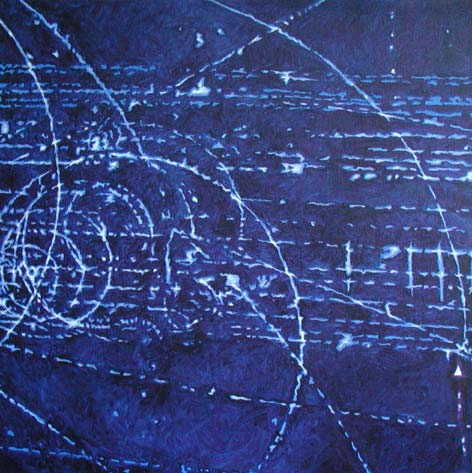
Mckenny-subatomic particle
Human consciousness is a substance outside the human body. It's a highly ordered energy capable of changing the physical world. We all knew this, once upon a time. This knowledge is old. It's the esoteric core of all the world's religions, East and West, ancient and modern.
Aldous Huxley describes:
"Perennial wisdom" that "recognizes a divine Reality substantial to the world of things and lives in minds..."
Whether it is a scientist studying measurements affected by psi (psychic phenomena) in controlled testing; whether it is a doctor, once again amazed at the effectiveness of a placebo delivered to his patient; or whether it arises from a personal, intuitive experience, the profound insight in a fundamental way is that our belief systems create our reality.
This wisdom is old.
Hindus knew it, as they walked across fire, lay on a bed of nails, or handled poisonous snakes with impunity; and lived, in comfortable serenity, on less than 400 calories a day.
Christians knew it, all the miracles of Jesus and His special healing gifts were explicitly part of this phenomena. Christ told his disciples that if they had faith as much as a grain of mustard seed, they could move a mountain.
This wisdom is new.
That our perception of reality affects reality, or indeed determines our reality, was the counter-intuitive product of quantum physics.
The conclusions scientists made that at its most elemental level, physical matter isn't solid or stable. It isn't anything at all, yet. Subatomic reality resembles not the solid and reliable state of being described by classical scientists, but an ephemeral prospect of unlimited options. So capricious are the tiniest bits of nature that quantum physicists have to make do with a crude approximation of the truth--these tiniest bits are described by a mathematical range of possibilities.
At the quantum level, reality is as shaky as unset Jello.
The quantum theories developed by Bohr, Heisenberg, and a host of other scientists over the last thirty-odd years rocks the very foundation of the Newtonian view of matter as something discrete and self-contained.
Matter at its most fundamental can't be divided into independently existing units or even fully described. Matter has no meaning in isolation: it exists only in a web of dynamic relationships. Quantum particles influence each other, without any impetus.
The universe isn't a storehouse of static, separate objects, but a unified organism composed of interconnected energy fields (quantum particles) in a continuous state of becoming. At it's most infinitesimal level, our universe resembles a vast network of information energy with all it's components continuously interacting, and changing.
The only thing, at the subatomic level, dissolving the cloud of probability into something solid and measurable is the presence of an observer.
Once a scientist decides to have a closer look at a subatomic particle, the entity which previously existed only as potential, collapses into something measurable.
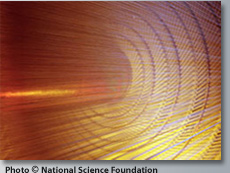
Subatomic Particle, Fermi Institute courtesy of the National Science Foundation
Noetics shows us a truth at once so old and new: Perception determines reality.
A sizable body of research now exists, which has been carried on by scientist in prestigious institutions all over the world, shows that thoughts affect matter, remotely.
This evidence shows that thoughts exist outside our bodies with an astonishing power to change the physical realities around us. Every thought we have is tangible energy with the power to transform.
These events were once simply legends: now, scientists in the field of Noetics have proven these seemingly physically impossible things to be true.
John Husted, a professor at Birkbeck College at the University of London, conducted this Noetics experiment:
He suspended latchkeys from the ceiling of the laboratory. His subjects were children. He stationed them at varying distances, from 3 to 10 feet away from their target key, so they could not possibly have any direct physical contact. He then instructed the children to try to bend their keys by thoughts alone.
During these sessions,Dr. Husted observed and recorded not only the keys swaying, and sometimes fracturing, but he was also getting voltage spikes from the keys, which he was also recording--up to ten volts, the limit of the recorder.
What does this mean to us? Can we put this information to good use? Can we "intend", and therefore create, a better world, out of our pure thoughts alone?
I am still studying this subject and will be for quite some time. It's a lot to take in, it's a lot to digest. I have several books on the subject and have sniffed around all over the place online. There is a wealth of material out there. It takes a lot of thinking about.
My natural skepticism says, it all sounds like wishful thinking. It sounds like pie in the sky. I smell the proverbial magic wand in here, somewhere.
But then I think, all those Italians who wanted to burn Galileo at the stake for saying the world was round instead of flat and the sun, not the earth, was in the center of the solar system, well, they were skeptics, too, weren't they?
Noetics is the new frontier in science. We may find more exploring the world of the mind, human consciousness and all its attributes, then we have ever discovered before in physical science. Noetics takes us on a journey to explore the science of consciousness. We've only begun to tap its possibilities.
If you want more information, click HERE:
- The Intention Experiment - The Largest Mind-Over Matter Experiment in History
The Intention Experiment is a series of scientifically controlled, web-based experiments testing the power of intention to change the physical world. Thousands of volunteers from 80 countries around the world have participated in Intention Experiment
The Noetics Paper, by George Zarkadakis
- George Zarkadakis
The official webpage of writer George Zarkadakis, it includes highlights and presentations from his literary work, novels, plays, poems, music, as well as the Noetics paper on the scientific study of human consciousness.
More fascinating science:
- The Event Horizon and Black Holes in Space
The event horizon of a black hole in the universe is the place where there is only one path to the inevitable, and time stops. - Are Computers Intelligent?
Are computers intelligent? Can computers really THINK? We've come a long way since the initial computers, which were room-sized adding machines powered by vacuum tubes. Artificial intelligence and the advancement of computers and robotics make it so - Mind Over Matter-The Science Behind It
Mind Over Matter and the Science Behind It--if you think "mind over matter" is BS of the purest ray serene, you might be surprised to find out how much valid science suggests that we have the power to change things and affect physical objects, with o - Quarks
All you need to know about quarks in one easy lesson.