Posture and Personality

Researchers into the connections between mind and body have identified further, less obvious, ways in which our bodies seem to shape themselves in response to our mental and emotional personality type. Dr. Ken Dychtwald, a professor of psychology working in the fields of human response and the body-mind awareness, has identified five basic ‘body splits' which give definite clues to character. However, these physical definitions must be viewed in context - your genetic inheritance plays a large part in deciding what shape you will be. If you are predominantly left-handed the left side of your body will be slightly more developed than the right. And your occupation, hobbies, or illness or injury can change both the shape and posture - all professional tennis players tend to overdevelop their racquet arm for example.

Right/left split
Nobody has yet discovered why between 80-90 percent of the population is right handed, yet this statistic is found throughout the world and consequently left-handed people are looked upon as strange and different. However, studies show that we are more ambidextrous than we think - even if we favor one hand for writing, we may clap, scratch, point and wave with the other hand. And in activities such as playing the piano, or typing, we have to use both hands equally. By trying a number of everyday actions, such as folding your arms, winking, or beckoning, you should be able to see which side of your body is dominant in which area, irrespective of the hand to use to hold a pen. And next time you are applauding, note which hand is uppermost as you clap - you may be surprised.
Left-handed children who were forced to write with their right hands at school often experienced learning difficulties, as they battled to overcome their natural preference. This practice has now ceased in most schools, for enlightened teachers have realized the needless problems it can cause
The Powerhouse
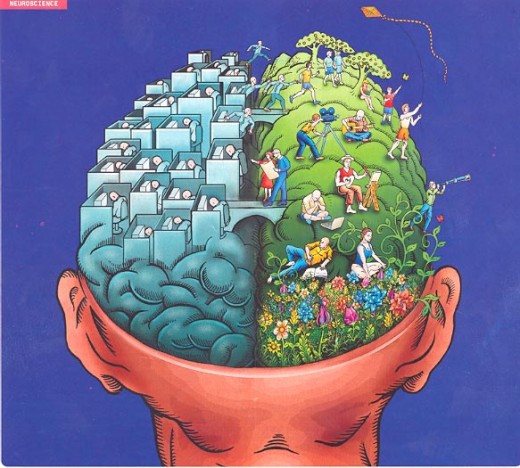
The characteristics of each hemisphere of the brain are illustrated by the following table:
Left Brain
- Verbal - the power of speech to describe things specifically
- Anatycal - a one-step-at-a-time way of thinking, one plus one equal two
- Symbolic - signs to represent things, such as male and female stop or go
- Rational, Logical, Liear - making decisions based on facts which are available; reasoned arguments; logical progression of ideas.
- Digital - using numbers, as in arithmetic
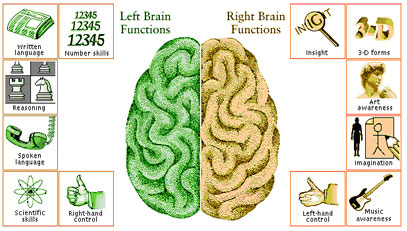
Right Brain
- Nonverbal - body language; an awareness of things which cannot necessarily be articulated.
- Synthetic - collecting ideas, feelings and facts together to form a whole.
- Intuitive - sudden, inexplicable insights not necessarily resulting from any particular train of thought but springing fully-formed into consciousness; the ‘hunch' of the outstanding detective; the problem solving dream.
- Nontemporal - no sense off time in terms of hours,minutes,days; often observed in situations where one is so involved in something that ‘time flies'
- Nonrational - the ability to suspend belief; children display this facility when becoming totally immersed in imaginative games; and adults who respond wholeheartedly to films, music and poetry have also entered the nonrational world of fantasy
- Spatial - orientation in space; understanding how parts of a thing fit together to form a whole.