Quantum Physics - The Double Slit Experiment (wave - particle duality)

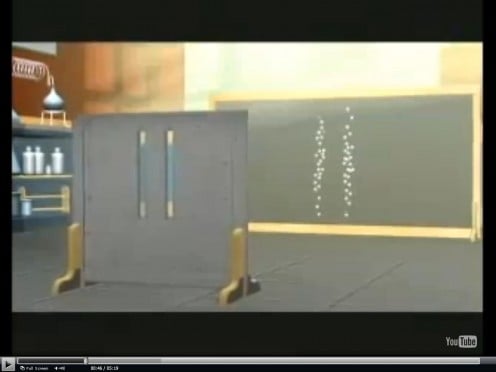
Paint balls through double split
Wave Particle Duality
Now to understand this experiment we first need to look at 2 things.
1. Matter
2. Waves
We will look at this with reference to the experiment we are studying.
Matter
If we take a macro (something large like paint balls) sized piece of matter, and we shoot it through a sheet of metal placed in front with a single slit of it and a screen behind to show where they land, now common sense tells you that they will form a straight line behind the slit...Correct, this is exactly what happens.
Now lets put a second silt in next to the other slit, what does the screen show now, again it matches with common sense it produces 2 lines of paint behind each of the slits, as well as a lot of mess on the metal sheet where the slits are; See image inset on right.
Waves through Single Slit
Waves through a double slit
Waves
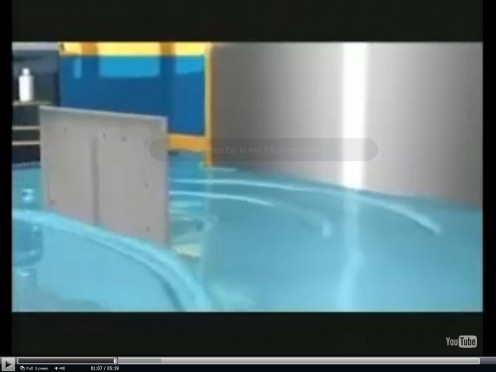
If we look at waves for, example waves in a pond, and we do the same as we did for the paint balls. We put a screen with one slit in the middle and a screen to detect where they land at the back, then what pattern do you think would form? That’s right the wave spreads out after going through the slit with the most intense band just behind the slit spreading out as we go see image on right.
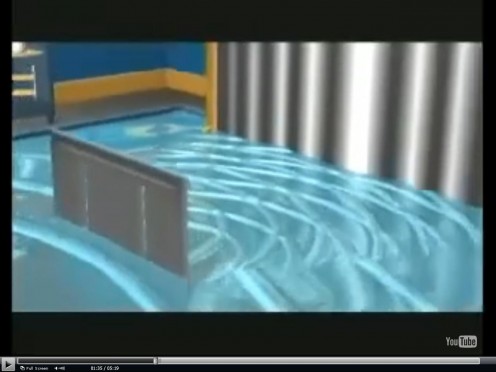
Now let’s add a second slit, now what happens? Where the top of the wave meets the bottom of the other wave, the waves cancel each other out, but where the top of a wave meets the top of the other wave, or bottom to bottom, we get a reinforced wave of extra bright ness and all those in-between, so we develop what is known as an interference pattern, bands of light and dark, where the waves have been constructive (reinforced) and destructive (cancelled each other out). See image to the right.
Quantum Effects
Ok let’s look at the Quantum Effects of this experiment. In this example we will be using electrons. Electrons are tiny particles of matter in fact it has a mass of just 9.10938215(45) ×10−31 kg, that’s very very small.
What happens when you fire these electrons through a single slit, well exactly what you would expect they form a band directly behind the slit, just as we expect with matter.
Now let’s add the second slit, expecting it to form 2 bands as with the paintball experiment we begin...whoa! It forms and interference pattern, matter forming an interference pattern, what’s going on? Physicists being smart thought about this and thought the electrons must be interfering with each other i.e. bouncing off each other to create this pattern. How can we solve this? The answer is let’s fire one electron at a time through the slit, then there is no way they can interfere with each other. This experiment was then left for an hour or so, when the scientists returned they saw an interference pattern! So we got an interference pattern just like waves, but from matter!
Interference pattern, with single electron at a time
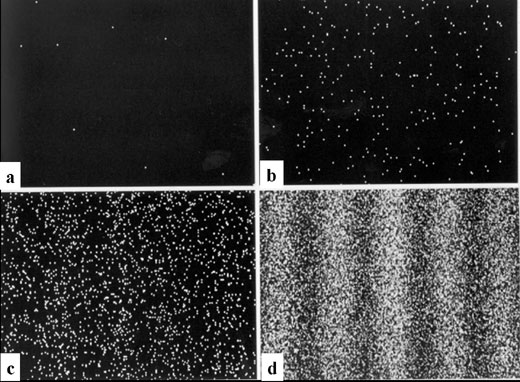
The conclusion is the electron leaves the source as a particle, becomes a wave of potentials and interferes with itself when it hits the wall. Don't worry if this boggles the mind, it goes against everything common since tells us yet this IS what happens. This is known as the wave-particle duality, the concept that matter and energy exhibits both a wave-like and matter-like properties.
The electron once leaving the source goes into what is known as superposition, that’s is the electron takes every conceivable and unconceivable path, through both slits, through one slit, through no slits rebounding against the sheet, around the experiment. This is known as the electrons wave function and upon measuring it the wave function collapses and that is where the electron is found, in this example on the detector screen at the back.
Superposition
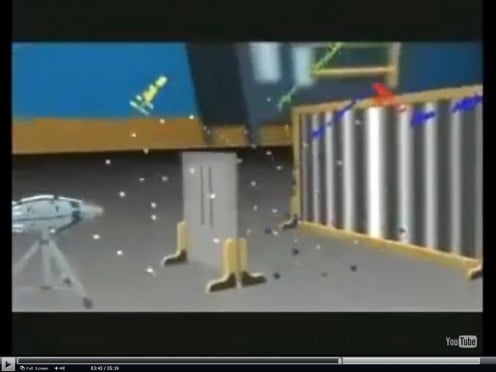
However physicists thought what happens if we try to detect which slit the electron is "really" going through, so they set up a detector at one of the slits, if it is detected it went through that slit if not it went through the other.
Now they released the electron and it went back to behaving like a particle and creates two bands, like in the first experiment with paint balls. Not the interference pattern! The very act of observing this caused it to only go through one slit.
So I here you say what did observing it have to do with anything? Well the fact is that observing the electron collapsed the wave function and forced it to go through a single slit, weird! Take a look at the video to summise what we have been disscussing, before moving on.
Summary of experiment
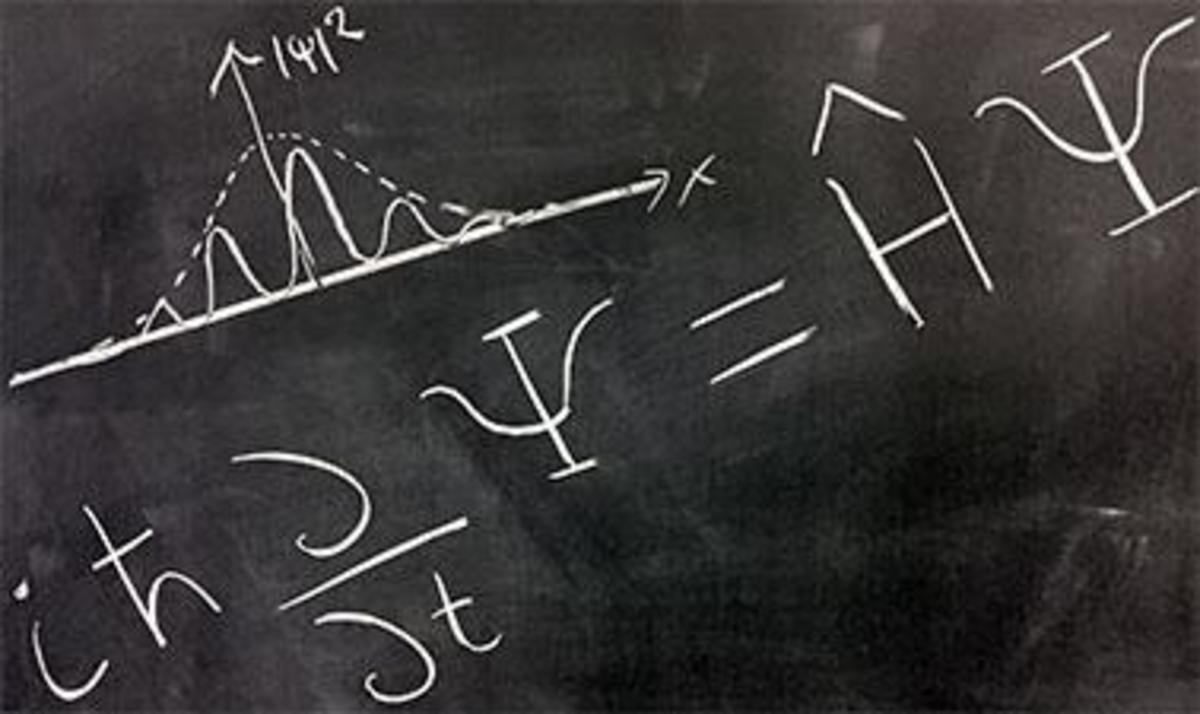
When you fire you electron source, what actually comes out is a Ψ (called psi, pronounced sigh) wave (i.e. a wave function). It is not random: it travels according to the perfectly predictable laws of wave propagation, moving out in all directions and interfering with itself and all that good stuff. According to the Copenhagen interpretation, the Ψ wave represents the probability of the photon being at any particular place. So at this stage, the question "Where is the electron?" does not have an answer—there is only a wave of probabilities traveling outward.
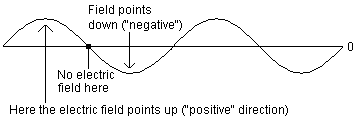
In terms of the math, we can represent Ψ with a drawing very similar to the drawing we used for a light wave at the beginning of the paper. But it's important to remember that the drawing means something very different! In a light wave, the height of the drawing corresponds to the strength of the electric field. In a Ψ wave, the height of the drawing represents the probability of finding the particle at a particular point. To make it more confusing, Ψ can be negative or positive, but the probability is always positive—the probability only cares how far from zero Ψ is, it doesn't matter at all which direction! So you might see something like this:
Wavefunction
Further material
- News | physics.org
A great resource of information for Physics - The double slit experiment and the collapse of the wavefunction
More information on collapsing wavefunctions, including a nice applet as a graphical representation of the double split results. - Double split experiment
A detailed look at the double split experiment history and evolution. Good resource for information.
So how does this apply to the experiment, well in the double split where we get the interference pattern, this is actually a probability pattern and of course, lots of electrons choose high-probability areas, only a few choose low-probability areas, and none of them choose zero-probability areas. That's why we see the interference pattern.
But when we put a measuring device to measure which slit the electron goes through we collapse the wave function and cause it to be 100% at one slit and 0% at the other hence why we get two bands and no interference pattern.
But of course, the theory also raises a lot of questions including;
-
What is this Ψ thing? What does it mean to say that ‘probability waves’ are flying through space, interfering with each other, and ‘collapsing’ into certainty?
-
What does it mean to "measure" it? Presumably the electron is bumping into, and interacting with, all kinds of things on the way to the metal sheet, but they apparently don't count as "measurements." At the same time, a measurement doesn't need to involve a person; you can stick a measuring device at one of the slits and never have a human being look at it, and the interference pattern on the back wall still disappears. So what is good enough to count as a "measurement"?
-
When you put a measuring device on a single slit, how does the wave going through the other slit "know" that it's supposed to collapse?
-
Isn't there some possible explanation that corresponds equally well to all the data, but makes more sense than this nonsense?
Some of these questions are completely unanswered, and some have had some thoughts and experiments however, understand this no one really “understands” this stuff not your teachers, not physicists no one, no one knows why Ψ can successfully predict experimental results but it does.
I will be writing more articles on quantum physics including some more mathematical interpretations of the experiments for those of you who are interested. There are also some great materials on the subject check out some of the books listed below.