Residential solar power systems - solar ovens and solar cookers

76Solar cookers / solar ovens
A solar oven uses solar energy as its sole source of fuel, and they therefore cost absolutely nothing to run.
They are fantastic to use when camping, trekking, cooking outdoors, or installing in the wall of a house.
Although mainly promoted in the third-world at the moment, they are increasingly being used in the western world, too.
Solar cookers work by combining three principles, namely converting light to heat, trapping heat, and concentrating sunlight.
A good solar oven uses all three of these in order to get an oven warm enough to cook in or boil water.
It is common for a solar oven to reach a temperature of about 150⁰C, or 300⁰F.
There are several main types of solar cookers, and this article explains what they are and how they work.
Panel solar ovens
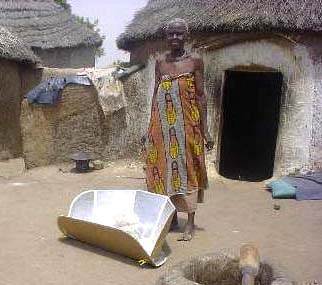
A panel solar oven uses shiny panels to direct sunlight to a saucepan of water or food. Aluminium foil is the most common, pasted onto cardboard or wood.
When made in bulk, in the absolutely cheapest way possible, they cost about £3.50 ($5.50) to make.
Panel cookers don’t reach as high temperatures as some cookers, but the oven reaches high enough temperatures to cook food such as barley, oats, meat, or rice, or to make unclean water fit to drink.
Solar kettles
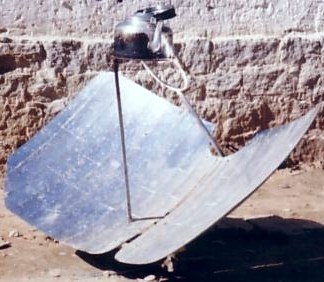
A solar kettle heats water in order to boil it and make it clean.
It’s particularly useful in third world countries with a great deal of sunshine but unreliable sources of water.
They are also great to boil water for hot drinks or cooking food, without the need to use fuel of any kind.
Because they can be made small and compact, they can be useful for walkers and hikers.
|
Deluxe Solar Cooking System
Price: $39.99
|
|
Solar StoveTop Cooker : Pattern, Instructions, Recipes
Price: $11.00
List Price: $12.00 |
|
Coleman 5010D700T Camp Oven
Price: $39.00
List Price: $39.99 |
Parabolic cookers
Parabolic cookers are as efficient and reach high temperatures as quickly as conventional ovens, and can and do cook large quanities of food.
Compared with the smaller types of solar ovens, parabolic ovens need a lot more care in building, and also need supervised and trained staff to operate them.
They are often used for cooking in China and India on a large scale where meals need to be prepared for a lot of people.
For example, a parabolic cooker in India is used to prepare 2,000 meals a day.
- Solar Food Processing and Conservation
An international NGO which promotes, encourages, and provides information on solar cooking. The initiative primarily targets third world countries with a high solar radiation, where there is a need for sustainable development.
Solar box cookers
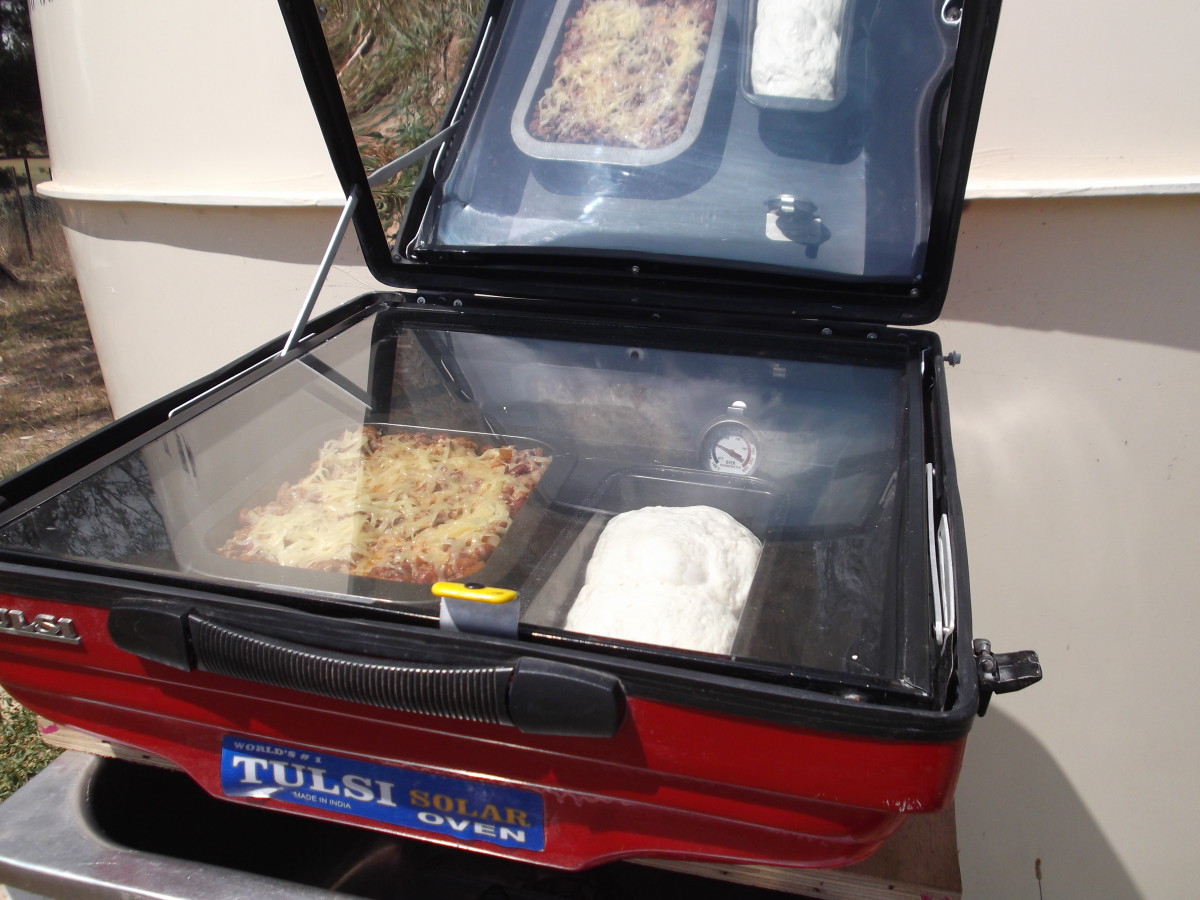
A solar box cooker has a transparent top which is often glass or an oven cooking bag which needs replacing every so often.
Saucepans and casserole dishes used in the solar oven need to be dark, ideally black, in order to increase the efficiency of the oven.
The sides of the cooker need to be insulated to some extent in order to keep heat in.
The maximum temperature reached is about 150⁰C, 300⁰F.
These box cookers can also be installed in the sides of houses and accessed from the inside which increases their utility.
- The solar bowl
Article about the solar bowl in Auroville, India, which powers a vast solar oven.
Solar cookers for travelling or hiking
Solar cookers have also been made for travellers and back packers, and the Swiss Federal Office of Energy has sponsored a foldable lightweight solar cooker weighing less than 2kg (4lbs) including the cooking pot, which can cook a meal for 2 people in approximately an hour.
These have obvious advantages for walkers. They don't need fuel (which is a significant running cost) and are light and easy to carry.
Hybrid solar ovens
Hybrid cookers are also available, which use elements of solar ovens and conventional heating for cooking at night or if the sun is not shining.
They are obviously more reliable, as they do not depend on good sunshine outside, but are more expensive to run as they need conventional fuel as well.
PrintShare it! — Rate it: up down flag this hub
Why we ignore a free heat source of heat for cooking is beyond me. I once attended a family reunion campout where the 20-some lb turkey ofr dinner the second night was cooked under an aluminum-covered cardboard box set in the sun all day. I've also had co-workers who use the back window of their cars in summer to cook the main course for that night's dinner. Works the same as a crockpot or slow cooker.
I agree with you both, and I think it's astonishing that we don't make more enthusiastic use of solar power for cooking, especially when it's free.
There's a place where I live called the Green Briar Jam Kitchen and they make Sun-Cooked Strawberry Preserves. You take fresh strawberries and lots of sugar and put them in porcelain pans with glass on top. Then let it sit in a special bin for quite awhile and cook away. This is the best strawberry preserve I've ever had!
That sound fantastic - I wish I knew of one near us!
Super job! I love solar ovens/solar cookers. They are such a fantastic idea and great for developing nations, as well as campers and hikers. Big thumbs up to you!
Very informative! I love how they are using solar cookers in Darfur - it is a clean alternative that makes life easier and safer - particularly for the women there.
Thanks Steph, glad you enjoyed it. I think they are a very important tool for the world as a whole.
Darfur is a particularly good example, Amy - couldn't agree more.
LondonGirl great information I'm going to make one of these and give it a try.
Let me know how it turns out?
I had never considered solar powered cooking. Very interesting hub!
Thanks very much - I think it will become increasingly important.
Using a natural source to power our home appliances--a viable and good energy alternative. Definitely the way of the future. Very informative.
I think solar ovens do have a significant and important role to play.
A nice page. in my country energy defficiency is a big problem. I don't know why we are ignoring solar power. I think the whole world should use solar energy. thanks for this nice write up.
As quickly as oil gets expensive, solar power will become popular in America! Right now we have plenty gas, oil and electric appliances and fuel! As these resources price themselves off the market, we will begin to seek cheaper, probably solar, then wind, wave,tidal hydro, and geothermal methods. Unless Steven Chu's recent allusion to more nuclear power was only a ploy to lever something else, the Obama administration may yield to temptation and give us the small underground self-contained "Neighbor-hood" reactors being built in New Mexico today! We can do better with Solar, wind, wave, tidal, hydro, and geothermal however, and have no waste to deal with later - Imagine! Propane so expensive, back-yard solar bar b ques get popular! I'll be Damned!
Yet another example of the amazing adaptability and variety that solar power systems can exhibit. Great information and great systems!
hi good info. While in Qinghai, China we taught ESL/EFL and how to cook out doors with solar in 91 and in 97 Hunan mts. When it is dark or over cast you can still cook with solar. most people today don't have film. it is photovoltic. a 4 foot square on pleciglass it takes 18 strips. by mistake we found that unexposed film would react to dark rays that heat very well. REI turned down out offer in seattle. May of the rock climbing and hikers there use the film and the solar combine unit it cost 35.00. try it out. you can also use it to charge batteries for cell phones. fun in the sun


shamelabboush says:
7 months ago
You've done a good research about this topic Londongirl. If it were up to me, I'd use solar power for everything in my everyday life.