Should Women Be Allowed In The Work Place?

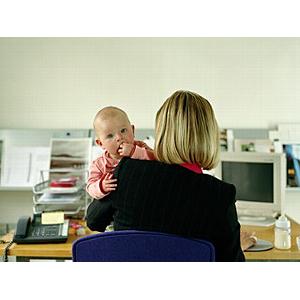
As a woman, campaigner for equal rights, and pseudo feminist extraordinaire, I pose this question after having read a most delightfully trashy romance novel. (I don't care, some of them are so utterly awesome it's a travesty that they're not recommended reading for men who would see the kind of drivel that women go mushy over and perhaps finally understand what women want, but that's another article and I digress,) anyway, in this romance novel, the strong, masculine conservative protagonist makes the claim that women should not be in the work force and that allowing women to join the workforce has lead to several negative consequences.
The gist of these consequences is that the workforce nigh doubled in size, giving employers more choice and allowing them to drop pay rates. At one time, a man's salary could support a wife and children, now the idea is laughable unless you happen to be a ponzi banker. Women no longer have the 'option' to work, they must work as well as raising any children they have.
I thought to myself, Egads! Slade McRomanceypants is quite correct, not only does he have imaginary broad shoulders and smoldering eyes, but he has accurately pin pointed the source of ills in our society.
At one time a woman could stay home and raise her babies if she so chose, nowadays a woman is torn between the need to make money and the desire to tend to her children. This leads to a deep seated guilt for many women who must drop their small children off to be cared for by others at a time when insticnt tells them that they should not leave them alone for a minute, lest a foul predator snatch them. Many claim that women have, in a sense, removed themselves or been removed from the roots of femininity which gave them their strength.
Recent years have seen a backlash against this type of thinking and increasingly, some women are wanting to stay home with their children and resume traditional gender roles. But it is harder now. The daughters of the women who burned lingerie and demanded to be allowed to work are now discovering that they must work. There's no doubt that women traded a certain amount of theoretical security and protection when they forged their way into the workforce, but that is the way life works. Everything is a trade off, and all things have consequences.
I said earlier that women now 'have' to work in the majority of cases to support themselves. This not some unintended consequence of the feminist movement however, this is the natural result of being equal. If men and women are equal, then men and women have the same responsibilities not as walking genders, but as individuals. Even to my ears however, this rings with but a hollow truth for it supposes that men and women can exist absent of their natural biological drives, and whilst we know very well that some women thrive in the workplace and even on the battle field, and some men thrive in the domestic arena, it does not mean that all men and women are so fluid.
Where things truly become convoluted is when children come in. A woman without children has no reason not to work, at least in my mind. However a woman who is trying to raise human beings to an age where they will no longer drink bleach if given half a chance may very well find that having a few meager months maternity leave and then being forced to leave her child in the care of another is a terrible situation to be in. Then again, she may be sick of making small talk with a barely sentient being by that time and leap at the chance to return to a world where the walls aren't all painted in bubblegum colors and caterpillars are just another bug and not an important educational tool worthy of devoting several brightly colored cut out tomes to.
The battle between so called 'equality' and the natural urges of the human male and female has been raging for eons and isn't likely to end any time soon, but it behoves us to remember that we are human animals, and that part and parcel of being human animals are gender differences which sometimes, really do make all the difference.
Should women be in the workplace? I believe they should be, but I also believe that we should acknowledge the sacrifices which are made not by a few men and women, but by the whole of society in order to support that ideal of equality.
Related
American Women in the Workforce - Why Are We Less Valuable?

Pacific Island Tattoos; Moko Style and Hawaiian Tattoos; Tattoo Ideas, History, Tattoo Meanings Men And Women

100 Inspirational Songs for Women

Why Are Men So Bothered by Women Choosing Peace Over Relationships?
Gender Roles and Ideology: Crossing the Divide