Site Waste Management Plans - 5 Ways to Reduce Waste

Site Waste Management Plans and 5 Ways to Reduce Your Construction Waste
It is a fact that clients and construction firms have finally waken up to waste planning. It makes good sense commercially due to escalating waste disposal costs, tighter legislation on landfill operators, and increasing pressure from both existing and potential clients to demonstrate positive environmental credentials. [Page originally published in 2009.]
Introduction
This process was long overdue for the construction industry, to bring it into-line with the amount of effort being put elsewhere in all businesses, to:-
-
minimize and avoid waste
-
re-use what would otherwise become waste
-
and recycle.
The incentive for construction firms to address site waste remains in 2019, and has never been greater.
All responsible Construction Contractors voluntarily complete a Site Waste Management Plan for all sites which they deem will benefit from advance planning of their waste management.
Since the introduction of SWMPS on 2008 construction waste recycling has risen to 90%.
This has required a large effort in devising many substantial ways to achieve the promised savings in waste generated, but does save money, and is a great success story for the UK industry.
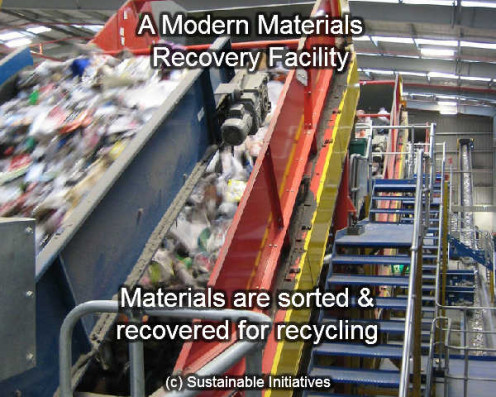
The 5 Top Ways to Reduce Construction Waste
Here are my favorite ways to Reduce Construction Waste:-
1. Waste Reduction 1 - Train Employees and Subcontractors in the Reasons for Operating Sustainably
At the most basic level this is essential as just about everyone within an organisation throws away materials at some time. So, careful sorting and segregation of materials into the right skips by the majority, can easily be sabotaged by an uncaring minority of individuals throwing materials carelessly into the wrong skips.
At higher levels within the organisation the designers, managers and project planners will all need to show commitment to waste avoidance and reduction. This will not happen unless they understand and become committed to the underlying principles of sustainability.
So knowledge and commitment are essential pre-requisites for continued high performance in waste reduction.
2. Waste Reduction 2 - Only Use Suppliers which will Accept Back Your Unused Materials
This first tip is so simple that it is incredible that it has not being done routinely by most contractors already.
Change your company policy to only work with suppliers that will take back surplus supplies. One example is that builders will order in bulk and not uncommonly order in batches of 20,000 bricks and firstly not use all of them. Then to make matters worse the left-over bricks most often get thrown into a skip and landfilled, or just buried on site.
Make it a requirement that you will not do business unless each of your suppliers will take back unused materials, you may not be paid for the returned goods, or if you are you may be at best given a very small sum, but it remains preferable in terms of sustainability to return these materials in any event. With landfill site costs as they are, for much of the time this will also make commercial sense as well.
3. Waste Reduction 3 - Use Excess Earthworks Materials to Contour and Landscape your Sites
This has already seen a large take up and when done well and landscaped with sensitivity the recontoured site becomes an asset to the project. Bunds can provide for screening and for private spaces, provide sound attenuation and on accasions even be used to hold back stormwater to minimise flooding potential in heavy storms.
The amount of material which may be used in this way may be severely limited on congested inner city sites, but remains worth doing wherever possible.
4. Waste Minimisation 4 - Use a Site Crusher to Reprocess Existing Concrete and Stone on Site for use in New Site Structures
Using site crushing plant to reprocess existing demolished site materials to re-use them again on-site is also becoming increasingly popular. It gives obvious environmental advantages over landfilling that material, and avoids the need to quarry fresh materials and transport them to the site for the new structure.
Again, such measures can also bring simultaneous cost savings.
5. Waste Reduction 5 - Think Creatively
This clearly needs to start with the designer, but can be much enhanced by a sensitive contractor in its implementation.
Examples would be the re-use a loved building facade, or other features from the original building. Cleaning off bricks and roof tiles, and re-using them as a feature to place in new walls to add character and perceived building value would be another example.
******************
However the savings are achieved, it is important to ensure that the company's waste management scheme takes on board the principles of the waste hierarchy. Good site waste management planning will always have this at its heart.
This is a concept which identifies possible waste disposal options, ranking them in order of environmental impact. This exercise prioritizes the prevention and re-use of waste and ensures compliance with sustainability requirements.
Your Chance to Learn More About Waste Management!

How to Create and Use a Construction Site Waste Management Plan
Some Facts About the Size of the UK's Construction Industry Waste
The construction industry produces a quarter of total waste each year of which up to 13% is delivered and unused. It produces three times more waste than all UK households combined.
Special care must be taken when handling certain types of construction waste. Concrete can be very heavy and may require a skip loader. Rebar, steel, wire, and pipe may be bent into irregular shapes and will require extra care when loading into a disposal bin. Exposed nails, glass, and tile can cause severe injury. Wood, drywall, and carpeting are sometimes in large pieces and may need to be cut into smaller sizes before safely lifting into a disposal bin.
Where Does the Huge Volume of Construction Waste Come From?
Construction waste is generated from construction building and demolition activities consisting of concrete, tiles, bricks, drywall, asphalt, plastics, metals, wood, rocks and more. These construction waste materials are often inert and non-biodegradable, heavy, bulky and overload landfills.
At the Landfill-Site , we are committed to reducing the amount of waste that is sent to landfill.
We help businesses to publicize waste management and for contractors to start recycling as much of their waste as possible. Plastics, concrete, wood and certain public fill can all be recycled. We can provide every business with a unique waste audit, making the process of separating recyclable construction waste hassle-free.
There are essentially three ways to represent waste reduction requirements in the contract documents. Describe the waste reduction goals and rely on the Contractor's own initiative to achieve them. Specify definitive minimum waste and debris diversion criteria. This may be implemented as an award-type incentive based on the diversion rate, or by including Options in the Bid Schedule for each of several ranges of diversion rates. Note that simply requiring a specific LEED rating does not guarantee credit MR 2.1 or 2.2 (50%, and an additional 25% C&D waste diversion, respectively) will be attained.
Related

Why Is Apple's Supply Chain so Successful?

Designating a Subcontractor in Your Project Proposal
The Environmental, Economic, and Social Components of Sustainability

Why Innocent Drinks Need To Incorporate CSR and Ethical Practices in Its Operations
Engaging Children in Creative Activities: How to Make Beautiful fun items from Waste Materials