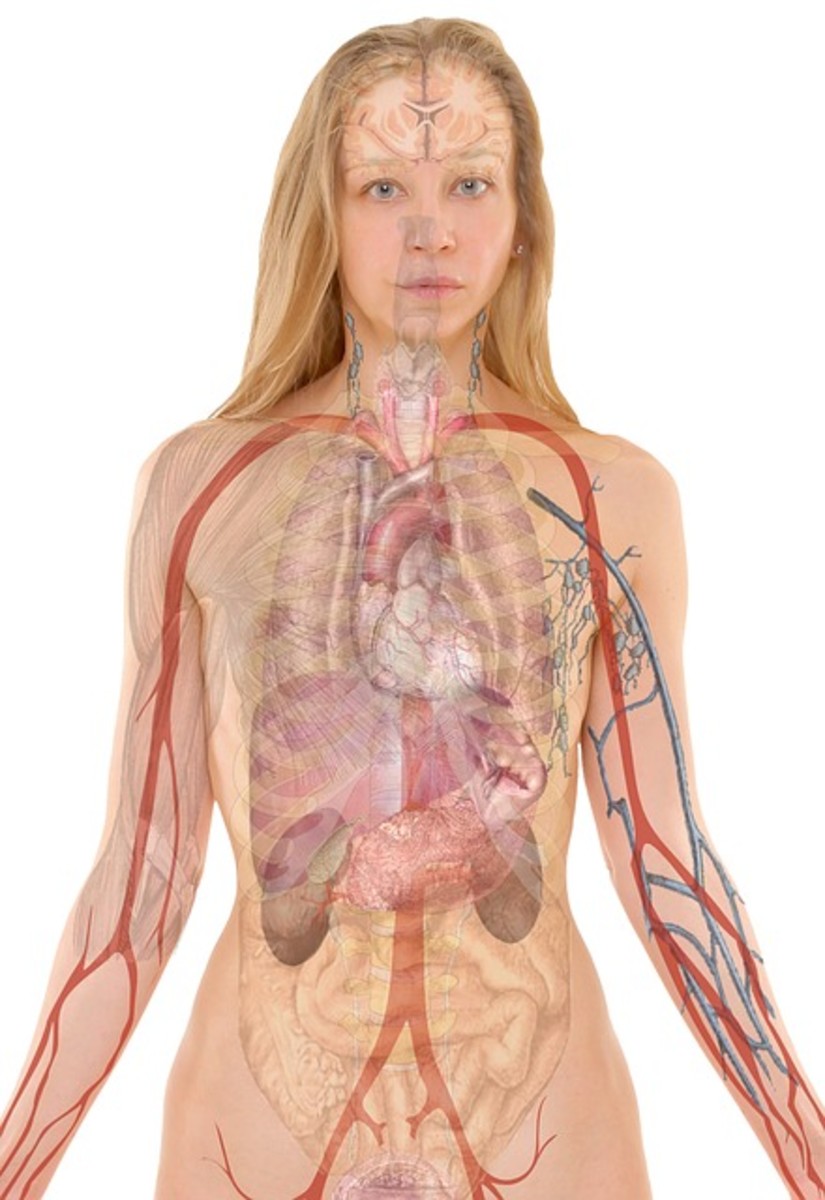
The Heart

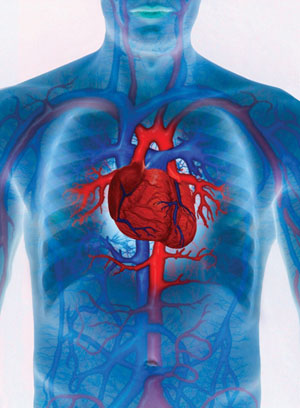
THE HEART
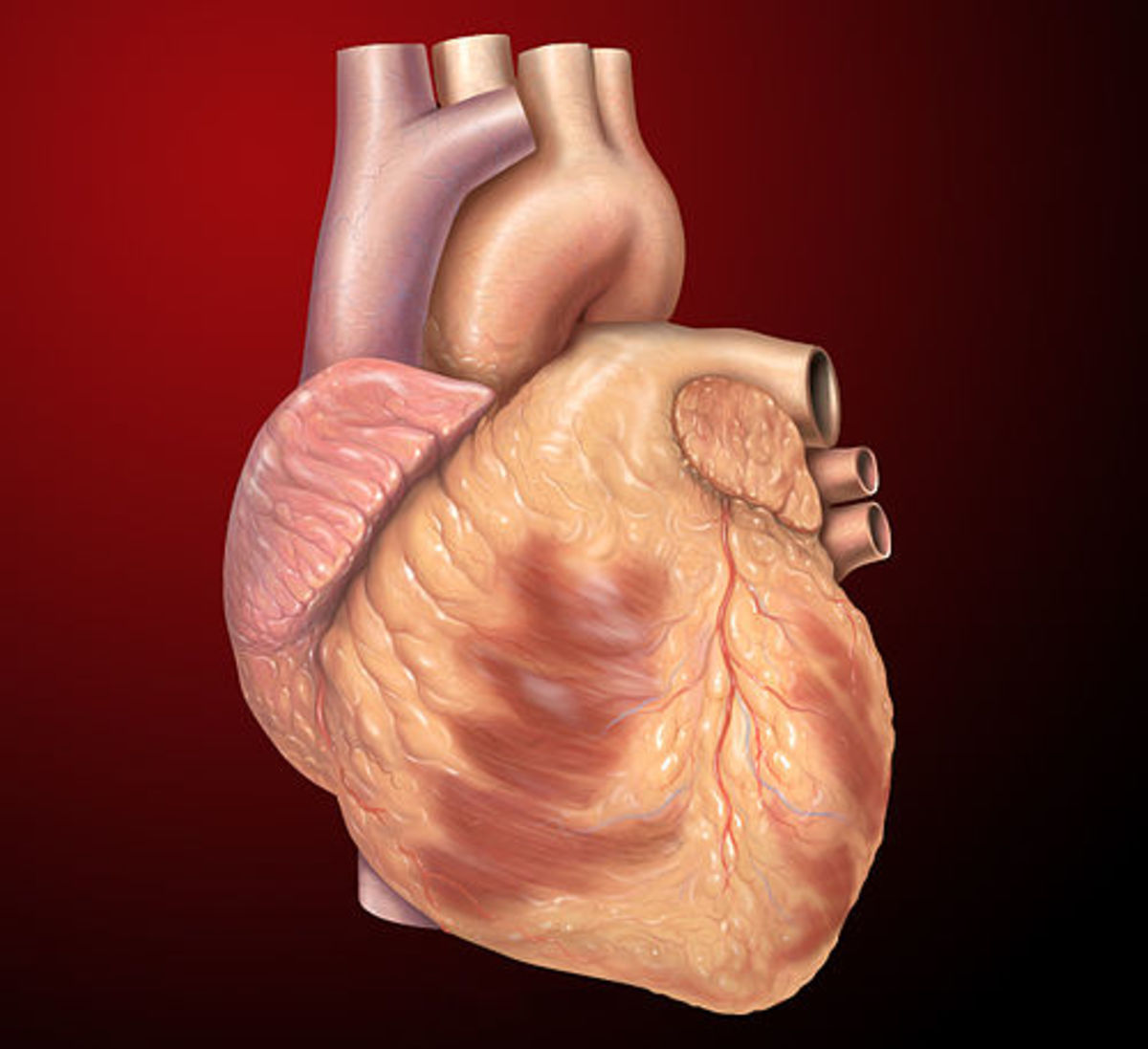
HEART is a hollow muscular organ that pumps blood through the body. The heart, blood, and blood vessels make up the circulatory system, which is responsible for distributing oxygen and nutrients to the body and carrying away carbon dioxide and other waste products. The heart is the circulatory system's power supply. It must beat ceaselessly because the body's tissues-especially the brain and the heart itself-depend on a constant supply of oxygen and nutrients delivered by the flowing blood. If the heart stops pumping blood for more than a few minutes, death will result.
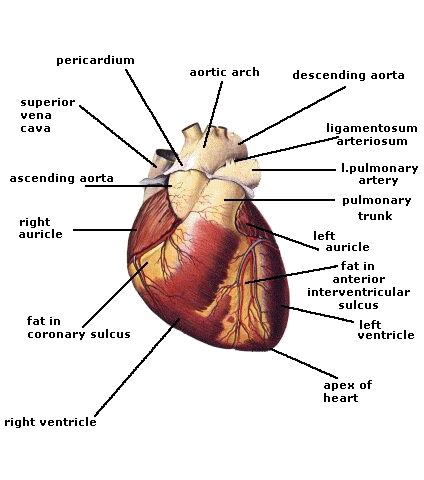
The human heart is shaped like an upside-down pear and is located slightly to the left of center inside the chest cavity within the bony thorax and is flanked on each side by the lungs. Its more pointed apex is directed toward the left hip and rests on the diaphragm, approximately at the level of the fifth intercostal space. (This is exactly where one would place a stethoscope to count the apical pulse.) Its broader posterosuperior aspect, or base, from which the great vessels of the body emerge, points toward the right shoulder and lies beneath the second rib.
About the size of a closed fist, the heart is made primarily of muscle tissue that contracts rhythmically to propel blood to all parts of the body. This rhythmic contraction begins in the developing embryo about three weeks after conception and continues throughout an individual's life. The muscle rests only for a fraction of a second between beats. Over a typical life span of 76 years, the heart will beat nearly 2.8 billion times and move 169 million liters (179 million quarts) of blood.
Structure of the Heart
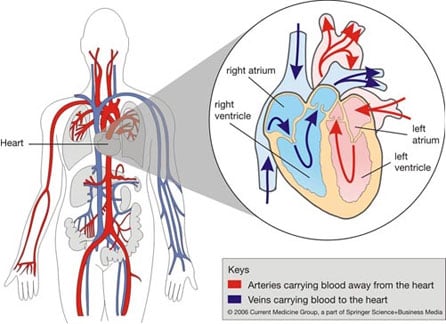
The human heart has four chambers. Two atria and two ventricles. The upper two chambers, the right and left atria, are receiving chambers for blood. The atria are sometimes known as auricles. They collect blood that pours in from veins, blood vessels that return blood to the heart. The heart's lower two chambers, the right and left ventricles, are the powerful pumping chambers. The ventricles propel blood into arteries, blood vessels that carry blood away from the heart.
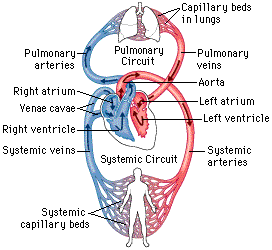
A wall of tissue separates the right and left sides of the heart. Each side pumps blood through a different circuit of blood vessels: The right side of the heart pumps oxygen-poor blood to the lungs, while the left side of the heart pumps oxygen-rich blood to the body. Blood returning from a trip around the body has given up most of its oxygen and picked up carbon dioxide in the body's tissues. This oxygen-poor blood feeds into two large veins, the superior vena cava and inferior vena cava, which empty into the right atrium of the heart.
The right atrium conducts blood to the right ventricle, and the right ventricle pumps blood into the pulmonary artery. The pulmonary artery carries the blood to the lungs, where it picks up a fresh supply of oxygen and eliminates carbon dioxide. The blood that is oxygen-rich returns to the heart through the pulmonary veins, which empty into the left atrium. Blood passes from the left atrium into the left ventricle, from where it is pumped out of the heart into the aorta, the body's largest artery. Smaller arteries that branch off the aorta distribute blood to various parts of the body.
A. the Heart Valves
Four valves within the heart prevent blood from flowing backward in the heart. The valves open easily in the direction of blood flow, but when blood pushes against the valves in the opposite direction, the valves close.
TWO VALVES, known as atrioventricular valves, are located between the atria and ventricles. The AV valves prevent backflow into the atria when the ventricles contract. The right atrioventricular valve is formed from three flaps of tissue and is called the tricuspid valve. The left atrioventricular valve has two flaps and is called the bicuspid or mitral valve. Tiny white cords, the chordae tendinae- literally, “heartstrings”- anchor the cusps to the walls of the ventricles. When the heart is relaxed and blood is passively filling its chambers, the AV- valve flaps hang limply into the ventricles. As the ventricles contract, they press in the blood in their chambers, and the intraventricular pressure begins to rise.
The other TWO HEART VALVES are located between the ventricles and arteries. They are called semilunar valves because they each consist of three half-moon-shaped flaps of tissue. They guard the bases of the large arteries leaving the ventricular chambers. The right semilunar valve, between the right ventricle and pulmonary artery, is also called the pulmonary valve. The left semilunar valve, between the left ventricle and aorta, is also called the aortic valve. When the ventricles are contracting and forcing blood out of the heart, the cusps are forced open and flattened against the walls of the arteries by the tremendous force of rushing blood. Then when the ventricles relax, the blood begins to flow backward toward the heart, and the cusps fill with blood, closing the valves. This prevents arterial blood from reentering the heart.
Each set of valves operates at a different time. The AV valves are open during heart relaxation and closed when the ventricles are contracting. The semilunar valves are closed during heart relaxation and are forced open when the ventricles contract.

- The tricuspid valve lies behind the right half of the sternum opposite the fourth intercostal space.
- The mitral valve lies behind the left half of the sternum opposite the fourth coastal cartilage.
- The pulmonary valve lies behind the medial end of the third coastal cartilage and the adjoining part of the sternum.
- The aortic valve lies behind the left half of the sternum opposite the third intercoastal space.
B. the Myocardium
Muscle tissue, known as myocardium or cardiac muscle, wraps around a scaffolding of tough connective tissue to form the walls of the heart's chambers. The atria, the receiving chambers of the heart, have relatively thin walls compared to the ventricles, the pumping chambers. The left ventricle has the thickest walls-nearly 1 cm (0.5 in) thick in an adult-because it must work the hardest to propel blood to the farthest reaches of the body.
C. the Pericardium
A tough, double-layered sac known as the pericardium surrounds the heart. The inner layer of the pericardium, known as the epicardium, rests directly on top of the heart muscle. The outer layer of the pericardium attaches to the breastbone and other structures in the chest cavity and helps hold the heart in place. Between the two layers of the pericardium is a thin space filled with a watery fluid that helps prevent these layers from rubbing against each other when the heart beats.
D. the Endocardium
The inner surfaces of the heart's chambers are lined with a thin sheet of shiny, white tissue known as the endocardium. The same type of tissue, more broadly referred to as endothelium, also lines the body's blood vessels, forming one continuous lining throughout the circulatory system. This lining helps blood flow smoothly and prevents blood clots from forming inside the circulatory system.
E. the Coronary Arteries
The heart is nourished not by the blood passing through its chambers but by a specialized network of blood vessels. Known as the coronary arteries, these blood vessels encircle the heart like a crown. About 5 percent of the blood pumped to the body enters the coronary arteries, which branch from the aorta just above where it emerges from the left ventricle. Three main coronary arteries-the right, the left circumflex, and the left anterior descending-nourish different regions of the heart muscle. From these three arteries arise smaller branches that enter the muscular walls of the heart to provide a constant supply of oxygen and nutrients. Veins running through the heart muscle converge to form a large channel called the coronary sinus, which returns blood to the right atrium.
Function of the Heart
The heart's duties are much broader than simply pumping blood continuously throughout life. The heart must also respond to changes in the body's demand for oxygen. The heart works very differently during sleep, for example, than in the middle of a 5-km (3-mi) run. Moreover, the heart and the rest of the circulatory system can respond almost instantaneously to shifting situations-when a person stands up or lies down, for example, or when a person is faced with a potentially dangerous situation
A. THE CARDIAC CYCLE
Although the right and left halves of the heart are separate, they both contract in unison, producing a single heartbeat. The sequence of events from the beginning of one heartbeat to the beginning of the next is called the cardiac cycle. The cardiac cycle has two phases: diastole, when the heart's chambers are relaxed, and systole, when the chambers contract to move blood. During diastole, the ventricles relax and fill with blood; then the atria contract, forcing more blood into the ventricles. During systole, the ventricles contract and pump blood, and the atria relax and begin filling with blood again. If the atria and ventricles contracted simultaneously, the heart would not be able to move as much blood with each beat.
During diastole, both atria and ventricles are relaxed, and the atrioventricular valves are open. Blood pours from the veins into the atria, and from there into the ventricles. In fact, most of the blood that enters the ventricles simply pours in during diastole. Systole then begins as the atria contract to complete the filling of the ventricles. Next, the ventricles contract, forcing blood out through the semilunar valves and into the arteries, and the atrioventricular valves close to prevent blood from flowing back into the atria. As pressure rises in the arteries, the semilunar valves snap shut to prevent blood from flowing back into the ventricles. Diastole then begins again as the heart muscle relaxes-the atria first, followed by the ventricles-and blood begins to pour into the heart once more.
A health-care professional uses an instrument known as a stethoscope to detect internal body sounds, including the sounds produced by the heart as it is beating. The characteristic heartbeat sounds are made by the valves in the heart-not by the contraction of the heart muscle itself. The sound comes from the leaflets of the valves slapping together. The closing of the atrioventricular valves, just before the ventricles contract, makes the first heart sound. The second heart sound is made when the semilunar valves snap closed. The first heart sound is generally longer and lower than the second, producing a heartbeat that sounds like lub-dup, lub-dup, lub-dup.
Blood pressure, the pressure exerted on the walls of blood vessels by the flowing blood, also varies during different phases of the cardiac cycle. Blood pressure in the arteries is higher during systole, when the ventricles are contracting, and lower during diastole, as the blood ejected during systole moves into the body's capillaries. Blood pressure is measured in millimeters (mm) of mercury using a sphygmomanometer, an instrument that consists of a pressure-recording device and an inflatable cuff that is usually placed around the upper arm. Normal blood pressure in an adult is less than 120 mm of mercury during systole, and less than 80 mm of mercury during diastole. Blood pressure is usually noted as a ratio of systolic pressure to diastolic pressure-for example, 120/80. A person's blood pressure may increase for a short time during moments of stress or strong emotions. However, a prolonged or constant elevation of blood pressure, a condition known as hypertension, can increase a person's risk for heart attack, stroke, heart and kidney failure, and other health problems.
B. Generation of the Heartbeat
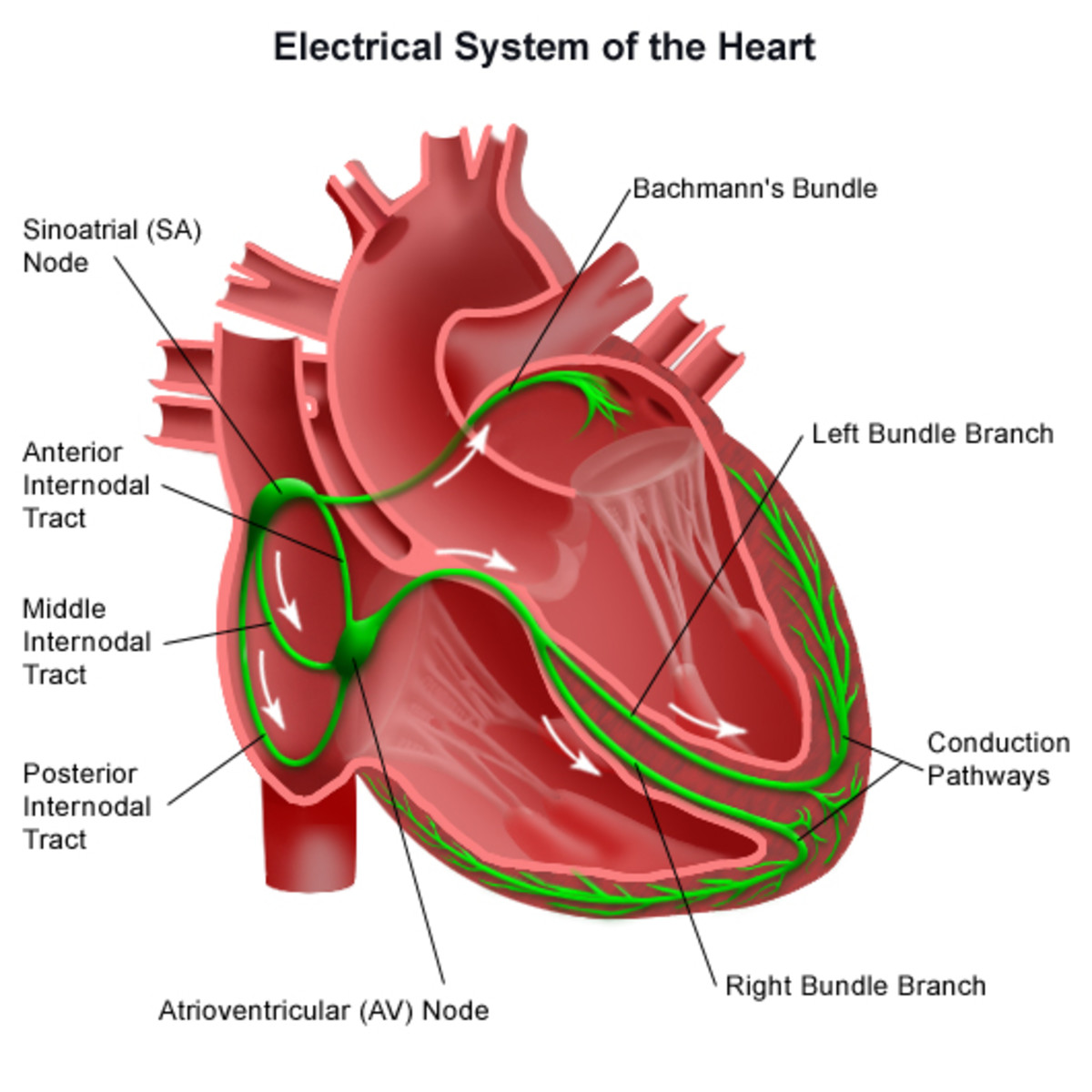
Unlike most muscles, which rely on nerve impulses to cause them to contract, heart muscle can contract of its own accord. Certain heart muscle cells have the ability to contract spontaneously, and these cells generate electrical signals that spread to the rest of the heart and cause it to contract with a regular, steady beat.
The heartbeat begins with a small group of specialized muscle cells located in the upper right-hand corner of the right atrium. This area is known as the sinoatrial (SA) node. Cells in the SA node generate their electrical signals more frequently than cells elsewhere in the heart, so the electrical signals generated by the SA node synchronize the electrical signals traveling to the rest of the heart. For this reason, the SA node is also known as the heart’s pacemaker.
Impulses generated by the SA node spread rapidly throughout the atria, so that all the muscle cells of the atria contract virtually in unison. Electrical impulses cannot be conducted through the partition between the atria and ventricles, which is primarily made of fibrous connective tissue rather than muscle cells. The impulses from the SA node are carried across this connective tissue partition by a small bridge of muscle called the atrioventricular conduction system. The first part of this system is a group of cells at the lower margin of the right atrium, known as the atrioventricular (AV) node. Cells in the AV node conduct impulses relatively slowly, introducing a delay of about two-tenths of a second before an impulse reaches the ventricles. This delay allows time for the blood in the atria to empty into the ventricles before the ventricles begin contracting.
After making its way through the AV node, an impulse passes along a group of muscle fibers called the bundle of His, which span the connective tissue wall separating the atria from the ventricles. Once on the other side of that wall, the impulse spreads rapidly among the muscle cells that make up the ventricles. The impulse travels to all parts of the ventricles with the help of a network of fast-conducting fibers called Purkinje fibers. These fibers are necessary because the ventricular walls are so thick and massive. If the impulse had to spread directly from one muscle cell to another, different parts of the ventricles would not contract together, and the heart would not pump blood efficiently. Although this complicated circuit has many steps, an electrical impulse spreads from the SA node throughout the heart in less than one second.
The journey of an electrical impulse around the heart can be traced by a machine called an electrocardiograph (see Electrocardiography). This instrument consists of a recording device attached to electrodes that are placed at various points on a person’s skin. The recording device measures different phases of the heartbeat and traces these patterns as peaks and valleys in a graphic image known as an electrocardiogram (ECG, sometimes known as EKG). Changes or abnormalities in the heartbeat or in the heart’s rate of contraction register on the ECG, helping doctors diagnose heart problems or identify damage from a heart attack.
C. Control of the Heart Rate
In an adult, resting heart rate is normally about 70 beats per minute. However, the heart can beat up to three times faster—at more than 200 beats per minute—when a person is exercising vigorously. Younger people have faster resting heart rates than adults do. The normal heart rate is about 120 beats per minute in infants and about 100 beats per minute in young children. Many athletes, by contrast, often have relatively slow resting heart rates because physical training makes the heart stronger and enables it to pump the same amount of blood with fewer beats. An athlete’s resting heart rate may be only 40 to 60 beats per minute.
Although the SA node generates the heartbeat, impulses from nerves cause the heart to speed up or slow down almost instantaneously (see Nervous System). The nerves that affect heart rate are part of the autonomic nervous system, which directs activities of the body that are not under conscious control. The autonomic nervous system is made up of two types of nerves, sympathetic and parasympathetic fibers. These fibers come from the spinal cord or brain and deliver impulses to the SA node and other parts of the heart.
Sympathetic nerve fibers increase the heart rate. These fibers are activated in times of stress, and they play a role in the fight or flight response that prepares humans and other animals to respond to danger. In addition to fear or physical danger, exercising or experiencing a strong emotion can also activate sympathetic fibers and cause an increase in heart rate. In contrast, parasympathetic nerve fibers slow the heart rate. In the absence of nerve impulses the SA node would fire about 100 times each minute—parasympathetic fibers are responsible for slowing the heart to the normal rate of about 70 beats per minute.
Chemicals known as hormones carried in the bloodstream also influence the heart rate. Hormones generally take effect more slowly than nerve impulses. They work by attaching to receptors, proteins on the surface of heart muscle cells, to change the way the muscle cells contract. Epinephrine (also called adrenaline) is a hormone made by the adrenal glands, which are located on top of the kidneys. Released during times of stress, epinephrine increases the heart rate much as sympathetic nerve fibers do. Thyroid hormone, which regulates the body’s overall metabolism, also increases the heart rate. Other chemicals—especially calcium, potassium, and sodium—can affect heart rate and rhythm.
D. Cardiac Output
To determine overall heart function, doctors measure cardiac output, the amount of blood pumped by each ventricle in one minute. Cardiac output is equal to the heart rate multiplied by the stroke volume, the amount of blood pumped by a ventricle with each beat. Stroke volume, in turn, depends on several factors: the rate at which blood returns to the heart through the veins; how vigorously the heart contracts; and the pressure of blood in the arteries, which affects how hard the heart must work to propel blood into them. Normal cardiac output in an adult is about 3 liters per minute per square meter of body surface.
An increase in either heart rate or stroke volume—or both—will increase cardiac output. During exercise, sympathetic nerve fibers increase heart rate. At the same time, stroke volume increases, primarily because venous blood returns to the heart more quickly and the heart contracts more vigorously. Many of the factors that increase heart rate also increase stroke volume. For example, impulses from sympathetic nerve fibers cause the heart to contract more vigorously as well as increasing the heart rate. The simultaneous increase in heart rate and stroke volume enables a larger and more efficient increase in cardiac output than if, say, heart rate alone increased during exercise. In a healthy adult during vigorous exercise, cardiac output can increase six-fold, to 18 liters per minute per square meter of body surface.
SOURCE:
- Microsoft ® Encarta ® 2009. © 1993-2008 Microsoft Corporation. All rights reserved.
- Essentials of Human Anatomy and Physiology 6th Ed.
- Clinical Anatomy for Medical Students 5th Ed.
Did you find this useful?
© 2008 phoebe180