create your own

Top Ten Worst Things to Say to Someone With an Eating Disorder

83
rate or flag this page

By Maddie Ruud


Good Intentions

You just found out that your loved one has an eating disorder. Or perhaps an acquaintance revealed their struggle during the course of a conversation. You want to be understanding. You want to help in any way you can. You want to encourage, affirm, support, validate. But what you thought were kind words seem to offend, even injure the person you so wished to show your empathy.

What went wrong? It's hard for someone without an eating disordered mind to comprehend the right and wrong things to say. Consequently, both you and your friend are left unsettled, unsatisfied, maybe even angry to a point that might damage your relationship.

As someone with insight, I've compiled a list of the top ten worst things to say to someone with an eating disorder, both from my own experience, and horror stories from other eating-disordered women. Some of the worst offenders to an anorexic might sound benign to you at first read, but once you understand how your loved one hears things, you'll find your relationship vastly improved. I hate to say it, but this is one case where it's not the thought that counts.

Bad Reactions

  1. Why? (Eating disorders are complex mental illnesses with multiple factors, and the last thing you want to do is put him/her on the spot, after a vulnerable revelation.)
  2. But you don't look like you have an eating disorder! (Sounds like: "You're fat!")
  3. If you want to lose weight, why don't you just diet and exercise? (This is like telling an alcoholic to just have a "few" drinks.)
  4. It's what's on the inside that counts. (Sounds like: "You're ugly.")
  5. You look great to me! (You do not know if this is his/her healthy weight, or what s/he may have done to get here.)
  6. How long has it been since you've eaten? (This is unimportant, and sounds callous. Eating disorders are never, at the heart, about food.)
  7. I had a friend once whose sister was bulimic, and she... (Invalidates him/her as an individual; sounds like you think you know it all. No two eating-disordered people are the same.)
  8. Just eat what you want! (Sounds like: "It's not a big deal.")
  9. Nice weather we're having. (Self-explanatory.)
  10. ____ (Self-explanatory.)


Constructive Comments

I may be able to list for you the "wrong" things to say, but I'm afraid I can't tell you what's right. I don't know you or your loved one. Each person has a unique situation; each conversation is a unique interaction. I can give you a few helpful tips for framing your responses:

  • Empathize (This doesn't mean telling the person that you know how they feel, because you don't, and that's obvious to both of you.)
  • Focus on Feelings rather than facts. Try to validate the person's experience, and take the emphasis off of attempting to grasp some objective "reality."
  • Listen - This person is telling you something intimate about themselves, and even if they do not conciously know what it is, there is a reason why. Rather than giving the impression of being burdened, appreciate the trust s/he has placed in you by confiding. It is a compliment.

If someone close to you does have an eating disorder, I suggest you pick up a few books on the subject. My recommendations are above. The rest is up to you.

Comments

RSS for comments on this Hub

Jennifer Chait profile image

Jennifer Chait  says:
2 years ago

Wow, I had no idea about all of the things you shoulden't say. What's hard is that there is no perfect comment (like you said above - everyone is different). Very useful post. It's sad that we need useful posts like this though. Great hub.

L.....  says:
2 years ago

good job! :)

I have myself an eating disoerder and my idiotic BF said :well just eat lots of fat...

smart a*** like it is working that way....

glassvisage profile image

glassvisage  says:
2 years ago

Is there anything you can do if it's someone you don't know? I sometimes see girls in my classes and I wonder if there's anything I can say that would affect them positively, if one of their acquaintances hasn't tried to help by saying something...

Patty Inglish, MS profile image

Patty Inglish, MS  says:
2 years ago

Great job on this Hub - I wish everyone could know this information.

The Good Cook profile image

The Good Cook  says:
2 years ago

As a former anorexia and bulimia sufferer for many years, I have very mixed emotions and reactions to information such as you present. Just as the introduction of sex and drug "awareness" and "education" to pre-pubescent children has only helped to increase the incidence of teen pregnancies and drug experimentation and addiction, attempts at "educating" the general public about eating disorders has only served to trivialise what is a very serious, and deadly, disease.

An eating disorder is not a conscious or unconscious decision or lifestyle choice that the sufferer makes. Rather, it is a silent predator that sneaks up and strikes without warning - and inevitably leave their victim feeling powerless and ashamed. Most sufferers will go to ridiculous extremes to hide their conditon and do not confide their sorry state to anyone!

You are absolutely correct in saying that it's not about food though.

As for what people should say ... well, sometimes the simple acknowledgement of a complete lack of experience or understanding can be very potent. The most useful, touching and empowering comment I have ever heard in my life was "I have no idea what you're going through".

Maddie Ruud profile image

Maddie Ruud  says:
2 years ago

Good Cook:

I always appreciate a critical thinker. However, I'm obliged to strongly disagree with you. It is a common misunderstanding that sex education has increased the rate of teen pregnancy and STDs... in fact, just the opposite! I don't know whether you are basing this claim on statistics or not, but I'd be curious to see them

The incidence of eating disorders has doubled over the last 10 years in Australia, and researchers claim that this is due, not to eating disorder awareness, which is practically nill, but rather to the hype and paranoia over the so-called "obesity epidemic." Indonesia, which had effectively no incidence of eating disorders up until very recently, saw a spike with the introduction of the televison... no knowledge whatsoever of the diagnostic criteria of or culture around eating disorders necessary.

I believe the more we talk about these taboo subjects, the better off the world is. Not talking about a problem does not make it go away, it only sweeps it under the rug, and alienates those who suffer. And if those of us who suffer do not speak out, who will?

Thanks for reading,

Maddie

Leslie  says:
2 years ago

Sorry but... is there anything you CAN SAY to a person with an eating disorder???? or is it all just listening??

that PRETTY much kicks out EVERY average human response... I think instead... we need to look at learning how to monitor our response to the persons REACTIONS because I'm thinking they probably might find a negative way to react to ANYTHING that is said.. no?? We should look at what we say SECOND.... not first.

WE'RE DAMN HUMANS. SOMETIME we're ALL going to tell someone with an eating disorder at least ONE of those things... .

This seems more like a document on WARNINGS for what their reactions might be to ANYTHING you could possibly come up with.... including NOTHING!!!! (# 10) !!

SHAH...... SO THEN WHAT?

I AGREE COMPLETELY with the poster called "Maddie Rudd" .... I personally have Herpes myself... and DISCUSSION, OPENNESS and COMMUNICATION are the only way to change ANYTHING in this shortsighted world of ours .....

SO TALK ABOUT IT FOR F'S SAKE!!!!!

PEACE.

Maddie Ruud profile image

Maddie Ruud  says:
2 years ago

Leslie:

Thanks for reading. Of course we're all human, and it's hard to (nor should we necessarily) censor ourselves all the time. Keeping that in mind, this article was meant as a tool for loved ones or friends who want to lend as much support as they can, and perhaps don't know much about the eating disordered mind. I do not mean to condemn anyone who has said one or more of these things, only to help those who'd like to be sensitive to understand what sorts of things are particularly hard for a person with an eating disorder to hear.

There are plenty of other things to say besides the items on this list. If in doubt, consult a mediator or counselor to help you navigate the troubling discovery that your loved one is struggling with an eating disorder.

Eating disorders are severely misunderstood by most of the population, precisely because there has not been an ongoing, open discussion about them. I am attempting to change that. If you found out that your grandmother had Alzheimer's, would you not go and find out all you could about it before talking to her? Believe it or not, eating disorders are more prevalent than Alzheimer's, yet less generally understood.

Would you tell an alcoholic, "Why don't you just have ONE glass of wine?" No. Because you know that would not get a positive reaction. Similarly, I am trying to educate people about some of the popular (avoidable) triggers for eating disordered people, to provide that same level of base understanding in the general public.

Once again, thanks for visiting and taking the time to share your thoughts.

Best,

Maddie

kimmy  says:
2 years ago

hey :) i think your pointers are really accurate. i suffer from anorexia myself and am currently in recovery. i've had people say some of those things to me and they really hurt. yeap! good job here..

natashadesianto profile image

natashadesianto  says:
2 years ago

Excellent tips, this is a really great article.

s.booker  says:
2 years ago

This is so true- people just don't know how their comments affect someone with an eating disorder. Read the book "Distorted" - it's just out and is an incredible read with lots of examples of what people say. Great book!

Calli   says:
2 years ago

Hey...I have a friend with an eating disorder so this page interested me. But I feel inclined to agree with the other person who commented, inquiring as to what we CAN say. You did knock out initial thoughts that people would tend to think after being informed. So, in turn, I think it's fair that you post some comments that are GOOD to say to someone with an eating disorder. Besides, your explanations for the comments aren't all rational; saying "You look fine to me" seems, in my mind, a sweet comment to say to someone with an eating disorder if the delivery is genuine. That's what I told my friend when I found out and I accompanied the words with a hug and lots of follow-up support. She is very sensitive about the problem and appreciated that comment. Perhaps when clarifying what you mean with some of those comments could turn them into appropriate reactions to "The News". :) Thank you for your time on this subject.-Calli

Maddie Ruud profile image

Maddie Ruud  says:
2 years ago

Hi Calli:

The problem with saying "You look fine to me," is that the person to whom you are speaking may be under their healthy weight, even if they do not look emaciated to you. By telling a person with an eating disorder that they look fine, or even good, the way they are, you are reinforcing that he or she needs to continue to maintain at that weight, even if doing so is unhealthy.

As far as things that ARE helpful to say, it definitely IS a lot of listening. Asking questions can be helpful and feel supportive, if done in a gentle manner (not interrogating). It's also more helpful, since eating disorders aren't actually about food or body at their core, to talk about and/or validate the person's feelings.

Thanks for reading critically, and contributing to the discussion. I'll write a hub on the best ways to talk to someone with an eating disorder as soon as I can, since there seems to be a demand for it.

Best,

Maddie

Calli Miller  says:
2 years ago

Oh, thanks so much. I guess I skipped over the part where they were severely skinny - my friend is overweight. I look forward to reading your hub regarding positive comments. :)

jonesj64 profile image

jonesj64  says:
16 months ago

I have a close friend who has had an eating disorder for ten years. We've discussed it, but for the most part she keeps it secret. She is bulimic and, therefore, does not look extremely thin. I took a psych class in college that discussed the challenge with recognizing bulimia because the sufferers tend to consume so many calories and the purging will not eliminate more than half, which can still lead to weight gain. Anyway, I have often considered talking to her boyfriend, but fear her reaction. The truth is that unless she comes to me for help, I would find it difficult to "out" her in this matter. Not to mention that I don't know how severe this disease is for her.

betherickson profile image

betherickson  says:
15 months ago

This is something we have to keep in mind to not offend someone who has this kind of disorder. Very nice of you to put this on your hub. Great job.

Zuzann  says:
13 months ago

love this article. its very helpful

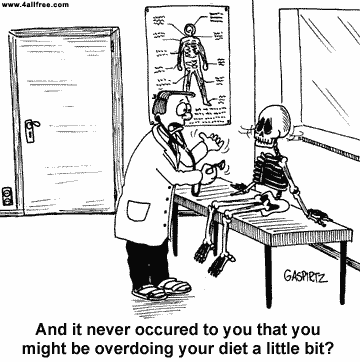
. the cartoon is hilarious

Moon Daisy profile image

Moon Daisy  says:
12 months ago

Very nice hub. It's a bit of a minefield isn't it? But I'm sure that this information will help a lot of people to understand what goes on in the mind of someone with an eating disorder.

sugar  says:
6 months ago

i totally agree with this article. My mom suffers from anorexia, and i have heard many people say these things. I have also seen how much it hurts to have someone make a comment like this. Is there a way to make them realize what they are saying, because sometimes, i don't even think they realize what they are saying or who they are sying it to.

allisonrenee  says:
4 months ago

what about saying

"just eat. its not THAT hard"

riiiiiiiiiiight.

people should do a little research before saying shit to someone with an ED. most of the time what you say will hinder and not help. be there to support NO MATTER WHAT. relapse is a part of recovery. its not as simple as eating more, or not sticking your finger down your throat. i know. i just started my recovery 3 weeks ago and its HELL. the ED voice screams to cover up the rational voice.

ITS NOT AN EATING DISORDER, ITS A MENTAL DISORDER ACCOMPANIED WITH DISORDERED EATING

JGelineau  says:
3 months ago

If you or someone you know struggles with an eating disorder, I stongly suggest the book "Life Without Ed." (Jenni Shaefer). It is writen by a woman who battled her eating disorder since the age of eleven and it does a great job giving advice (for those who have an eating disorder), and explaining how the mind of a person with an eating disorder works (for those that don't).

Great article Maddie! The general public seems to have a very unrealistic idea of what an eating disorder is and I believe that it's important to spread awareness of that.

Annie  says:
3 months ago

Instead of trying to figure out how to comment about the disorder or to 'manipulate' her into correct thinking....just reassure her by telling her you are concerned, you care about her, and want her to be happy and healthy. She needs a lot of contact and reassurance and though she will refute your positives, keep giving them unil they sink in.

Not Home Yet  says:
3 months ago

Thanks Maddie for your article. Our family has recently been effected be the horrible venom that ED spews. It has been a great heart break as a mom to watch my precious daughter go through the steps of recovery. So many people don't understand. Sometimes even I don't understand, but I continue to love my daughter and fight fiercely against the monster that wants to kill her.

wsp2469 profile image

wsp2469  says:
3 weeks ago

I know someone with an eating disorder. (I have a child with her.) She is strong and stubborn enough to deal with it. I'm proud of my "babymomma" but I have to say I don't think she needed Overeaters Anonymous; (although she does attend meetings and help others). I also don't think she needed or even believed in a lot of what I hear and read from others.

She reached a point in her life where she said she was going to do it. I argued with her that if she can argue with ME and be so stubborn about other things that she didn't need a 12-step program. I was right and she saw my point but chose to join OA because it was something in which she could get involved. From the stories I have heard from her what she most got out of it was examples of what she did NOT want to become and support. After going over a year without eating sugar she realizes SHE did it . . . not a group . . . and she did it regardless of what anyone said or did NOT say to her. I believe she found the answer within herself. . . where I told her it was all the time.

See? Even in the real world i have to set women straight about things!

(Look, a post without explicit sexual content OR nipples. Mind you, since she still lives in my house I guess I COULD have included that stuff, BUT, I digress . . . )

Sheila Wilson profile image

Sheila Wilson  says:
2 weeks ago

I love this hub. Thank you for an informative article. As a freelance writer, I've written a lot about anorexia for a client.. and hated it. Not because I feel it is a bad topic, but because I do not have anorexia, therefore I am limited to only reporting the facts. As someone with PTSD and depression, I would not expect others to know what those conditions are like unless they lived it. I felt horrible that I had to write several articles on "pro-ana," but because my client only cared that the keywords were in the articles, I wrote them very biased as moving towards recovery safely at one's own pace.

Submit a Comment

Members and Guests

Sign in or sign up and post using a hubpages account.


optional


  • No HTML is allowed in comments, but URLs will be hyperlinked
  • Comments are not for promoting your hubs or other sites

working