create your own

What is Atheism?

75
rate or flag this page

By fatfist


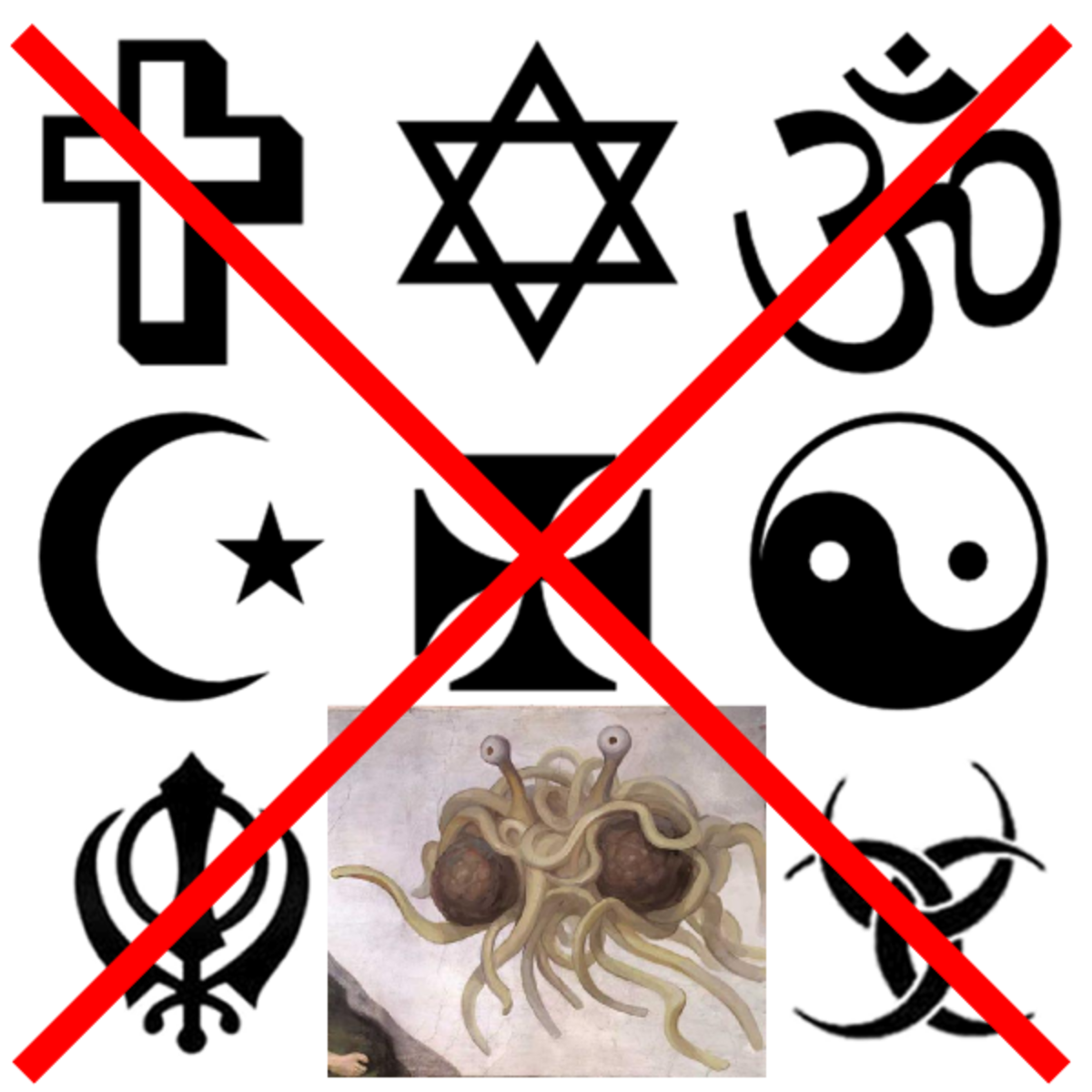
Atheism is an intellectual position or a conclusion that we arrive at; not a philosophy, not an ideology, not a religion, not a science, and definitely not the denial of a religion or a god.

Atheism is not a system of belief. Atheism is a CONCLUSION and a RESPONSE to theism. Theists initially proposed the blind idea and concept that “god exists”, and managed to convince many people to join their group. After consideration, many people believed this proposition to be true, and thus are known as what we call “theists”. While others believed the proposition to be false, and hence responded with what is known as “atheism” - a rational conclusion based on the objective belief that there is no god. Atheism is simply scepticism directed towards theistic claims; not Big Foot, ghosts, UFO’s, etc. Without theists, there couldn’t possibly be any atheists.

Atheism is not the “denial of god” or “being against god”, because in order to “deny” or be “against” the existence of a given object, one must assume the “existence” of that very object. Why? Because only meaningful cognitive propositions can be true; that is, they must denote something. And if they denote something, then that something exists either as an object or a concept. It is impossible to deny the existence of an object without getting involved in a contradiction, or possibly conceding that the assumed object must be a concept after all. Atheism has no set of prescribed rules or dogma of what is to be denied. How can atheism possibly deny or be against anything? Sure, there could be atheists that are against a religion, or deny a religion for whatever subjective reason they personally hold. But religion exists and people are free to deny or be against anything that exists. It’s impossible to deny or be against anything that is not shown to exist; like god.

There are no prescribed rules, ideology, doctrine, dogma, or absolute truth that atheists must adhere to. Philosophy and objective reason are actions one can take, with modern logic as a tool one can use, in order to reach the conclusion of atheism. But if you do arrive thru philosophy, reason, and logic to atheism, then you will arrive at a lot more things than simply atheism. You will arrive to a meaningful understanding of the reality in which we live in, and you will arrive to a rational system of thinking which explains our reality without resorting to magic, gods, demons, an afterlife, and absolutism. Philosophy and logic show us that there are only two kinds of possible truths: empirical and tautologous; that they are meaningful only within an already established system of truth; that truth only applies to a point in time; and that absolutism is an impossibility. So any claims falling outside this established and accepted system of truth can only be taken as belief. And human belief manifests itself in three forms: objective belief (reasoned), subjective belief (faith-based), and mythical belief (based on a story whose only evidence is the story itself). Theists don’t want to embrace these basic principles of modern logic and reason. Their doctrine rejects them in favour of a faith-based dogma of absolute truth; which is true for everyone, at all times, forever and ever amen!

Atheists and theists alike are known to wrongfully label atheism as a philosophy; implying a “noun” such as: an organization, a state of being, an ideology, a worldview, and even a religion. To the ancient Greeks, philosophy was a “verb”, an action, and not a thing. It was the action they took whenever they used doubt and question to explore and understand life and the world around them. When we question and doubt we are being philosophical. More than 2,300 years ago Aristotle said that the ability to doubt is rare, emerging only among cultivated, educated, and thinking persons.

Atheism is the positive position/conclusion that people hold to the question: “Do you believe that there is no god?” Atheists believe that there is no god. This is all that atheism is about and nothing else. Atheism posits that there is no god, which is a belief. Atheism proposes a godless cosmos, a belief; one that can be objectively justified far better than the blind belief that a god exists. Atheism and skepticism is a necessary aspect of the healthy human thought process; for to be human, is to think and question everything.

Wouldn't you agree that the sole issue of atheism is based on the initial claim that “god exists”? Outside of that claim and what we resolve, there are no qualities for atheists. Whereas, non-theism implies that you don’t know what a god is, and that you haven’t heard of the god concept. Non-theist is the default position when we are born; not atheist. If you believe Yahweh is a god and Allah is not a god, you are technically still an atheist about Allah. But non-theist means you have never been exposed to the concept of belief in any god. The negation of theism is non-theism; not atheism. Just like the negation of symmetrical is non-symmetrical; not asymmetrical - big difference!

Theist: A person who believes that the proposition, “god exists”, is true.
Atheist: A person who believes that the proposition, “god exists”, is false.
Non-theist: A person who does not understand or has never heard of the proposition, “god exists”. For consistency, objects and concepts also fall under the category of non-theist.

No one can prove they are an atheist and no one can prove they are a theist. Why? Because beliefs cannot be proven as we cannot read minds; only truths can be proven. Atheism can be and is best argued by way of inductive logic, which is an objective belief. But not thru an opinion or faith, which is a subjective belief. Only idiots will claim that: "It takes just as much faith to be atheist as it does to be a theist". People are entitled to their opinions, but there is no excuse for stupidity.

There are many irrational arguments for atheism, such as: "Aunt Gladys was raped by a priest so there cannot be a god", or "My parents said so", or “Evolution proves it”, or “I’m a Communist and therefore an atheist”. These are not logical reasons to come to the conclusion of atheism. Often we see as many logical fallacies used to defend atheism as we do defending theism. A common fallacious argument from theists is: “Stalin and Hitler were atheists, so atheism is based on hate and evil”. Stupidity is has no limits; it encompasses all of the irrational.

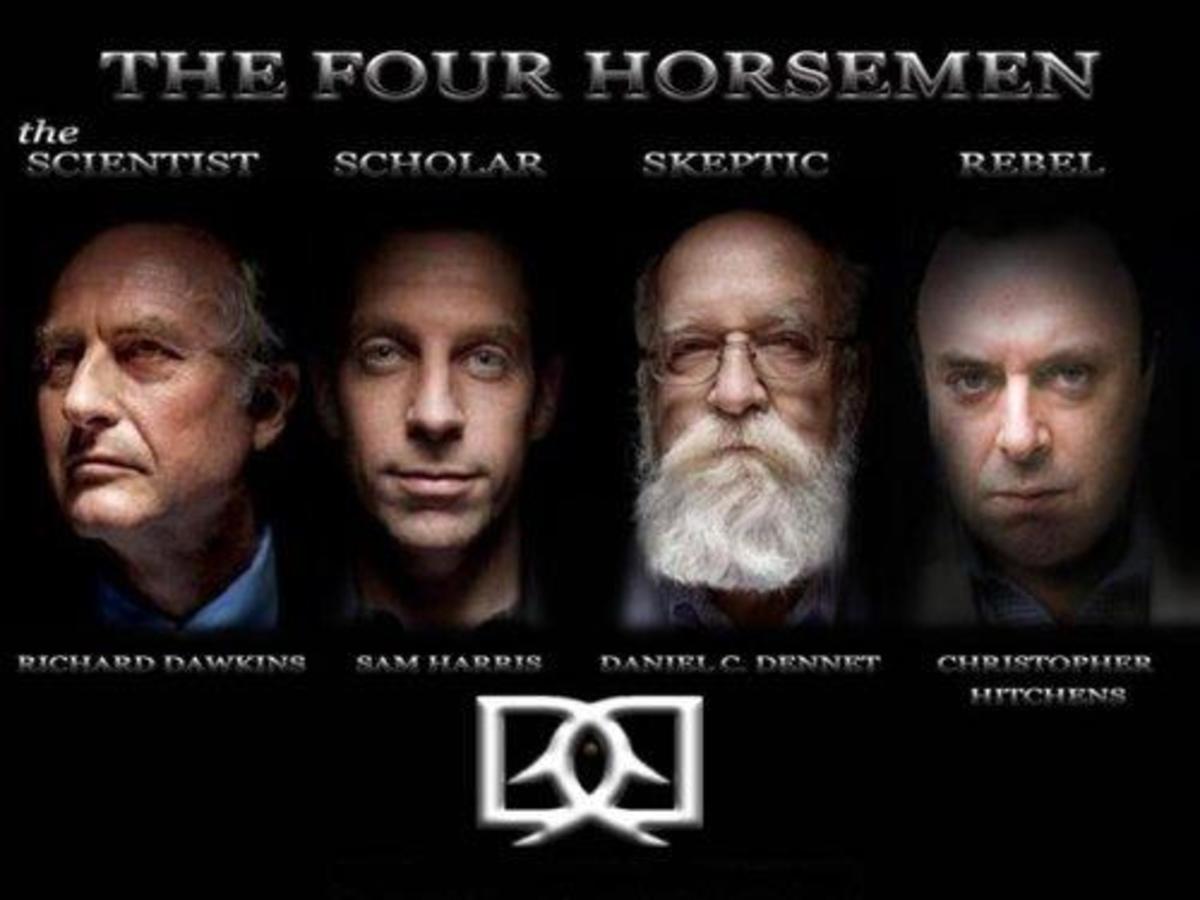
Even so-called “atheists” who claim that atheism is based on Science, Physics, Evolution, or based on some argument of a purported authority like Stephen Hawking, Albert Einstein, Richard Dawkins, etc. These people are not atheists. They couldn’t even rationally tell you what they are. They are probably anti-theists, who fall under the general category of “dumbasses” that use “atheism” as a label for self-promoting their ignorance. The word “atheism” itself does not necessarily result in good logic; only good logic results in atheism, as a positive position. And while some atheists may oppose theology, simply opposing theology is not a positive effort in the support of atheism. Many people confuse the two, but the only way to support atheism, is to be able to give logical and rational arguments that show why the atheistic conclusion is the most objective one.

Most people are raised by their parents believing in the existence of a particular god, so the very idea of abandoning this imaginary being is often frightening. It can be psychologically difficult to become an atheist due to the repetitive religious doctrine that was drilled into a person’s brain over many years. There are often strong family and social pressures against questioning ones religious beliefs, and believers usually represent atheists as inherently sinful and amoral. Most people who become atheists do so thru their own thinking and investigation. They see atheism as an understanding and appreciation of the universe as it truly is, rather than how some 2000-year-old simple-minded tribesmen who didn’t know what they were talking about, fantasized it to be. Are we supposed to believe the purported eyewitness accounts of some simpleton ignoramus village people from thousands of years ago, written in a book with countless contradictions, falsehoods and revisions? Think about it!

The following is an analogy that clearly captures the essence of the different positions of belief that people can possess regarding the existence of god:

Imagine you preach to somebody about a special box you have, which has the word GOD marked on the outside.

· Theists will believe there is something in the box.

· Atheists will believe the box is empty.

· Agnostics claim they are not sure what to believe either way; but when questioned further, they are indeed atheists.

· Non-theists don’t understand what you are talking about; they look at you funny, and believe that the box and its contents are part of your imagination.

DON'T PARROT, JUST EXPLAIN

In conclusion, I would like to welcome all those intellectually dishonest people (and you know who you are) who claim that atheism is a RELIGION or that atheism is FAITH-BASED; and have them post their rational explanations in the comments section below. Please, hit me with your best explanations to support your position.

Print   —   Rate it:  up  down  flag this hub

Comments

RSS for comments on this Hub

Dgerrimea profile image

Dgerrimea  says:
4 weeks ago

Good hub! But you still seem to lack an awareness that your particular definitions are not the only ones out there. Otherwise very enjoyable.

fatfist profile image

fatfist  says:
4 weeks ago

Thanks for the comment Dgerrimea.

If anything written in this hub is irrational, then please explain why in a logical manner. I don't try to make any particular definitions that are my "own", or that represent my "subjective opinion" on these matters.

In order to understand what atheism really is, we need to understand the following:

- the difference between ancient atheism (based on rejection and hatred of assumed gods) and modern atheism (based on logic and reason)

- why atheism is a belief, and not a truth, and not a lack of belief, and not a rejection of a god or gods

- the rationality and logic behind the positive position of atheism

This hub illustrates a rational analysis of what atheism is. Yes there are many definitions of atheism out there. I am not trying to compete with any definition for atheism. I am trying to bring to the table a "rational" argument for atheism. And this argument isn't my own; many such arguments have been floating around by philosophers for at least 100 years.

I am not the type of person to mention any names or give references to something that supports my argument. Such arguments are simply fallacious because it is a special pleading to an authority. There are NO authorities. There is no objective right or wrong way. There is only rational and irrational.

I have no desire to blindly follow what is accepted and what is popular. If that was my goal then I would be a theist.

There will be more hubs to follow that illustrate the logic and rationality of why atheism concludes what it does.

qwark profile image

qwark  says:
4 weeks ago

Hi Fatfist:

Excellent "hub." Well written and composed. Seriously, What is this god thing you write about?

Qwark

fatfist profile image

fatfist  says:
4 weeks ago

"Seriously, What is this god thing you write about?"

LOL

I wish I knew. If there is a single person on this planet that can answer this question, then there would be no Christianity, Islam, Judaism, Hinduism, Buddhism, or any other religion. And there would certainly be no atheistic response from me. I'll take up bowling instead :-)

qwark profile image

qwark  says:
4 weeks ago

Hi Fatfist;

Exactly! Ty.

I have written extensively on the "subject" atheism and theism.

Unless one can define this "god" thing factually, it can only exist as being an abstract concept. It is imagined, just as all of man's gods have been since he created them.

When I discuss "atheism" and "theism" with folks, my comment is that neither exist.

This god thing is unknowable, undefinable, incorporeal and supernatural. It can exist only in the fecund mind of an infant evolving species:..man!

To my way of thinking, those who deny or accept the god concept should be referred to as: "atheistconceptists," or "theistconceptists."

For too may years I considered myself to be a "strong atheist." I finally understood that I cannot deny that which cannot be defined and exists only as conjecture. I can only deny the "guess."

Thanks for the thoughful "hub."

Keep writing.

Qwark

fatfist profile image

fatfist  says:
4 weeks ago

Qwark,

(Unless one can define this "god" thing factually, it can only exist as being an abstract concept.)

Yes, an abstract concept which is based on the consideration of necessity vs contingency. The confusion over what is contingent and what is necessary is where almost all theistic arguments fail. To say that god is necessary is to say that god is a logical necessity; a metaphysical object (abstract concept). So theists are indeed correct to say that god exists and god is not physical. But they haven’t a clue why they are correct or what they are correct about. The only things that can be shown to exist and not be physical are metaphysical objects, which are abstract concepts stemming from the mind – like “2 + 2 = 4”. These are tautologies, and are necessarily true (assumed true), irrespective of the facts. That the earth is spherical is contingent on the facts.

(When I discuss "atheism" and "theism" with folks, my comment is that neither exist.)

Well, that’s a little extreme, but I understand your frustration as you’re not the only one. It’s quite obvious that theists exist, but they can’t produce a single truth statement about their dogma. And of course atheists exist to respond to the theistic wild assertions. But really, when races stop existing, so will racists. When gender stops existing, so will feminists and male-ists. And when theism goes away, atheism is dead!

(This god thing is unknowable, undefinable, incorporeal and supernatural.)

Aha! Did you notice the choice of words you used? The same words theists use to describe god. This is called NEGATIVE THEISM, as the supposed definition of god, is not really a definition. In fact, it’s nothing. The only way to define something that can be consistently used in an academic and rational exchange, is by using POSITIVE PREDICATION. That is, we have to say what god IS; not what god ISN’T. “I am not a car” is true about what I am not, and true about every single thing in the universe is not (except for a car). But it’s NOT true about what I AM – and that is exactly where theism fails as a logical and rational position.

(To my way of thinking, those who deny or accept the god concept should be referred to as: "atheistconceptists," or "theistconceptists.")

Well to “deny” something, is to implicitly assert that it exists. If it didn’t exist you wouldn’t deny it or be against it; you would “respond” POSITIVELY to its “claims of existence”. And that is what atheism is. As you can see, not everyone who claims to be an atheist, actually is one. Many of them “deny” god, or are “without” god, or “lack a belief” in god – this is NEGATIVE ATHEISM, and is no different than Negative Theism – same stupidity! These idiots don’t even realize that their contextual position of denial or negation actually presupposes that god exists. This is why theists often claim that atheism is a religion. Taken from this idiotic point of view, it is a religion! Like I said, stupidity does not discriminate.

(strong atheist, weak atheist, strong agnostic, weak agnostic, etc.)

Well, don’t even get me started on these idiotic terms either.

Thanks for your responses and intellectual conversation.

qwark profile image

qwark  says:
4 weeks ago

Hi Fatfist:

My goodness! You actually spent time dissectng and commenting on salient facets of my "hub!"...thank you!

There is little I disagree with in what you write.

In what other manner can one exemplify whatever this word god means except "nothingness?

As the sophistication of Homo/sapiens increased and his conjured supernatural entities could be explained away, his "gods" followed suit to the point of becoming abstract and inexplicable. Their creation continued to be the result of infantile fear, superstition and ignorance and it exists thus today.

I do disagree with you on this point: After many years of study and thoughtful deliberation, I have determined that I cannot deny or accept that which can only be defined by opinion or conjecture. It has no reality. I can only deny or accept the idea or concept. Since theism and atheism are naught but concepts based 100% on opinion and not fact they are but imagined and vary in definition in myriad ways.

Let me put it another way, If empirically proved something becomes credible and "reality" and I can deny or accept it. If something exists as nothing but hypothesis or theory it can only be imagined and cannot, yet, be considered to be credible.

As a logician and pragmatist god exists only as a "word" and has no potential for credibility....ergo I can't consider it in ref to the subjects of acceptance or denial.

Until such time the word god expresses itself in some form of empirical reality, it can only exist in the minds of the lesser evolved human creature.

I cannot be an atheist, as it is defined, because i cannot deny nothing.

your remarks are appreciated they inspire "thought" which is exercise for the mind.

Keep writing.

Qwark

fatfist profile image

fatfist  says:
4 weeks ago

Qwark:

(In what other manner can one exemplify whatever this word god means except "nothingness?)

Yes. That fact of the matter is that by using negative terms to define god, the definition doesn’t even make it abstract concept. It only makes it nothing.

(Since theism and atheism are naught but concepts based 100% on opinion and not fact they are but imagined and vary in definition in myriad ways.)

Well here’s the difference: theism isn’t the only idea brought forth that is based on opinion and not fact. There are tons: alien abductions, ghosts, big foot, lochness monster, fairies, angels, psychics, telekinesis, homeopathy, etc. What happens when nobody responds to these claims? Well, more and more people are brainwashed to believe this nonsense. Human beings just need the slightest hint to believe anything – we are all genetically wired this way. I hope many of us have reasoning abilities to think things thru before accepting claims at face value. This is why sceptics like James Randi and Michael Shermer have been responding to this nonsense for decades. Atheism is the same – it’s a response to these claims, nothing more! Your negative view of the word atheism stems from all the popular nonsensical and religious definitions of the term. This circus of garbage and nonsense annoys me too. Hopefully the reasoning in my arguments will wake up some people and get them to see that theism is a CLAIM (just like big foot) and atheism is just a RESPONSE. Only logic and reason can possibly define terms – not people’s opinions. This is why my rational explanation of atheism pisses off all those so-called atheists who are parroting the same mistakes as authorities like Christopher Hitchens, Richard Dawkins, etc. In case you didn’t notice, I am not here to win popularity votes or hub scores.

(If empirically proved something becomes credible and "reality" and I can deny or accept it.)

Human reality has 2 types of truths. Empirical truths, which are facts. And tautologous truths which are axiomatic concepts. That 2+2=4 is a tautologous truth – not empirical and not a fact. It is true via axiomatic necessity irrespective of any facts. Theists have defined god to be an axiomatic necessity. The fact that the word GOD exists without an empirical truth, proves that it is a concept. The way we can prove that something exists is by showing 1 truth statement about it. The only truth we can show about god is in concept form – it’s existence as an abstract concept. Hence god does exist as a concept in people’s mind. If anybody claims otherwise, then they should be able to produce a truth statement to prove their claims. Nobody has been able to do so.

Thanks :-)

qwark profile image

qwark  says:
4 weeks ago

Hey FAtfist;

lol ..is that a picture of you or Robert Shaw from the movie "Jaws."

I'm trying to figure out how your use of the word "tautology' fits here. I've always used it to define repetition. I can't fit it in to any definition of "truths."

Other than that, I find no objection to anything you purport.

Man is an easily led "beast" at this stage of his tortuous evolution.

Read some of "ColdWarBAby's stuff." He is a "thinker" and expresses himself well.

Thanks for responding thoughtfully.

Qwark

fatfist profile image

fatfist  says:
4 weeks ago

Qwark:

Yeah that’s Quint from Jaws.

(I'm trying to figure out how your use of the word "tautology' fits here. I've always used it to define repetition. I can't fit it in to any definition of "truths." )

Look in Wikipedia, this is one of the rare instances where Wiki has it exactly right. There are 2 definitions. One is tautology as rhetoric, which is the repetition you are referring to. The other is tautology as logic/conceptual truth.

A tautology is a proposition that is always true under any possible valuation. Why? Because it is assumed to be an axiomatic necessity in any formal system - like formal logic (classical), or mathematics, for example.

Consider the following scenario: There are 9 planets in the solar system. We know that “9 > 5” is a necessary truth. Does this mean that it is necessary that there are greater than 5 planets in the solar system? No! The key is that “9 >5” is necessarily true, and that there are 9 planets is an empirical truth, contingent on the facts, and not a necessary truth, like “9 > 5” which is true by the inherent necessity of mathematical axioms. Tautologies show the existence of what is necessary – like the god concept as discussed before. All logical necessities are limited to our mind, they only exist as conceptual thoughts. They can only be used to show thoughts exist, not empirical things or anything outside of thought itself.

Tautology is a term used by Wittgenstein and means the same thing as the term “a priori”, used by Kant.

I will check out ColdWarBAby. Thanks.

qwark profile image

qwark  says:
4 weeks ago

Fatfist:

I will definitely look it up.

I have used the "repetition" connotation often. This new "definition" is interesting.

I have 2 graduate degrees. I love "words." Of course language is forever evolving that's what makes it so attractive to me.

I will read more of your stuff to decide if I'd like to become a fan.

Thanks.

Qwark

fatfist profile image

fatfist  says:
4 weeks ago

(I will read more of your stuff to decide if I'd like to become a fan.)

Like I said before, I'm not here to get fans, scores, accolades, or popularity. Hopefully I can open some eyelids and get people to read and think for themselves, instead of having others to think for them. That's the best I can hope to accomplish.

And for the idiots who claim that atheism is a religion or that it takes faith to be an atheist: I hope they have the guts to bring their arguments here and discuss them in a rational manner. I'd like them to HIT me with the BEST rational explanations they've got! I don't get offended; only enlightened, and hopefully they can teach me a thing or two of what they parrot.

I don't think they will tho. They just sit in their little hubs and use arguments that appeal to emotion and appeal to authority to draw in "fans". When asked to defend their "wild claims", all they do is whine about how they were insulted by being asked to "explain" themselves. How can we expect to take anything these clowns say seriously?

Thanks for your comments

qwark profile image

qwark  says:
4 weeks ago

Fatfist:

You write well and, to my way of thinking, honestly.

I have no aptitude for the quantitative. My strength lies in the qualitative.

I read the biography of Wittgenstein and tried to follow his quantitatively explained examples concerning philosophy. It was way beyond my ability to grasp.

My "Masters" work was in the field of psychology. To be specific "clinical psychology" and another in "Guidance and Counselling."

Rationality/religious belief? The acme of the definition of "oxymoron."

We both know that rationality, pragmatism, logic and reason are the antithesis of that which religions are founded upon.

I consider monotheists to be primitives existing at the lowest level of human evolution.

It is likely that "religion" will be the perpetrator of a massive diminution of life on this planet....and not in the too distant future.

I look forward to reading your "hubs."

Qwark

Submit a Comment

Members and Guests

Sign in or sign up and post using a hubpages account.


optional


  • No HTML is allowed in comments, but URLs will be hyperlinked
  • Comments are not for promoting your hubs or other sites

working