- HubPages»
- Education and Science»
- History & Archaeology»
- History of the Modern Era»
- Twentieth Century History
World War 1 Gallipoli WWI


Gallipoli 1916
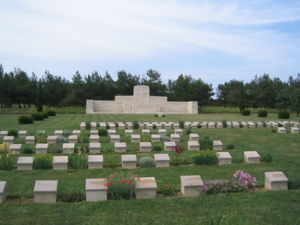
The Commonwealth War Graves near Sulva Bay
The ANZAC Memorial in Sydney

Gallipoli
On 19th February 1915, British naval ships attacked Turkish forts at the Dardanelles; they started with a long-range bombardment followed by heavy fire at closer range. This forced the Turks to retreat from the outer forts, allowing minesweepers to clear six miles into the straits.
The ships were then forced to retreat when they came under heavy fire from the Turkish forts, which were out of range of the British guns.
On 18th March eighteen battleships entered the straits fifteen from Britain and three from France, they were making good progress until the French ship Bouvet struck a mine and sunk,
Soon after two British ships also hit mines, the Irresistible and Ocean both sunk with the loss of 700 souls. Three ships were sunk, another three were severely damaged, and once again, the allies were forced to retreat.
Vice-Admiral Sir John de Robeck informed Winston Churchill that to take the Gallipoli peninsula he would need the help of the army, General Ian Hamilton, commander of the troops on the Greek island of Lemnos, who had watched the failed naval operation, agreed and plans were now made for full-scale landings at Gallipoli.
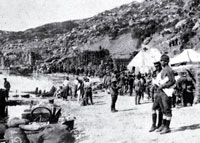
On the 25th April 1915 the assault began, at Helles and Gaba Tepe, beachheads were established. On august the 6th another landing was made on Sulva Bay.
By the end of August, the Allies had lost over 40,000 men. General Ian Hamilton asked for 95,000 more men, but although supported by Winston Churchill, Kitchener was unwilling to send more troops to the area.
On 14th October, Hamilton was replaced with General Munro who after visiting the three beachheads recommended that the troops be withdrawn, two weeks later Lord Kitchener arrived and agreed with Munro's decision, The operation began at Sulva Bay on 7th December. The last of the men left Helles on 9th January 1916.
About 480,000 Allied troops took part in the Gallipoli campaign. The British had 205,000 casualties (43,000 killed). There were more than 33,600 ANZAC casualties (8,700 killed) and 47,000 French casualties (5,000 killed). Turkish casualties are estimated at 250,000 (65,000 killed).
Australian and New Zealand Army Corps
Anzac day:
The Gallipoli campaign marked the first time that Australians went into combat as Australians. The term ‘ANZAC' originated from that time and ANZAC Day, arguably Australia's most significant national holiday, occurs annually on 25th April, the date of the start of the Gallipoli campaign.