Writer's Market: A Freelance Writer's Best Resource for Places to Submit Writing

Writer's Market is the Bible for writers, particularly freelance writers. A 1,000+ page tome, it comes out once a year with thousands of listings for book publishers, consumer magazines, trade journals, and literary agents, and limited listings for newspapers, screenwriting, playwriting, greeting cards, and contests/awards. In addition to the listings, this anthology includes informational articles on freelance writing, professional writers' views on writing, a list of professional writing organizations, and a glossary of freelancing terms.
The newest version is the 2018 Writer's Market. Each year it is updated to reflect the most current (as of the book's publication date, of course) information on the magazines, publishing houses, etc.
To give you an idea of the types of articles included, here is a sample of the informational articles and writers' essays that have been included in past Writer's Market editions:
- Before Your First Sale
- Query Letter Clinic
- Perfect Pitch: Pitches that Never Fail, by Mark Acito
- Landing the Six-Figure Deal, by SJ Hodges
- How to Find Success in the Magazine World, by Kerrie Flanagan
- Earn a Full-Time Income from Blogging, by Carol Tice
- Finding Freelance Opportunities Online, by Carol Tice
- Reprints and Reslants, by Sue Bradford Edwards
- Funds for Writers 101, by C. Hope Clark
- Ghost Writing 101, by Eva Shaw
- Self Publishing Checklist
- The Writing Entrepreneur, by J.M. Lacey
- Contracts 101, by Cindy Ferraino
- Recordkeeping 101, by Joanne E. McFadden
- Making the Most of the Money You Earn, by Sage Cohen
- Repurposing Writing for Platform and Profit, by Sage Cohen
- Should Your Business be an LLC?, by Carol Topp, CPA
- How Much Should I Charge?, by Lynn Wasnak
- several articles under the heading Promoting Work, such as Balancing Your Writing and Your Platform, How to Launch an Author Website, How to Get Social, How to Improve Your Presentation Skills, and The Art of Promoting
Of course, Writer's Market is not the only resource for freelance writers. There are plenty of great freelance writing websites out there, and most specific publications have lots of information online or in their magazine that will help you land an article with them.
The Anatomy of a Magazine Listing
Here is a brief guide on how to dissect and understand individual listings in Writer's Market.
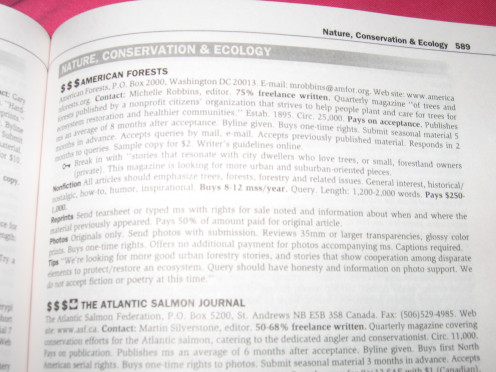
I'll use the listing below as a sample to help explain what each element means.
NATURE, CONSERVATION, AND ECOLOGY: This is the category for the subsequent listings. As you can see, this particular category is for magazines with an environmental focus.
$$$ AMERICAN FORESTS: This is the heading, which includes the initial icon and title. There is an explanation at the beginning of the book of all the icons, of which I have included a picture above. This particular icon ($$$) indicates that this magazine pays pretty well, the third highest out of four according to the Writer's Market pay scale. The words "American Forests" are, of course, the title of the magazine.
Address, email address, website, Contact : This is self-explanatory, I'm sure, but just in case: this is contact info for the magazine. The email address is for the contact person listed. The name listed after "Contact" is the editor that deals with queries and submissions, the name that you should address any letters or emails to.
75% freelance written: Every listing gives you an idea of the publication ratio of freelance-written material to commissioned material. This magazine has a high percentage of freelance material, so you have more of a shot here than a magazine that only accepts one or two freelance articles per issue.
Description, Estab., Circ.: The next element in a listing is the description of the magazine. It describes how often it's published (this one is quarterly) andt the magazine is about. This listing is pretty specific; not all are quite so much. It describes the magazine as "of trees and forests published by a nonprofit citizens' organization that strives to give people plant and care for trees for ecosystem restoration and healthier communities." Hence, if you are a supporter of lumberjacking, this isn't the magazine for you. The listing then tells what year it was established, in this case 1895, and its circulation (approximately how many people read it, in this case 25,000).
Pays on acceptance: This handy little bold-faced sentence tells you when you get paid if they agree to publish you.
Publishing Information
This next part of the dissection might be easier to follow if I use footnotes. The next chunk reads as follows:
Publishes in an average of 8 months after acceptance.1 Byline given.2 Buys one-time rights.3 Submit seasonal material 5 months in advance. Accepts queries by mail, e-mail. Accepts previously published material.4 Responds in 2 months to queries.5 Sample copy for $2. Writer's guidelines online.6
- The amount of time between when they accept your article and when it appears in print.
- Whether or not you get a little bio of yourself in the magazine (called a byline)
- The type of rights they buy for your article. The different types of rights are described in the beginning of the book.
- The most basic requirements for submissions that you must follow to even be considered. Deadlines for certain types of articles and how to submit.
- How long it usually takes them to respond to your query. Most magazines will let you know even if you've been rejected.
- Price for a sample copy of the magazine and how to get guidelines for submission.
If you want to get published...
Key Tips: The key symbol is not in every listing, but you should pay attention if it is. The section includes a tip directly from the editor's mouth for how to break into their market if you're new to freelancing.
Nonfiction: This describes the types of nonfiction the magazine prefers. In this case, "all articles should emphasize trees, forests, forestry, and related issues." Many magazines also accept fiction; this one does not.
Buys 8-12 mss/year: "Mss" stands for manuscripts, basically meaning articles. This section tells how many freelance manuscripts they buy each year.
Query: This section explains the way they prefer to be queried. This magazine doesn't appear to be too strict. Some require published clips.
Length: 1,200-2,000 words: This tells you about how long a submission should be.
Pays $250-1000: Obviously, this tells you how much they pay. Not all listings specify an exact amount.
Reprints: This section explains their rules and specifications if you are submitting an article that has already been published somewhere else.
Photos: This explains their requirements and preferences about submitting photos, with or without a written article.
Tips: Tips straight from the editor's mouth on how to get published in his/her magazine. This is pure gold. Read it carefully.