All about Breast Feeding - Myths & Facts with videos


Breastfeeding is Always Best
Learn all about breastfeeding
- Breastfeeding allows you and your baby to get closer and to bond easily.
- Babies need only breastmilk for the first 6 months of their lives - No water, no solids, no juices or other fluids
- If you breastfeed your baby for just one day you can improve his future wellbeing and if you continue for a month this can be for up to 14 years? Research has shown that if you breastfeed for just one day it makes a difference by protecting babies gut, providing antibodies against disease and balancing blood sugar.
8 Conditions that Breastfeeding Protects Your Baby Against
- Asthma
- Chest Infections
- Childhood Diabetes
- Ear Infections
- Eczema
- Gastro-intestinal Infection
- Obesity
- Urinary Infections
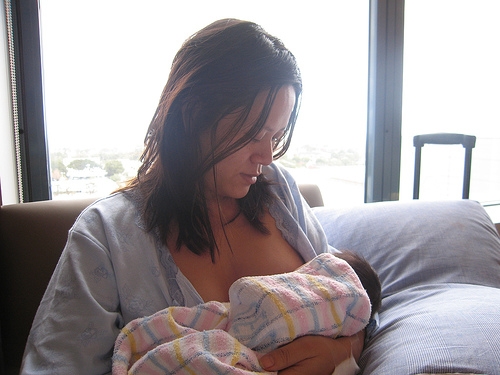
In the UK the National Childbirth Trust (NCT) is promoting taking one day at a time because every feed makes a positive difference to both infant and mother. This is because the UK has one of the lowest rates of breastfeeding in Europe.


Lack of Support and Knowledge
Lack of knowledge and support can put many mothers off breastfeeding as there are a myriad of myths surrounding this most natural event.
10 Breastfeeding Myths
- Myth 1 - Not enough milk
Fact: Supply and demand is the rule of thumb. Most women can produce much more milk than they need. The more often you feed, the more milk you produce. If your baby is not gaining weight quickly enough it is probably not because you don't have enough milk. It could be that baby is not able to get the milk due to not being latched on properly to the breast. Also if you are nervous or anxious the milk will not be let down. So make sure the baby has latched on well and that you are relaxed.
- Myth 2 - Breastfeeding always hurts
Fact: You can expect a little tenderness in the early days due to breast fullness but this should only be temporary. The main cause of pain is again the baby not latching on properly. If you have nipple pain which has not improved after 4 days should be reported to your health professional and could be caused by a yeast infection. Please note that reducing feeding duration does not prevent soreness.
- Myth 3 - There is no milk during the first 3 days after birth and baby will need formula.
Fact: Mother's first milk is called colostrum and is rich in nutrients and antibodies which fight infection. It is a thick yellow substance produced in late pregnancy and the first few days after giving birth. Colostrum alone is sufficient for the needs of the infant and he does not need any additional supplementary feeds. Once again if the baby is not latched on properly he will be unable to get this and may seem hungry. After the first 3 or 4 days the proper milk comes in and provided you get baby properly onto the breast there should be no problems.
- Myth 4 - A baby should be at the breast 10 minutes on each side.
Fact: There is no hard and fast rule as to how long to feed on each side. It is purely choice whether to feed from both breasts at each feed or whether to alternate.
- Myth 5 - My Milk is too Weak and Watery
Fact: Breastmilk does not look like ordinary cows milk. It is thinner and bluish in colour; this does not mean that it is weak. In fact it is more nutrient and antibody rich than even the richest of cow's milk.
- Myth 6 - A breastfeeding baby needs extra water in hot weather.
Fact: Breastmilk contains all the water a baby needs.
- Myth 7 - A mother should wash her nipples each time before feeding the baby.
Fact: Breastmilk protects against infection; excess washing will only remove the protective oils from the nipples and make soreness more likely. Obviously normal hygiene rules apply - regular baths and showers.
- Myth 8 - Pumping is a good way of knowing how much milk the mother has.
Fact: This probably the worst indicator of how much milk you have. If you are focussing on how much milk you can get out of your breast you are likely to be stressed and this can affect milk flow. You do not need to worry about the volume of milk you are producing if baby is content and gaining weight.
- Myth 9 - If the mother has an infection she should stop breastfeeding.
Fact: There are very few infections that would require cessation of breastfeeding. What you need to remember is that if you have an infection you have probably already passed it to the baby because it will have been incubating for several days. Baby will be protected by breastfeeding therefore you should continue. few exceptions, the baby will be protected by the mother's continuing to breastfeed. At this moment in time AIDS is about the only condition a mother would be advised not to breastfeed with.
- Myth 10 - Breastfeeding babies need extra vitamin D.
Fact: Unless the mother is exceptionally undernourished herself baby will have built up a store of Vitamin D in the womb. If baby is exposed to the outdoors regularly she will get all the vitamin D she needs.
10 More Breastfeeding Myths
- Myth 11 - Breastmilk does not contain enough iron for the baby's needs.
Fact: Breastmilk is marvellous, it is designed to contain just enough iron for at least the first 6 months of baby's life. Formula often contains too much iron for his needs
- Myth 12 - Breastfeeding is too expensive because of the equipment you need
Fact: Breastfeeding is FREE. Pumps and special equipment are not essential.13
- Myth 13 - It is easier to bottle feed than to breastfeed.
Fact: Provided a mother gets proper instruction in hospital or by her midwife or health professional this should not be true. With breastfeeding there is no sterilizing, warming, washing and scouring of bottles. The only real problem is that your husband or partner can't do it for without you expressing the milk first.
- Myth 14 - Breastfeeding ties the mother down.
Fact: You can feed your baby anywhere without any special equipment.
- Myth 15 - There is no way to know how much breastmilk the baby is getting.
Fact: Why would you want to? As long as baby is drinking at the breast at regular intervals and seems satisfied and gaining weight she is getting enough so there is no need to know exactly how much she is taking. Another good indicator is the amount of wet and soiled nappies/diapers. You can expect 6 - 8 wet and 2 soiled per day.
- Myth 16 - Modern formulas are identical to breastmilk.
Fact: Formulas contain no hormones,antibodies, living cells, or enzymes. They contain much more aluminium, manganese, cadmium and iron than breastmilk. They contain significantly more protein than breastmilk. Breastmilk varies from the beginning to the end of the feed, from woman to woman, from the age of the baby. It is a unique substance and can never be recreated exactly. Your baby may grow quicker on formula but will not necessarily be any healthier.
- Myth 17 - If the baby has diarrhoea or vomiting, the mother should stop breastfeeding.
Fact: Breastmilk is the best thing for baby at this time. If baby is partially weaned stop all other foods for a while but continue with the breastmilk. Your health professional will advise on this. Oral rehydration solutions should not be needed if baby can be persuaded to suckle
- Myth 18 - There's no point in continuing breastfeeding if I'm using formula.
Fact: Mixed feeding still provides some protection from infection for babies of under 6 months
- Myth 19 - Once solids are introduced there is no point in continuing breastfeeding
Fact: Breastfeeding is still beneficial to baby
- Myth 20 - If f the baby does not feed for a more than a day the milk will be sour and breastfeeding should be stopped
Fact: Breastmilk does not go sour in the breast; it is always fresh.

It's Good for Mum too
It reduces the risk of breast and ovarian cancer and osteoporosis
- It can help with wieght loss after the birth
- It can help with bonding between mother and baby
- It is calming and has a sedative effect on mum
- It reduces post-partum blood loss and can stop anaemia developing
- It can save up to £800 per year

How to Breastfeed
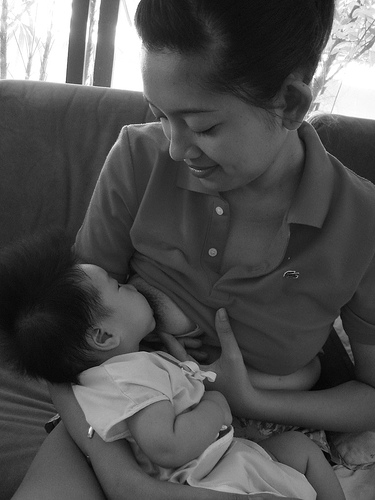
It doesn't really matter how you sit or lie as long as you are comfortable but some mothers find it helpful to use a horshoe shaped pillow which fits around your waist. It provides a comfortable armrest whilst you are feeding your baby.
In order to get baby to latch on to your nipple properly make sure baby's whole body is facing towards you. Put one hand under his bottom and support his head in the crook of your elbow in a slightly tipped back position. Support your breast underneath with the other hand. Brush baby's bottom lip against your nipple and he will open his mouth wide. Immediately pull the baby in quickly so that his mouth attaches to the dark part around the nipple (areola) rather than just the end of the nipple. The more of the areola you get in his mouth the less likelihood there will be of sore nipple problems
To make sure that each breast is being used you can start each feed with the breast you ended with at the previous feed although this isn't completely necessary. Some mothers feed only from one breast and start on the opposite on at the next feed.
BREASTFEEDING PROBLEMS
Cracked Nipples
- Let the nipples dry naturally in the open air if possible. Applying breast milk to the dry nipple can speed up healing.
- Calendula cream (made from Marigolds) is good for cracked nipples - Apply to dried nipples and wash off before feeding baby
- Sweet almond oil and Olive oil can be used too but need to be removed before the next feed.
Mastitis
Mastitis usually affects only one breast and the symptoms can develop quickly.
Symptoms of mastitis include:
- the appearance of a red area on part of your breast that may feel hot and painful to touch,
- the breast can then start to appear lumpy and red, and
- a burning pain in the breast, that may be continuous or only occur when you are breastfeeding.
Some women will also experience flu-like symptoms such as:
- aches and pains
- fever
- shivering and chills
- fatigue
- feeling anxious or stressed
- a general sense of feeling unwell
You do not need to stop breastfeeding if you have mastitis.
- Try to massage the lumpy area towards your nipple as you breastfeed.
- You can also place warm flannel over the breast to encourage blood flow to the area.
- An old remedy is to place a cabbage leaf in your bra - this actually does work but can get a bit smelly as the leaf heats up.
- Check that your nursing bra fits properly, if it's too constricting around the breast this can cause duct blockages.
Engorgement
- Breastfeed frequently
- Bathe breasts with warm water and express a little milk before you start feeding otherwise baby may gag or be unable to latch on.

Additional Interesting Facts about Breast Feeding
- During the last decade, much research has been carried out across Europe into lessening the risk of dying of any kind of cancer. It was found that breastfeeding for six months can cut the risk for mums by at least 10%.
- Breastfeeding cuts your risk of having a heart attack by 17%
- 93% of mums wean their babies too early. 6 months is the recommended age for introducing solids. If you wean your baby too early it can increase their risk of developing diabetes, coeliac disease and obesity.
Breastfeeding Organizations US
Breastfeeding Organisations UK
Useful UK Websites
Useful US Websites
- Sue Bailey, Writing and Editing
Sue Bailey, Writing and Editing: The authoritative source of Sue Bailey's personal information, links, and social activity.
© Susan Bailey 2009 All Rights Reserved