Greek Philosopher: Heraclitus

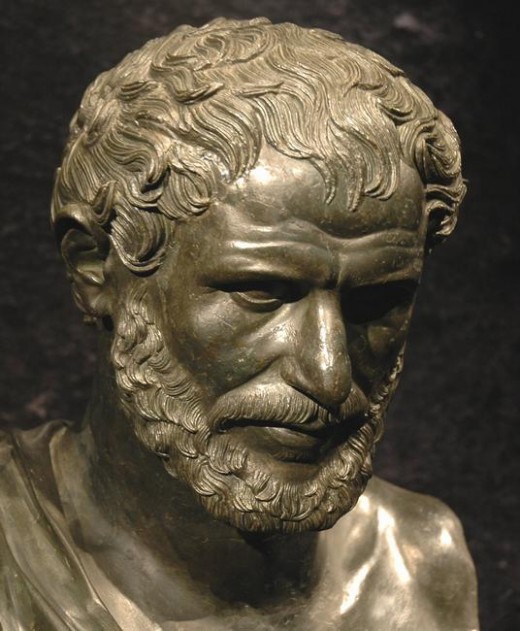
Heraclitus
Heraclitus was an early famous Greek philosopher, and a leading member of the so-called pre-Socratics.
He was a descendant of the royal line of his native city and it is probably that he help temporal and religious powers commensurate with his rank, It seems likely, however, from Heraclitus' attachs upon the mysteries and the sacrifices, that he renounced his priestly privileges.He wrote numerous works on religion and politics. In 'Concerning Nature' (513 BC) he maintained as a principal doctrine, that all things were in a state of flux and that fire, the type of this constant change, was their origin.His melancholy views on the changing character of life led to his being known as the 'weeping philosopher'.He was born and died in Ephesus of Asia Minor.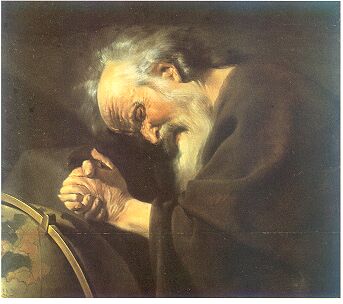
540 - 475 BC
Few philosophies have exerted a more powerful influence than has that of Heraclitus. His speculatiopns upon the cosmos, the processes of events in the cosmos, the theory of perpetual change, and the conception of law which governs change have an enormous instrinsic value and as powerful an effect upon history as had any philosophy of which we have record.
Because of the loneliness of his life and the obscurity and misanthropy of his philosophy, he was called the "dark philosopher" or "weeping philosopher".Heraclitus was in a sense one of the founders of Greek metaphysics, although his ideas stem from those of the Ionian School of Greek philosophy. He postulated fire as a primal substance or principle that, through condensation and rarefaction, creates the phenomena of the sensible world. Heraclitus added to the "being" of his predecessors the concept of "becoming" or flux, which he took to be a basic reality underlying all things, even the most apparently stable.In ethics, he introduced a new social emphasis, holding virtue to consist in subordination of the individual to the laws of the a universal, reasonable harmony.Although his thought was strongly tinged with elements of a popular theology, he attacked the concepts and ceremonies of the popular religion of his day.Quotes by Heraclitus
"Abundance of knowledge does not teach men to be wise."
"It is better to hide ignorance, but it is hard to do this when we relax over wine.""If it were not for injustice, men would not know justice."References
Library of Essential Knowledge, Volume 2, Readers Digest, 1980
Pears Cyclopaedia, Twenty-Ninth Edition, 1926
New Encyclopedia, Volume 12, 1971, Funk & Wagnalls
Great Encyclopaedia Dictionary, Volume One, 1965, Readers Digest
Early Greek Philosophy, 4th Edition, 1964, Milton C. Nahm
This content is accurate and true to the best of the author’s knowledge and is not meant to substitute for formal and individualized advice from a qualified professional.
© 2008 Glen