ArtsAutosBooksBusinessEducationEntertainmentFamilyFashionFoodGamesGenderHealthHolidaysHomeHubPagesPersonal FinancePetsPoliticsReligionSportsTechnologyTravel

Skydiving is DANGEROUS. Or is it?

Updated on January 8, 2009

As an avid adrenaline junkie, I recently decided to try something new in an attempt to find a good rush. I found an airport nearby that offered skydiving courses for the beginner and they allowed a first time jumper to skydive alone after taking their 4-hour course. Count me in!!

Most of the class consisted of teaching us how to recover from a disabled canopy (that’s skydiver talk for a parachute that didn’t open properly.) With each scenario given, we were taught to disconnect from our canopy and pull the reserve if the main canopy was not opened properly within 5 seconds of deploying it. As we were learning the different ways skydiving could kill us, the instructor made a very interesting statement. He said, “With most sports you’re alive until something goes wrong. With skydiving your dead from the beginning and you hope everything goes right.” Well that’s nice. Maybe it’s time I finally write a will.

What exactly can go wrong?

 There are several different ways a canopy can open that could cause the diver to become seriously injured if immediate action is not taken. A few possibilities are:

  • Line twists
  • Line over (lines wrapped around the canopy)
  • Snivel (slow opening)
  • Canopy not properly inflated (they have cells that fill with air once deployed.)
  • Slider stuck too close to the canopy (the slider keeps the canopy from opening too quickly and snapping the diver’s neck. If the slider doesn’t slide closer to the diver after the canopy is opened it can create problems)
  • Hole in the canopy
  • Tension line knots
  • Broken lines
  • Bag lock (canopy is stuck in the bag and will not open)
  • Streamer (canopy is out of the bag but will not open)

 That is ten different problems that could cause a skydiver to die IF the diver doesn’t react immediately AND the diver’s equipment is not installed with an automatic activation device (AAD). An AAD is a small electronic device that detects the altitude and rate of decent of the diver. If a diver has not deployed their canopy by about 1000 feet or if their rate of decent is too quick, the AAD will automatically deploy the canopy. Sounds like a pretty nifty device.

 Could skydiving be the most dangerous sport?

 Two days before I was scheduled to go skydiving, my friend told me about a recent skydiving accident that ended with a fatality. Not something I wanted to hear, but it did make me wonder just how much danger I was putting myself in.

 I do not know what caused the accident that lead to the skydiver’s death my friend told me about; it could have been any number of things. Most people who die from skydiving do so because of:

  • Bad landings
  • Colliding with other canopies
  • Pulling the canopy too late
  • Waiting too long to cutaway from a malfunctioned canopy
  • Reserve problems
  • 90% of skydiver fatalities are caused by human error

 In 2008 there were a total of 31 skydiver fatalities in North America, most of which were caused by hard landings. I found this statistic to be very interesting because the entire time I sat through the training course, no one asked me about my upper body strength. I decided to do a tandem jump (skydiving with an instructor strapped to your back) simply because I wanted to jump from a higher altitude and it turned out to be one of the best decisions I have ever made. It wasn’t until I was in the air at 6,000 feet that I learned I wasn’t strong enough to steer or pull the breaks on the canopy. Long story short, I could have crashed and died had I jumped solo that day!

 Back to statistics: 31 skydivers died in 2008. Did you know there were 31,110 highway fatalities between January and October 2008? Each year there are about 3 million skydives performed, and deaths each year seem to stay within the mid-30s range. Given the statistics I would have to say it’s safer to jump out of an airplane (with a parachute, of course) than it is to drive to the airport to get in said plane. How bout that? Skydiving is a fairly safe sport!

 How can I skydive safely?

 By following these few safety tips, you have a very high chance of making a successful skydive…and landing.

  1. Make sure you’re strong enough to control the canopy!!!!!!!!!!!
  2. Make your first jump a tandem. The rush you get makes it easy to forget your training and you could very easily forget something important like checking your canopy for malfunctions or monitoring your altitude closely.
  3. Wear a helmet and goggles.
  4. Dress appropriately for the weather. Remember, if it’s cold on the ground, it’s even colder in the air!
  5. Make sure you fully understand what you will be doing in the air.
  6. Ask questions about anything that isn’t 100% clear.

 Please remember, I have only been skydiving one time. I am NOT certified (but plan to be eventually). Should you decide to skydive, PLEASE ask a certified instructor any questions you may have BEFORE jumping! And one more thing….

 Happy safe skydiving!
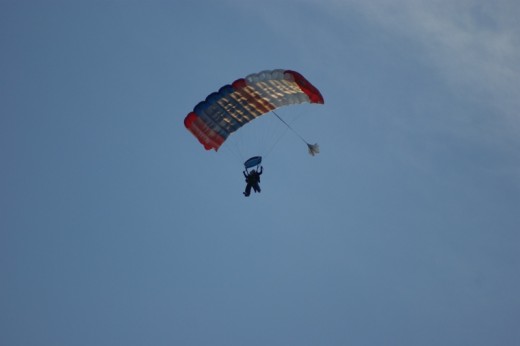
My first skydive
My first skydive
working

This website uses cookies

As a user in the EEA, your approval is needed on a few things. To provide a better website experience, hubpages.com uses cookies (and other similar technologies) and may collect, process, and share personal data. Please choose which areas of our service you consent to our doing so.

For more information on managing or withdrawing consents and how we handle data, visit our Privacy Policy at: https://corp.maven.io/privacy-policy

Show Details
Necessary
HubPages Device IDThis is used to identify particular browsers or devices when the access the service, and is used for security reasons.
LoginThis is necessary to sign in to the HubPages Service.
Google RecaptchaThis is used to prevent bots and spam. (Privacy Policy)
AkismetThis is used to detect comment spam. (Privacy Policy)
HubPages Google AnalyticsThis is used to provide data on traffic to our website, all personally identifyable data is anonymized. (Privacy Policy)
HubPages Traffic PixelThis is used to collect data on traffic to articles and other pages on our site. Unless you are signed in to a HubPages account, all personally identifiable information is anonymized.
Amazon Web ServicesThis is a cloud services platform that we used to host our service. (Privacy Policy)
CloudflareThis is a cloud CDN service that we use to efficiently deliver files required for our service to operate such as javascript, cascading style sheets, images, and videos. (Privacy Policy)
Google Hosted LibrariesJavascript software libraries such as jQuery are loaded at endpoints on the googleapis.com or gstatic.com domains, for performance and efficiency reasons. (Privacy Policy)
Features
Google Custom SearchThis is feature allows you to search the site. (Privacy Policy)
Google MapsSome articles have Google Maps embedded in them. (Privacy Policy)
Google ChartsThis is used to display charts and graphs on articles and the author center. (Privacy Policy)
Google AdSense Host APIThis service allows you to sign up for or associate a Google AdSense account with HubPages, so that you can earn money from ads on your articles. No data is shared unless you engage with this feature. (Privacy Policy)
Google YouTubeSome articles have YouTube videos embedded in them. (Privacy Policy)
VimeoSome articles have Vimeo videos embedded in them. (Privacy Policy)
PaypalThis is used for a registered author who enrolls in the HubPages Earnings program and requests to be paid via PayPal. No data is shared with Paypal unless you engage with this feature. (Privacy Policy)
Facebook LoginYou can use this to streamline signing up for, or signing in to your Hubpages account. No data is shared with Facebook unless you engage with this feature. (Privacy Policy)
MavenThis supports the Maven widget and search functionality. (Privacy Policy)
Marketing
Google AdSenseThis is an ad network. (Privacy Policy)
Google DoubleClickGoogle provides ad serving technology and runs an ad network. (Privacy Policy)
Index ExchangeThis is an ad network. (Privacy Policy)
SovrnThis is an ad network. (Privacy Policy)
Facebook AdsThis is an ad network. (Privacy Policy)
Amazon Unified Ad MarketplaceThis is an ad network. (Privacy Policy)
AppNexusThis is an ad network. (Privacy Policy)
OpenxThis is an ad network. (Privacy Policy)
Rubicon ProjectThis is an ad network. (Privacy Policy)
TripleLiftThis is an ad network. (Privacy Policy)
Say MediaWe partner with Say Media to deliver ad campaigns on our sites. (Privacy Policy)
Remarketing PixelsWe may use remarketing pixels from advertising networks such as Google AdWords, Bing Ads, and Facebook in order to advertise the HubPages Service to people that have visited our sites.
Conversion Tracking PixelsWe may use conversion tracking pixels from advertising networks such as Google AdWords, Bing Ads, and Facebook in order to identify when an advertisement has successfully resulted in the desired action, such as signing up for the HubPages Service or publishing an article on the HubPages Service.
Statistics
Author Google AnalyticsThis is used to provide traffic data and reports to the authors of articles on the HubPages Service. (Privacy Policy)
ComscoreComScore is a media measurement and analytics company providing marketing data and analytics to enterprises, media and advertising agencies, and publishers. Non-consent will result in ComScore only processing obfuscated personal data. (Privacy Policy)
Amazon Tracking PixelSome articles display amazon products as part of the Amazon Affiliate program, this pixel provides traffic statistics for those products (Privacy Policy)
ClickscoThis is a data management platform studying reader behavior (Privacy Policy)