Critical periods in development: Lessons learned from wolf children

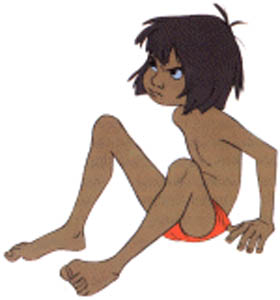
We all know who the boy in the picture is. He's one of the world's most beloved boys, Mowgli, the main character from "
Mowgli's parents lost him as a baby during a tiger attack in their village, and Mowgli was raised in the jungle by wolves, Raksha, the mother wolf, and Father Wolf. So the story goes.
Kipling depicted Mowgli as a wolf child, a human child who has lived in isolation from any human contact from a very young age and was raised by a wolf. Is Wolf Child fiction or fact? If it is a fact, would a wolf child generally behave like any other child, as Mowgli does?
Documented cases of wolf children
As it turns out, Kipling based Mowgli on an actual event. Wolf, or more precisely feral children, do exist (see Wikipedia). There are a number of cases where children were raised by wolves in the wild, completely isolated from human contact and care.
The most known case is probably the two Indian girls, Amala and Kamala, who were found in 1920 in the Calcutta region. Amala was 18 months old and Kamala was 8 years old when a group of villagers found them in a wolf's den. A missionary in charge of an orphanage in Northern India, Reverend Joseph Singh and his wife took them into the orphanage and raised them.
When found, the girls had developed the habits and behaviors of wolves. They walked on their hands and knees, growled at anyone who came close to their food, ate only raw meat, emitted wolf-cries, and were unable to speak.
Amala died the year after she was found, and Kamala lived to the age of 17 before she could fully recover from her trauma of lacking human contact. While she was alive, Rev. Singh taught Kamala to behave like any normal human child. In the nine years, he taught her to stand upright and walk on her feet, socialize with people, and speak.
At 16, she mastered the new skills, but her development was that of a three-year-old.
Lacking human contact: The consequences
The case of Kamala and several others shows that without proper exposure and experience, these children could lack human capabilities. Let's focus on human language to narrow our discussion of human capabilities broadly.
Even after nine years of training, Kamala could only utter so many words and lacked the ability to structure complex sentences as any normal teenager does. Her speech ability fell too short of that of a normally raised child. After all, she was not much different from a three-year-old child.
Like his peers, psychologist David Cohen believes that when the proper experience of normal language development is missing, the parts of the brain responsible for language won't work. In his book "
This period is known as the critical period of language development, or the period during which the brain must be exposed to language to develop the competence to speak.
The lessons learned
Feral children are a true phenomenon. Even though the cases are very rare, they teach us a very important lesson.
Let's use the computer analogy to wrap up this lesson. Suppose our biology is the "human-specific hardware" and the brain is the "human-processor. " Our society and human interaction are the " human programming."
Even though a human baby is born with human-specific hardware, she still requires the proper human programming to function as a member of human society. Without these data, the human processor appears to be wasted, as it is used to run other programs or even shuts itself. Further, human programming must be executed within a specific period since birth.
'Hardware, 'processor, 'programming' is too simplistic a term to describe our wonderful yet intricate biology and our interaction with our environment. The point is, however, clear: Encourage contacts and social interactions as much as possible. While at it, enjoy.
© 2008 Anne Burlinson
Related
Genie: The Wild Child Of L.A.
Activities for Young Children- Sorting by Shape and Other Attributes
English Lit in Anime: The Characters of Jungle Book Shonen Mowgli
Children of the Wild: Living-Wild Influences on Human Development (Part 2)
How Birth Order Affects Your Child’s Characteristics and Psychological Development