ArtsAutosBooksBusinessEducationEntertainmentFamilyFashionFoodGamesGenderHealthHolidaysHomeHubPagesPersonal FinancePetsPoliticsReligionSportsTechnologyTravel

Clownfish: Surviving Nemo

Updated on October 31, 2010

Highly decorative clownfish peers from his anemone
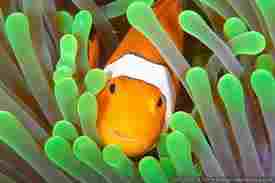
Theeeeer's Nemo!
Theeeeer's Nemo!

"Finding Nemo" brought the little Clownfish to us all

Clownfish: Surviving Nemo.

The Pixar movie, “Finding Nemo,” in 2003, by Andrew Stanton, won the Oscar and introduced the Clownfish to the hearts of people from all ages, but especially kids who immediately wanted one or more in an aquarium. Clownfish were, even then, a recognised salt-water aquarium fish and had been bred in captivity since about 1970. More on this later*.

There are 29 species of Amphiprioninae Percula - clown fish, and perhaps more as yet unknown. They are reef dwellers, found in tropical waters from Africa to Polynesia; Japan to Australia, with the largest concentration of species found in New Guinea: the last member of the family to be named was found recently in Fijian waters, the Amphiprion Barbari. They are remarkable for their bold colouring, purpley-brown to orange, red and yellow, the colours often separated by bands of white or black; these adornments, of course, reminded early marine biologists of how a clown paints his face, hence their name.

Their life is as interesting as their colouration is arresting. Clownfish all have a symbiotic relationship with venomous anemonefish in the wild: commonly called sea-anemones. The clowns spend their whole lives inside the protective tentacles of their host, or in water close by where they can beat a hasty retreat into the anemone’s protection if threatened, especially by their arch enemy, the Moray Eel. In return, the clown provides its own faecal matter as food for the anemone; circulates water around the creature, and also protects the anemone from predators such as the Butterfly Fish.

It is not entirely clear to biologists why the clownfish doesn’t get stung by the anemone. They theorize that the clown has a film of mucus all over its body which fools the anemone into not firing its Nematocysts. A large anemone may have as many as 30 clownfish or varying sizes living around and in it. Clownfish are all born males but can use Sequential Hemaphroditism to change sex as circumstances direct. They are one of the very few which can change from males to females, as well as the reverse.

In the wild, mainly due to predation, the clowns have a life span of about 7 to 10 years; they have reached more than 20 years in captivity. Omnivorous, clownfish feed on minute organisms around their host, such as plankton and algae. They grow, depending on species, from 3 to 7 inches.

*Since the wonderful movie, clownfish have become one of the most popular aquarium species. This has caused a problem on many reefs: as the fish were taken in their thousands, the anemones soon died or were predated upon, contributing, in some cases, to the death of the reef itself. Breeders and stockists have done well in catching up, and tank-bred fish now make up around 80% of those acquired for aquariums.

Some species are better suited than others to aquarium life with other denizens. The Maroon Clownfish, for example, may be aggressive to other aquarium dwellers, whereas, the False Percula, for one, is usually peaceful. In many ways, it is better to only buy artificially raised clownfish. Not only do you then eventually ensure the cessation of the cruelty of removing them from the wild and protecting the anemone and the reef environment, wild fish may soon die due to the stress of catching and shipping. With those raised in captivity, you may have to artificially “teach” the clowns to inhabit and live with any anemone you have introduced. They will seek shelter, but it may be a rock or coral in your tank where you might hardly see them at all. Wild fish will, of course, need to have anemones in place and these are also special species: The Bubble Tip is perhaps the most common, but there are more which different clownfish use and they may or may not easily adapt..

For me, these gaily coloured and fascinating little reef dwellers should be enjoyed in situ, or perhaps in a large commercial aquarium which as nearly imitates their natural life as possible.

If you do decide to keep them, remember that they live in family groups in the wild and should never be kept as just one individual fish…a breeding pair would be the minimum I would consider - and don’t forget, any two clowns can be a breeding pair as they adjust their sex to suit conditions: Might pay to wait awhile before you name them!
working

This website uses cookies

As a user in the EEA, your approval is needed on a few things. To provide a better website experience, hubpages.com uses cookies (and other similar technologies) and may collect, process, and share personal data. Please choose which areas of our service you consent to our doing so.

For more information on managing or withdrawing consents and how we handle data, visit our Privacy Policy at: https://corp.maven.io/privacy-policy

Show Details
Necessary
HubPages Device IDThis is used to identify particular browsers or devices when the access the service, and is used for security reasons.
LoginThis is necessary to sign in to the HubPages Service.
Google RecaptchaThis is used to prevent bots and spam. (Privacy Policy)
AkismetThis is used to detect comment spam. (Privacy Policy)
HubPages Google AnalyticsThis is used to provide data on traffic to our website, all personally identifyable data is anonymized. (Privacy Policy)
HubPages Traffic PixelThis is used to collect data on traffic to articles and other pages on our site. Unless you are signed in to a HubPages account, all personally identifiable information is anonymized.
Amazon Web ServicesThis is a cloud services platform that we used to host our service. (Privacy Policy)
CloudflareThis is a cloud CDN service that we use to efficiently deliver files required for our service to operate such as javascript, cascading style sheets, images, and videos. (Privacy Policy)
Google Hosted LibrariesJavascript software libraries such as jQuery are loaded at endpoints on the googleapis.com or gstatic.com domains, for performance and efficiency reasons. (Privacy Policy)
Features
Google Custom SearchThis is feature allows you to search the site. (Privacy Policy)
Google MapsSome articles have Google Maps embedded in them. (Privacy Policy)
Google ChartsThis is used to display charts and graphs on articles and the author center. (Privacy Policy)
Google AdSense Host APIThis service allows you to sign up for or associate a Google AdSense account with HubPages, so that you can earn money from ads on your articles. No data is shared unless you engage with this feature. (Privacy Policy)
Google YouTubeSome articles have YouTube videos embedded in them. (Privacy Policy)
VimeoSome articles have Vimeo videos embedded in them. (Privacy Policy)
PaypalThis is used for a registered author who enrolls in the HubPages Earnings program and requests to be paid via PayPal. No data is shared with Paypal unless you engage with this feature. (Privacy Policy)
Facebook LoginYou can use this to streamline signing up for, or signing in to your Hubpages account. No data is shared with Facebook unless you engage with this feature. (Privacy Policy)
MavenThis supports the Maven widget and search functionality. (Privacy Policy)
Marketing
Google AdSenseThis is an ad network. (Privacy Policy)
Google DoubleClickGoogle provides ad serving technology and runs an ad network. (Privacy Policy)
Index ExchangeThis is an ad network. (Privacy Policy)
SovrnThis is an ad network. (Privacy Policy)
Facebook AdsThis is an ad network. (Privacy Policy)
Amazon Unified Ad MarketplaceThis is an ad network. (Privacy Policy)
AppNexusThis is an ad network. (Privacy Policy)
OpenxThis is an ad network. (Privacy Policy)
Rubicon ProjectThis is an ad network. (Privacy Policy)
TripleLiftThis is an ad network. (Privacy Policy)
Say MediaWe partner with Say Media to deliver ad campaigns on our sites. (Privacy Policy)
Remarketing PixelsWe may use remarketing pixels from advertising networks such as Google AdWords, Bing Ads, and Facebook in order to advertise the HubPages Service to people that have visited our sites.
Conversion Tracking PixelsWe may use conversion tracking pixels from advertising networks such as Google AdWords, Bing Ads, and Facebook in order to identify when an advertisement has successfully resulted in the desired action, such as signing up for the HubPages Service or publishing an article on the HubPages Service.
Statistics
Author Google AnalyticsThis is used to provide traffic data and reports to the authors of articles on the HubPages Service. (Privacy Policy)
ComscoreComScore is a media measurement and analytics company providing marketing data and analytics to enterprises, media and advertising agencies, and publishers. Non-consent will result in ComScore only processing obfuscated personal data. (Privacy Policy)
Amazon Tracking PixelSome articles display amazon products as part of the Amazon Affiliate program, this pixel provides traffic statistics for those products (Privacy Policy)
ClickscoThis is a data management platform studying reader behavior (Privacy Policy)