Magnificent Magpies

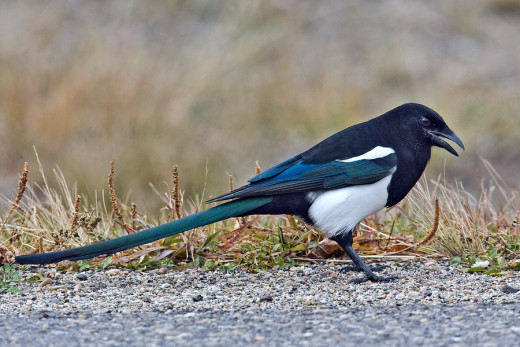
Magpies are Little Acrobats
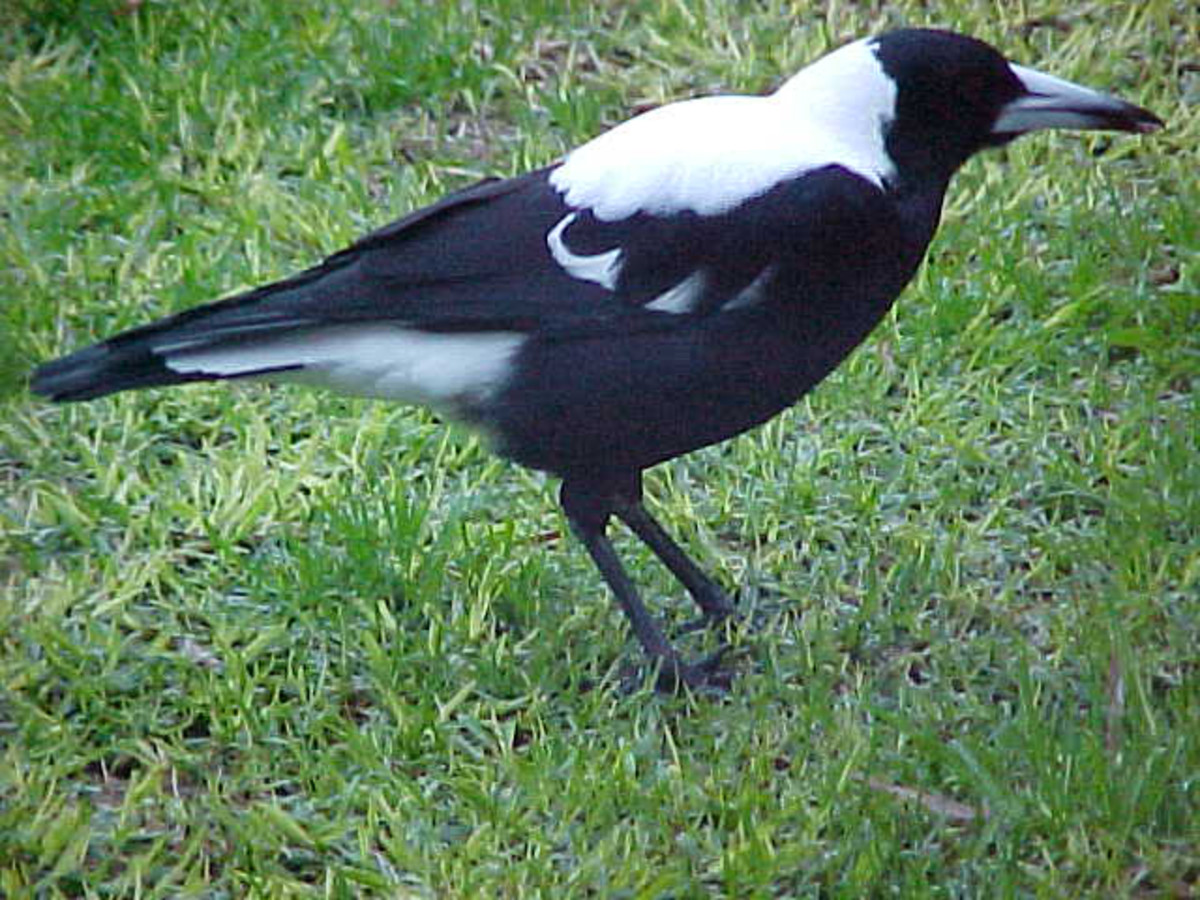
The first time I saw a Magpie was last winter in the little Canadian prairie town where my parents live. The temperature was 25 degrees below zero, Celsius, in mid-afternoon when I looked out the window to try to see what kind of bird I was hearing out there. I was amazed to hear a bird on such a cold day! I opened the kitchen door so I could view the 30-foot high Poplar tree and try to catch a glimpse of the brave fellow who had so much to say. The leafless branches of the Poplar tree were frozen solid and laden with heavy snow. I looked upward and saw a beautiful white and navy-blue bird flitting, dancing -- almost somersaulting -- from branch to branch in the tree top; chattering and calling as he merrily pivoted.
I called my dad from the other room to come see. Dad hurried as I exclaimed there is a most magnificent bird outside. Dad looked out the door, rested his gaze for a moment at the treetop, then walked away, stating, "Oh, that's just a Magpie."
In appreciation of Magpies.
I have seen many Magpies since that cold afternoon, but none of them will ever be 'just a magpie' to me. They are beautiful little creatures and so smart, resourceful and entertaining.
I have learned Magpies actually do perform a few services for people. What is your favorite comfort food? Magpies have their favorite foods, just like you and I. They do -- when opportunity presents itself -- eat large amounts of pesky insects -- even the big, ugly kinds. To my way of thinking, that's a huge service.
Magpies also eat carrion which means the fire department doesn't have to be called every time there is a poor dead deer on the roadway. Magpies also like to be helpful by reminding people to keep their outside garbage cans closed up tightly. If the lid remains open, Magpies will hop right in, have a look-see at last night's dinner and bring some leftover morsels out to the roadway to share with friends.
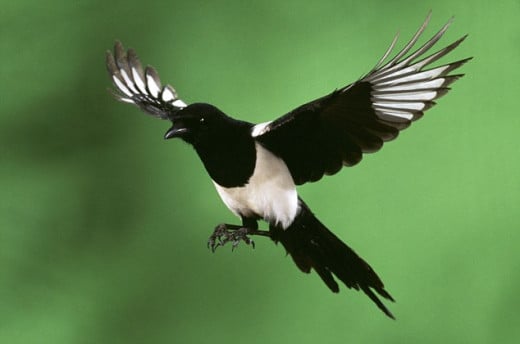
Facts about Magpies.
Magpies are members of the corvid family -- as are jays and crows. Magpies are not picky eaters. They will eat fruit and grain. They will also eat insects such as grasshoppers, beetles, scorpions and anthropods, but they will also kill small animals such as squirrels and vole to appease their appetites. Magpies will raid the nests of other birds to dine on young birds or the eggs. Magpies sit on the shoulders or back of a cow, a moose or other large animals to pluck the ticks out of the animal's fur.
Magpies generally range in length from 17 to 23 inches. They have a wingspan of 22 to 24 inches and a weight of approximately 5 to 7 ounces.
According to the Map of Cornell Lab of Ornithology, Magpies reside year-round in Western United States, Western Canada and Western Alaska. Magpies are also in parts of Europe. Their numbers are increasing in England and Ireland. It is legal to kill these lovely birds in some countries.
How do you feel about this?
Is it difficult for you to like a type of bird if you know the bird will eat smaller birds?
Magpies have enemies: the Raptors.
These pretty birds know instinctually to beware of the raptor families of birds. They take cover when necessary and do their sleeping and nesting in trees and bushes. There is constant danger in the life of a magpie -- just as there is for the little nestlings the magpie will try to eat when foraging for food for its young.
Video -- short video -- of two cheeky fellows
More facts about Magpies
Magpies mate for life. I don't think that means they are faithful to their mate. According to the RSPB nature website and information posted by a Kathy and a Dave, a male magpie can be fooled by a female decoy. The male will attempt to court the decoy if he is alone. But if his mate is with him, the two of them will be aggressive toward the supposed female magpie.
Magpies build their nests in trees.
Magpies do not migrate. They stay close to the area in which they were born.
They build nests with a roof and two little doorways or they build open nests.
Magpies roost communally in wintertime if they can find some chums to roost with.
There is an old nursery rhyme about Magpies that starts out like this:
One for Sorrow, Two for Joy, Three for a Girl and Four for a Boy, Five for Silver, Six for Gold...
Apparently the nursery rhyme has its roots in superstition.
Well, I'm not superstitious but I do know when I feel lucky. I feel very lucky indeed each time I get to see a Magpie.
Sources for information and photographs used in this hub.
Nature Pics Online, a photo gallery for public use. See photo notes/sources.
All About Birds, an online source.
Twenty-one Facts about Magpies on the RSPB site.
Alberta Fish and Wildlife government information.
© 2013 Pamela Kinnaird W