La Dormeuse - Analysis

The Mistress of Art Deco
Art Deco was a movement that started in the roaring twenties and continued to the thirties. It was the machine age, and the age of chromed cars, talking movies and long cigarette holders... it was also a time of reaction to the spartan culture brought about by the first world war. And the second world war was responsible for its demise.
Art Deco was about shiny surfaces, geometric shapes and elaboration. Aero-dynamism and slickness, style and ostentation.
Tamara Lempicka painted in a post-post-impressionist style. Cubism first appeared as an offshoot of impressionism in the works of artists like Cézanne, and later became a full-fledged movement. There's cubism and cubism, and the soft variety is that which is not greatly abstract, but uses geometric shapes and stylised lighting to make a decorative and graphic statement.
Tamara was a soft cubist, who also led a delightfully scandalous art-deco life. But I am talking about the colour in her art here, not in her life.
Every artist draws a self-portrait
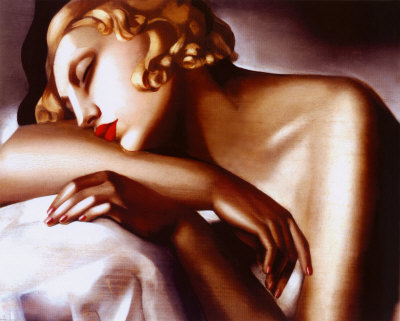
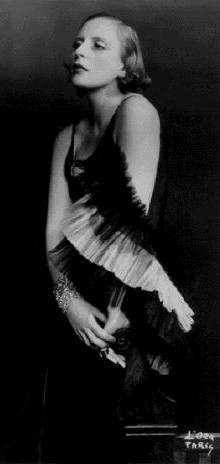
La Dormeuse means the sleeper, I think. I have a theory that every artist does a self-portrait everytime. Compare the painting with the photograph of the painter and see if you can spot the six differences. Whether she used a model or not, I guess she painted her own portrait. The eyes, the lips, the nose, the hair...or is it that fashion and make-up of the times made every lady look the same way? I don't know, I could be wrong. Or right.
At a 1994 New York auction, they were amazed when Lempicka's painting Adam and Eve was unveiled. The painting seemed to glow and shimmer, due to the artist's brilliant use of colour and light. She had had great tutors: Vermeer and other great masters had taught her through their paintings in the Louvre, where she had spent hours studying them.The painting fetched nearly two million dollars. After that, her paintings became popular again, and Hollywood helped further the popularity. Her originals hang in the homes of stars like Madonna and Jack Nicholson.
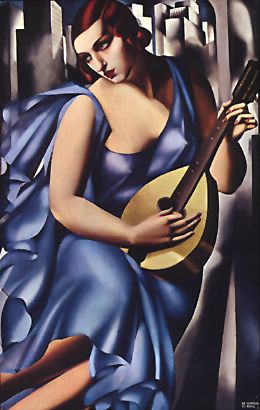
Why the shine and gloss? I think that was the twenties look. If you take a look at The Musician, on our right, you will notice that the lady looks like she is made of chrome. She can be stuck on the hood of a '20s car, no questions asked. The paintings are like sculpture in chrome. Most things, like the drapery, look like metal foil. It's the effect of using sharp contrast and shading that simulates reflective material.
I have nothing much to say about the composition, as the lines are obvious, not hidden. This artist uses dynamic diagonals for her subjects and sets them against secure verticals in the background. Funnily, in The Musician, the musician looks like an angel in a niche, reminding me of early Christian icons.