How Much Money Will I Save?


How Much Will I Save?
Your at the department store; the one you saw in the advertisement touting "Everything on Sale! Save Up To 50% Store-wide." You know the store. You are about to scale the very summit of savings; surrounded by tags of blue, red and green. Reaching for a top on the first rack, a blue tag is screaming "30% OFF." The top is marked $34.50, and you suddenly realize you have no idea how much money you are about to save.
It is time to stop wondering. A few quick steps will have you calculating and subtracting discounts in no time.
What is My Discount?
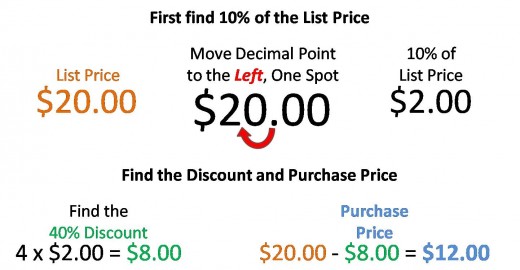
We will start with a simple example to illustrate the method for finding the savings. The item you wish to purchase has a list price of $20.00. The sale tag shows 40% off that price. Use Fig. 1 (below) to follow along
First, we wilI calculate 10% of the list price of $20.00. To do this, locate the decimal point and move it one place to the left. We are left with $2.00. That means $2.00 is 10% of $20.00.
Now that the 10% value has been found, finding the 40% value is a matter of multiplication. If we multiply 10% by four, we get 40% as an answer (10% x 4 = 40%). If we multiply $2.00 by four, we will find the 40% savings ($2.00 x 4 = $8.00). You will save $8.00 on the purchase. The purchase price can be found by subtracting $8.00 from $20.00 ($20.00 - $8.00 = $12.00).
Finding a 40% Discount
What is My Discount?
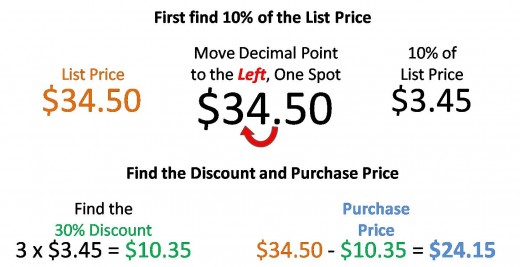
This time we will use a number that is a little harder. The process will not change, but I will show a couple of ideas for making the math simpler. Use Fig. 2 to follow along.
Starting with $34.50, let's find 10% of the list price. To do this, find the decimal point and move it one place to the left. That will leave you with $3.45, or 10% of the list price. Multiplying $3.45 by 3 will yield the 30% savings. $3.45 x 3 = $10.35. Your total savings will be $10.35. to find the actual purchase price, subtract $10.35 from $34.50 ($34.50 - $10.35 = $24.15).
Finding a 30% Discount
Making the Math Easier
This method of finding percentages of numbers can be used for numbers of any size or application, and it will get easier with practice.
One way to make the math easier is to round the numbers to more manageable number for multiplying and subtracting. Unless you need the exact amount, rounding the numbers will give you a good estimate of the discount.
In the last example, $34.50 was the list price. Rounding the price to $35.00 would mean the 10% discount is $3.50. That number may be easier to multiply then $3.45. The overall difference in the outcome would be 15 cents.
The other option would be to estimate the discount. For instance, if you know that a 30% discount on $30.00 is $9.00, and a 30% discount on $40.00 is $12.00, then the estimated savings would be about half-way between $9.00 and $12.00, which would be $10.50.
Summary
I hope this wil help on your next shopping spree. Even if you don't purchase anything, try a couple of thes while at the store. It's good practice and it will boost your confidence. To check yourself, bring a calculator or someone good with numbers.
Good luck.