Why Learn French? Four Good Reasons


As a native born Canadian, it was compulsory for me to learn French in school from the age of nine to fifteen. It is also routine for Anglophone Canadian children and teenagers to opt to carry out their elementary and/or high school education in French. However, most of us complained incessantly about the omnipresence of the French language in school. When I continued to fill my elective slots with French after it was no longer mandatory, I was often asked why I would choose to put myself through it. This is a question I answered so often as a kid that I think it’s time I wrote an article on it to clear things up once and for all.
1. Similarity to English
As I discuss in my hub on debunking myths of the English language, I discuss at length the historically intimate relationship between English and French. Although English originates from the tongues of Northern German tribes who migrated to the British Isles over 1000 years ago, the language currently enjoys one of the richest vocabularies of any other language in the world. Much of this is thanks to the massive migration of French vocabulary into English as a consequence of the Norman Conquest of 1066. There was a period where English was the language of the British peasantry, while a rural dialect of French was the language of royalty, law, education, business, and administration. As a consequence, most of the English words in these fields retain their French origin. Long story short, the learner of French will quickly realize just how many French words are practically the same as those of their English counterparts. As a final note on vocabulary, it’s useful to mention that French does not have as severe a synonym crisis as English does. As a point of comparison, English has about 400,000 words in common use, while French has about 150,000. The English speaking learner of French will, as a consequence, quickly gain a much firmer understanding of his or her native language
2. Topical Significance
After English and German, French is the third most prominent language in the European Union. Twenty percent of non-French Europeans learn French as a second language. Furthermore, the colonial history of France and Belgium has resulted in the language’s massive spread over the world with the modern consequence that it is now an official language in 25 countries other than France, Belgium, Switzerland, and Canada:
Democratic Republic of the Congo
Madagascar
Cameroon
Ivory Coast
Burkina Faso
Niger
Senegal
Mali
Rwanda
Guinea
Chad
Haiti
Burundi
Benin
Togo
Central African Republic
Republic of the Congo
Gabon
Comoros
Equatorial Guinea
Djibouti
Luxembourg
Vanuatu
Seychelles
Monaco
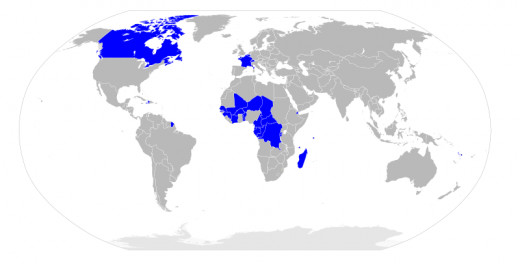
Also, for those who live in Canada, it is compulsory for Canadian citizens to speak BOTH national languages in order to work in most government positions.

3. Historical and Literary Significance
We are all by now used to English as the dominant global language and the lingua franca of science, business, and travel. However, only recently has this become the case. From the 17th century to the middle of the 20th was French the most important language of diplomacy and international relations. This legacy carries over to today as French remains a staple language in such agencies as NATO, the UN, and the Council of Europe.
None can dispute the enduring literary significance of the French language through the ages. The best part is that French is particularly easy for English speakers to read as the written languages are much more similar to one another than the spoken. Easily attained passive reading ability in French will give you access to a wealth of literature in its original language including, but not limited to, great names such as:
François Rabelais
Madame de Lafayette
Voltaire
Diderot
Victor Hugo
Gustave Flaubert
Jules Verne
Charles Baudelaire
The French are also responsible for incredibly influential literary developments of the past couple centuries, amongst which are symbolism, naturalism, surrealism and existentialism.
4. Similarity to Other Languages
Knowledge of French is a helpful gateway to the study of other Romance languages, such as Spanish, Portuguese, Catalan, Italian, Romanian, and even Latin. The Romance languages are one of the two most influential language groups of Western Europe, and enjoy a wide degree of global representation and recognition.