Adult Education: Have it Your Way!

Good for Kids and Adults
After years of studies on adults and children, the all-mighty test remains the standard assessment used by institutions around the globe.
Sparks of light from individual institutions here and there do gleam on the horizon of education for change; however, at the most prominent institutes of higher learning much yet remains to do.
One particularly interesting type of instruction that has dawned is unschooling children. Employing this teaching, the child decides what to learn; and the instructor follows the lead--pursuing the course until the child learns the subject and/or changes interests.
This type of learning is not new to adult learning since adults tend to learn through what interests them or helps in some form. It does send a message to youth that change will come and provide alternatives to the favored standard education--bringing with it different ways of assessing what a child learns. By the time the children experience that change, however, for most, they will be adults in a post-secondary institution.
Assessment-based Learning
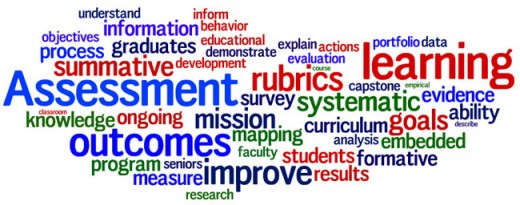
Assessments help determine what instructors need, resource and such, to assist students to progress, and how to efficiently and successfully teach students by adjusting instructional methods.
"The assessment movement has had an important impact on the design and content of standardized tests and, to a lesser degree, on curricula and graduation requirements” according to Angelo and Cross (1993). The influence that assessments provide to the classroom specifically helps to direct the course of students toward better learning, at the least, and in their careers, at the most. The effect of formative (or shaping) assessment for adult students produces course material that leads to the revolution of adult education.
July 23, 2008, Business Wire published the article Identify Future Trends in Adult Online Higher Education with New Report providing information about trends in adult education enrollment based on a survey used to influence future program development and advertising.
The article focused specifically on online training and teaching registration because predictions that online education will be the mainstay of future educational endeavors come from multiple opinion sources, which is a true indication since the COVID-19 outbreak changed the landscape of all education and social interactions.
The report came from a survey of people with designs to continue education who have yet to enroll. The article Identify Future Trends in Adult Online Higher Education with New Report (2008) reported that of those surveyed nearly half indicated extreme interest to pursue further education via the web—with 50 percent of that group designing to do so within a year of the inquiry results.
That number is much higher due to some cultural shifts since 2020.
More than 10 million college students took at least one distance education class in the fall of 2022. Slightly less than half of those students took all of their courses online. Most of these online learners are undergraduates (8.4 million) attending four-year, public institutions (7.4 million). (Hamilton & Beagle, 2023)
The survey measured demographic information to determine the best target group for educators—relating information to specifics such as motivation. The fact that an assessment, and a survey, played a hand in finding this information indicates how valuable the use of assessments serves students and forecast how institutions can tailor their instruction for the future. The fact remains, still, that currently the types of assessments or tests used in modern education today have a limited scope of measuring all that needs measuring.
Angelo and Cross (1993) limited data analysis provided are based on memory for most subjects in public education. Even for adult education systems, the tests measure from memory for things such as the bar exams for lawyers and the many tests that doctors of medicine abide before licenses are awarded.

Adult Unlearning
Adult education has great potential for expansion as the generation of Baby Boomers needs more catering for entertainment and education. Merriam, Caffarella, and Baumgartner (2007) mentioned that adult learners tend to come from the middle class and have a certain level of education and experience before furthering training or education.
The challenge for creating assessments will center around what types of needs can be determined educationally. As the populations increase with those retiring of the Boomer generation, more of them may lean towards extracurricular activities to enrich their lives to some degree and thus the creation of types of assessment to determine the sorts of classes or seminars in demand.
Another challenging aspect that may occur for assessment creation is the ability to produce an assessment without the use of some software aid. The art of producing simple things now belongs to software and machinery in many facets of education and life. Handcrafted items now top the price charts rather than machine produced ones such as clothing and furniture.
Producing an assessment or evaluation now consists of simply inputting information into a software program about educational goals and objectives, and having the correct type and style of assessment or evaluation outputted ready for use using AI or artificial intelligence.
AI makes the intellectual reasoning that goes into deciding from many types of assessments (or creating new ones) unnecessary and an endangered if not forgotten skill. The conundrum of more technology creating little need for skills such as picking cotton or plowing with a mule could very well further tax human self-sufficiency.
The greatest challenge of all may come from finding ways to diversify assessments for higher education to include more even applications than tests. The difficulty of doing so may only disappear as new instructors replace the older generation in the classrooms willing to employ fresh ideas. Years may pass before the current system of advancement changes enough for commonplace testing is supplanted by multiple-level assessments that grade the student on more than memory.
Wrap Up
As the world changes, education will also change to fit the cultural demands of learners and the tools needed to furnish the instructors.
The practicality of educators teaching using traditional methods continues to change—even within the realm of pedagogy. With it, the changes to the types of measures and checks needed to assess learning and instruction will increase in demand and variety. Educators continue to learn to accommodate the students with added focus on helping themselves in their role to form a more assessment-based education. The future is here now! The changes to education across the world to accommodate learning due to social distancing from COVID-19 facilitated the test that proved to the world that with current technology, distance learning is not so difficult with a computer and WiFi. Assessments are now a foundational teaching tool.
References
- Angelo, T. A., & Cross, K. P. (1993).Classroom assessment techniques: A handbook for college teachers(2nd ed.). San Francisco: Jossey-Bass.
- Hamilton, I., & Beagle, V. (2023, May 24). The Rise Of Online Learning In The U.S. – Forbes Advisor. Www.forbes.com. https://www.forbes.com/advisor/education/online-colleges/online-learning-stats/
- Identify Future Trends in Adult Online Higher Education with New Report. (23 July). Business Wire, Retrieved May 1, 2011, from Business Dateline. (Document ID: 1515850741).
- Merriam, S. B., Caffarella, R. S., & Baumgartner, L. M. (2007). Learning in adulthood: Acomprehensive guide(3rd ed.). San Francisco: Jossey-Bass.
This content is accurate and true to the best of the author’s knowledge and is not meant to substitute for formal and individualized advice from a qualified professional.
© 2012 Rodric Anthony Johnson
Related

External Factors That Could Impact American Higher Education

The Positive and Negative Sides of Using Cell Phones for Teaching and Instruction in the Classroom

Seriously Considering Online Education?
Best Lesson Plan Websites - Teachers, Free Lesson Plans
Math Project Ideas: Examples of Project-Based Learning