ArtsAutosBooksBusinessEducationEntertainmentFamilyFashionFoodGamesGenderHealthHolidaysHomeHubPagesPersonal FinancePetsPoliticsReligionSportsTechnologyTravel

Art History Formal Analysis: Bermini Sculpture by David

Updated on March 22, 2012
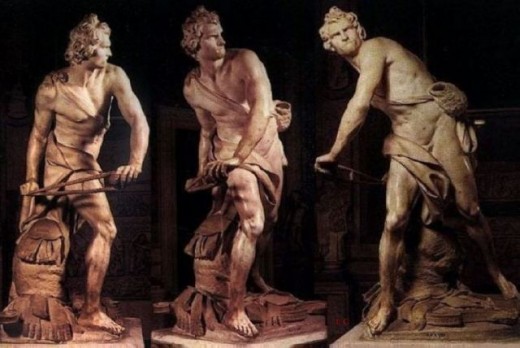
David
David | Source

In this article, I will be focusing on the sculpture of, “David,” by Gianlorenzo Bermini. Bermini was a well known architect in the mid-seventeeth century in Rome, Italy where he operated out of. According to Gardner’s Art Through the Ages, “Architect, painter, and sculptor, Bermini was one of the most important and imaginative artists of the Italian Baroque era and its most characteristic spirit.” Although architecture is what put him on the map; he is almost equally well-known for his handy-work with marble. Fine examples of this handy-work are “Ecstasy of Saint Teresa,” “David,” “Apollo and Daphne,” and “Pluto and Persephone.” However as I stated above, I will be focusing on the attributes of the sculpture of “David.”

What makes this sculpture so unique; is not that it is completely original. On the contrary, we have seen the character David portrayed a few times through sculpture; once by Donatello and the other by Michelangelo. It is unique because of the style, manner, and perspective in which it was done. In regards to style and manner of this piece the biographer, Filippo Baldinucci claims, “He gave his works a marvelous softness…making the marble, so to say, flexible.” The muscle tones and smooth surface give the illusion of realistic skin and body form. This form also holds more “props” which compared to Donatello and Michelangelo’s renditions gives it a natural element. In Donatello and Michelangelo’s David the character is portrayed with very little surface color change and it is just the character taken out of his element. Bernini leaves David in his element. These “props” are also part of the story. His armor has been shed because he did not feel the need for them, because he knew that God was protecting him and he could fight better without them.

For those who are unfamiliar with the biblical story of David, I will give a short summarization of the event. David is famous for this battle with the giant, Goliath. The battle was provoked by Philistine warrior, Goliath. He repeatedly challenged the Israelites for a battle, telling them to send out their best warrior. Obviously when they sent tiny little David up against six foot nine inches tall Goliath, he thought he was in for an easy victory. However, David surprised everyone when single-handedly he took out Goliath with his slingshot.

In regards to perspective and with this biblical story in mind, Bermini did a fantastic job of telling this story through this stationary piece. “David” is what art historians call a ‘sculpture in the round.’ If you see this piece in person, you have to walk around the piece to catch the whole story. It is almost sequenced in time, from when David takes the stone from his pouch, to when he winds back, and finally to the release point of the stone. Out of all of the times that this character as been portrayed, Bermini was the first one to place David in this specific time in history. Bermini shows off his skill of precision throughout the whole sculpture, but especially in the young warriors facial features. His concentration and anger are dramatically conveyed. This sculpture stands at 5’7” which is an accurate height of David. This also gives you the illusion that he is standing right in front of you, and that the battle is also taking place in front of your eyes due to Bermini’s wonderful portrayal of time sequencing. Accordint to our textbook, “Bermini’s sculptures are expansive and theatrical, and the element of time plays an important role in them. His emotion-packed David seems to be moving through both time and space.

This sculpture in no way shape or form can be confined to a niche in a museum or church. It is far too life-like and has too much energy housed within its marble. The story of David is alive in front of you every time you view this piece. If you are ever at the Galleria Borghese in Rome, Italy this is a must see. Bermini was the first artist since the Hellenistic period that created a piece that “came to life” in front of you. I believe this was Bermini’s intention. It was an intention that was more than accurately portrayed it was successfully portrayed. Bermini was at the forefront of this “alive sculpture” revolution and he definitely made his mark on artistic history.

working

This website uses cookies

As a user in the EEA, your approval is needed on a few things. To provide a better website experience, hubpages.com uses cookies (and other similar technologies) and may collect, process, and share personal data. Please choose which areas of our service you consent to our doing so.

For more information on managing or withdrawing consents and how we handle data, visit our Privacy Policy at: https://corp.maven.io/privacy-policy

Show Details
Necessary
HubPages Device IDThis is used to identify particular browsers or devices when the access the service, and is used for security reasons.
LoginThis is necessary to sign in to the HubPages Service.
Google RecaptchaThis is used to prevent bots and spam. (Privacy Policy)
AkismetThis is used to detect comment spam. (Privacy Policy)
HubPages Google AnalyticsThis is used to provide data on traffic to our website, all personally identifyable data is anonymized. (Privacy Policy)
HubPages Traffic PixelThis is used to collect data on traffic to articles and other pages on our site. Unless you are signed in to a HubPages account, all personally identifiable information is anonymized.
Amazon Web ServicesThis is a cloud services platform that we used to host our service. (Privacy Policy)
CloudflareThis is a cloud CDN service that we use to efficiently deliver files required for our service to operate such as javascript, cascading style sheets, images, and videos. (Privacy Policy)
Google Hosted LibrariesJavascript software libraries such as jQuery are loaded at endpoints on the googleapis.com or gstatic.com domains, for performance and efficiency reasons. (Privacy Policy)
Features
Google Custom SearchThis is feature allows you to search the site. (Privacy Policy)
Google MapsSome articles have Google Maps embedded in them. (Privacy Policy)
Google ChartsThis is used to display charts and graphs on articles and the author center. (Privacy Policy)
Google AdSense Host APIThis service allows you to sign up for or associate a Google AdSense account with HubPages, so that you can earn money from ads on your articles. No data is shared unless you engage with this feature. (Privacy Policy)
Google YouTubeSome articles have YouTube videos embedded in them. (Privacy Policy)
VimeoSome articles have Vimeo videos embedded in them. (Privacy Policy)
PaypalThis is used for a registered author who enrolls in the HubPages Earnings program and requests to be paid via PayPal. No data is shared with Paypal unless you engage with this feature. (Privacy Policy)
Facebook LoginYou can use this to streamline signing up for, or signing in to your Hubpages account. No data is shared with Facebook unless you engage with this feature. (Privacy Policy)
MavenThis supports the Maven widget and search functionality. (Privacy Policy)
Marketing
Google AdSenseThis is an ad network. (Privacy Policy)
Google DoubleClickGoogle provides ad serving technology and runs an ad network. (Privacy Policy)
Index ExchangeThis is an ad network. (Privacy Policy)
SovrnThis is an ad network. (Privacy Policy)
Facebook AdsThis is an ad network. (Privacy Policy)
Amazon Unified Ad MarketplaceThis is an ad network. (Privacy Policy)
AppNexusThis is an ad network. (Privacy Policy)
OpenxThis is an ad network. (Privacy Policy)
Rubicon ProjectThis is an ad network. (Privacy Policy)
TripleLiftThis is an ad network. (Privacy Policy)
Say MediaWe partner with Say Media to deliver ad campaigns on our sites. (Privacy Policy)
Remarketing PixelsWe may use remarketing pixels from advertising networks such as Google AdWords, Bing Ads, and Facebook in order to advertise the HubPages Service to people that have visited our sites.
Conversion Tracking PixelsWe may use conversion tracking pixels from advertising networks such as Google AdWords, Bing Ads, and Facebook in order to identify when an advertisement has successfully resulted in the desired action, such as signing up for the HubPages Service or publishing an article on the HubPages Service.
Statistics
Author Google AnalyticsThis is used to provide traffic data and reports to the authors of articles on the HubPages Service. (Privacy Policy)
ComscoreComScore is a media measurement and analytics company providing marketing data and analytics to enterprises, media and advertising agencies, and publishers. Non-consent will result in ComScore only processing obfuscated personal data. (Privacy Policy)
Amazon Tracking PixelSome articles display amazon products as part of the Amazon Affiliate program, this pixel provides traffic statistics for those products (Privacy Policy)
ClickscoThis is a data management platform studying reader behavior (Privacy Policy)