Drosophila Genetics, What have Mutant Flies Ever Done For Me?

Drosophila Genetics: How Does the Fruit Fly Work?
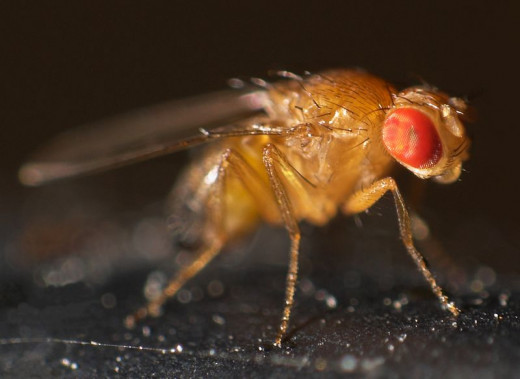
I bet you don’t spend a huge amount of time feeling grateful to the little fruit fly, Drosophila melanogaster, or contemplating its contributions to humanity. At best you ignore them, at worst you curse yourself for leaving a banana skin in the open when you see a cloud of these little insects appearing out of nowhere around the tasty snack. The general public is quite unaware that thousands of scientists world wide dedicate their working lives to Drosophila genetics, trying to learn how a fly is put together.
Genes Code for Proteins, but What do the Proteins Do?
The triumph of genetics in the 19th century was based on Gregor Mendel’s observations about how traits are inherited. In the last century huge progress was made in working out that Mendel’s factors, which carried genetic information are, in fact, genes, made out of DNA, which makes up chromosomes in the cell nucleus. The DNA acts as a template for making messenger RNA, which exits the nucleus and is translated in the cytoplasm into proteins. Hence genes carry the genetic instructions, in the form of DNA sequence, for making proteins. However, knowing this, and even having the full sequence of the human genome, as we now do, does not actually mean very much if we don’t know what the function of the different proteins and genes is.
There are many ways of figuring out what a protein does in the body, but the best is to see what happens when that protein is missing. This has been compared to figuring out how a car engine works by breaking different parts of it at random. However, for many years it was impossible to simply cut out a bit of DNA from all the cells of an animal, or remove a protein. Luckily nature helped scientists out, by occasionally throwing up a mutation that they could study.
Some Random Genetic Facts
Figuring Out Gene Function form Mutations
A mutation is a ‘mistake’ in the DNA sequence. It can be caused by a chemical, or by radiation or just occur spontaneously. Sometimes a mutation will not have a huge effect on the function of a protein, but occasionally it will make in completely non-functional. Hereditary genetic diseases in humans, such as achondroplasia (dwarfism), sickle cell anemia or haemophilia are caused by mutations in genes which render the proteins non-functional. However, there is obviously a limit to how much we can learn from studying humans. Most of our knowledge about the function of different genes comes from studying model organisms, and Drosophila flies are one of the most thoroughly studied ones.
Fruit Flies in the Lab, Fast, Cheap and Cheerful
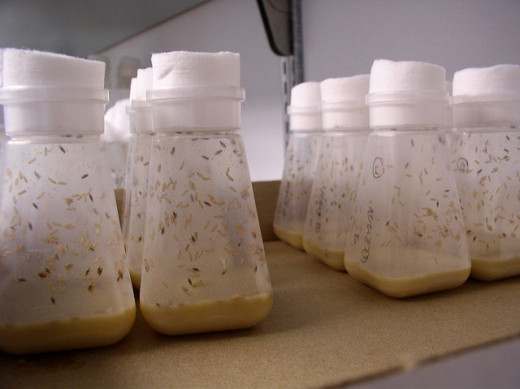
The flies are small and very easy and cheap to keep, compared to say mice or rats. They have a very short generation time, about 10 days, which is very useful in a genetic model organism, several generations can be analyzed in a short period of time. Drosophila females produce a lot of eggs, about 100 at a time, which provides many individuals for analysis. The flies also have a much simpler genome than mammals, they have three chromosomes compared to humans who have 23, and the full sequence of their genome has been known since 2000.
Thomas Morgan and the First Drosophila Genetic Mutant
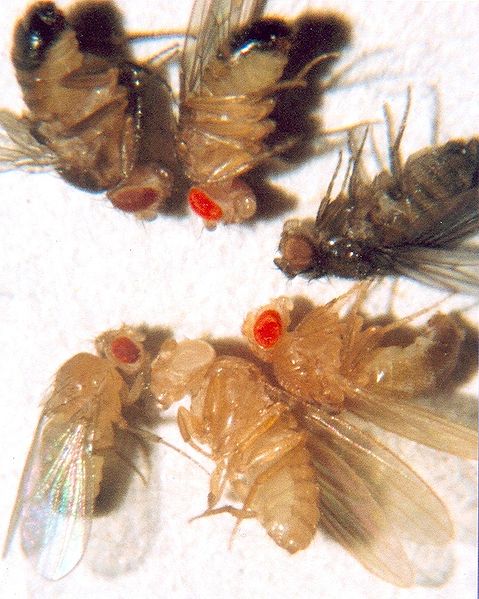
The suggestion that Drosophila melanogaster might be useful to geneticists is credited to C.W Woodworth, an entomologist at Harvard. Eventually they came to the attention to the legendary geneticist, Thomas Hunt Morgan at Columbia University. It was Morgan who found the first mutant fly, in 1910. Instead of the typical red eyes, the white mutant has white eyes. Since then many other mutations affecting eye colour have been identified, as well as mutants with curly wings, or no wings etc. Morgan worked out how to identify the genes responsible for the mutant phenotypes through genetic mapping. To this day the unit describing the genetic distance between two loci on the chromosome is known as the centiMorgan in his honour. Oh and he also got the Nobel prize for his work.
Nusslein-Volhard and the Master Genes in Fly Emryos
The use of Drosophila genetics to work out the function of different genes really took off with the work of two German scientists, Christiane Nusslein-Volhard and Eric Wieschaus, who, impatient with waiting for nature to throw up interesting mutations for them to study, decided to speed things up by using a chemical mutagen. The Heidelberg screen for mutant phenotypes threw up a huge number of different mutations, many of which had catastrophic effects on fly embryo development. The was incredibly fruitful for developmental biology, the study of how multicellular organisms develop.
All people, fish and flies start out as one cell, the fertilized egg, which divides many times producing an organism that is made up of thousands of cells. However the cells don’t just divide, that would result in a huge blob of cells, they also specialize and differentiate, some become nerves, other muscles, blood, gut, skin etc. Figuring out how exactly a cell decides whether to become a brain cell, or a skin cell on your big toe is an ongoing scientific project.
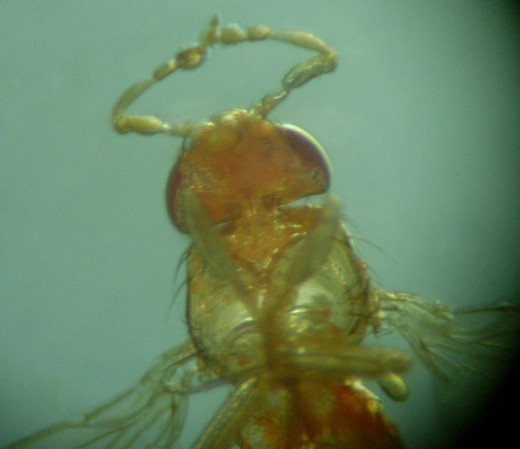
Many of the Drosophila mutants produced in the genetic screens in Germany ended up with very messed up body plans, for example flies that had legs instead of antennae on their heads.
Cute Drosophila Gene Names
It is something of a tradition that researchers who clone a new gene give it an amusing name often based on the phenotype of the mutant, below are some examples.
mutant name
| phenotype
|
|---|---|
cheap date
| Mutant flies are particularly sensitive to alcohol
|
mothers against decapentaplegic (mad)
| motheWhen this gene is mutated in the mother, activity of another gene, decapentaplegic, is repressed.
|
tinman
| A gene necessary for heart development, mutant flies lack hearts, like the character in Wizard of Oz.
|
dunce
| A memory and learning impaired mutant. Rumour has it that the researchers originally wanted to call the genes after American presidents, but then realised that might have adverse effects on their funding.
|
groucho
| Mutants have excessive bristles on their heads, as did Groucho Marx
|
A few cute drosophila mutant names and their phenotypes
Fruit Fly Mutants and Human Diseases
Since then many other screens for fly genetic mutations have been carried out, producing thousands of mutants, which are all catalogued in the Drosophila genetics database, flybase. These mutations not only affected early embryo development, but also fly behaviour, learning and memory, addiction to alcohol and cocaine and immunity.
All this would be of limited interest, if it wasn’t for the fact, that many of the genes identified through fly genetics, have homologues with similar functions in higher animals, including humans. It appears that once evolution figures out a good way to do something, it keeps doing it, rather than reinventing the wheel every time a new species arises. About 75% of human disease genes have Drosophla equivalents and flies are used to model many conditions that affect humans including Parkinson’s, Alzheimers, Huntington’s and many others. Unfortunately many people including politicians don’t fully appreciate the usefulness of flies in biomedical research as can be seen in the video below.
Sarah Palin vs. Fruit Flies
Related
The Replication of DNA: The DNA replication process and Genetic Disorders

How to Get Rid of Fruit Flies?
Gene Testing Holds The Key to Chronic Medical Conditions - Why Chronically Ill Need Genetic Testing
Genetics of Cat Coats, Siamese Kittens and Calico Females

Angelman Syndrome, a Rare Genetic Disorder: My Family's Experience