Tacoma Narrows Bridge Collapse

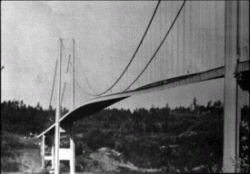
Collapse of the Tacoma Narrows Bridge
Having seen some of the old video clips of the Tacoma-Narrows Bridge collapse, I really wanted to learn more. I found out that the original bridge, that opened with much fanfare on July 1, 1940, and stunningly collapsed into Puget Sound on November 7, later that same year. The bridge's instability in high winds inspired its nickname "Galloping Gertie".
Public domain photo courtesy Wikipedia
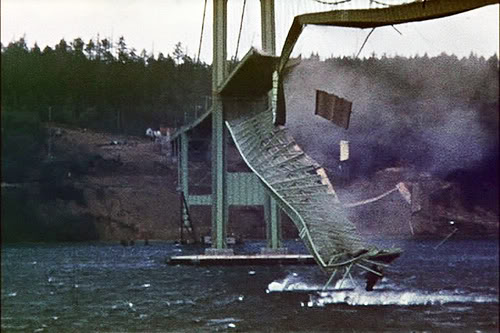
Public domain photo courtesy Cflhd.gov
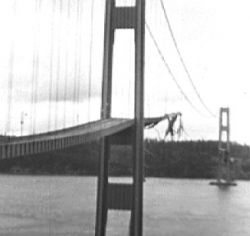
Collapse of the Bridge
The Tacoma Narrows Bridge was very well constructed, with carbon steel girders anchored in massive concrete blocks. The bridge was the first to use plate-type girders to help hold up the roadbed. With the earlier designs any wind would simply pass through the truss, but in the new design the wind would be diverted above and below the structure. Shortly after construction finished at the end of June (opened to traffic on July 1, 1940), it was discovered that the bridge would sway and buckle dangerously in relatively mild windy conditions for the area. This vibration caused one-half of the central span to rise while the other lowered. Drivers would see cars approaching from the opposite direction rise and fall, riding the energy wave through the bridge. However, at the time the mass of the bridge was considered sufficient to keep it structurally safe.
The November 7, 1940 failure of the bridge occurred when a never-before-seen twisting mode occurred, from winds at a mild 40 miles per hour. This is a torsional vibration mode, whereby when the left side of the roadway went down, the right side would rise, and vice versa, with the center line of the road remaining still. Specifically, it was the "second" torsional mode, in which the midpoint of the bridge remained motionless while the two halves of the bridge twisted in opposite directions. Two men proved this point by walking along the center line, unaffected by the flapping of the roadway rising and falling to each side.
Eventually, the twisting motion produced by the fluttering increased beyond the strength of the suspender cables. Once several cables failed, the weight of the deck transferred to the adjacent cables that broke in turn until almost all of the central deck fell into the water below the bridge.
Public domain photo courtesy Wikipedia
Historic Video of the Collapse
Bridge Question
Does driving over long or tall bridges make you anxious?
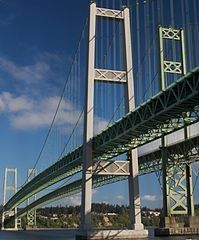
Today's Bridges
Due to materials shortages as a result of the United States' participation in World War II, it took 10 years to replace Galloping Gertie. Its replacement opened to the public on October 14, 1950, and is 5,979 feet long - 40 feet longer than the original bridge.
Over fifty years later, it became clear that the 1950 bridge was exceeding its traffic capacity, and a second, parallel suspension bridge was constructed to carry eastbound traffic, while the 1950 bridge was reconfigured to carry westbound motorists. The new bridge opened in July 2007, greatly improving the flow of traffic in the area.
Creative Commons photo courtesy Wikimedia/Kevin Madden