The Singing Brakeman--Jimmie Rodgers

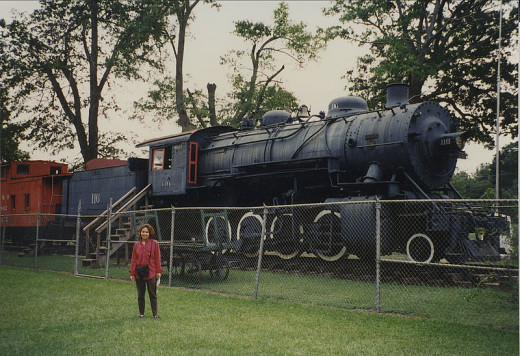
Meridain Locomotive
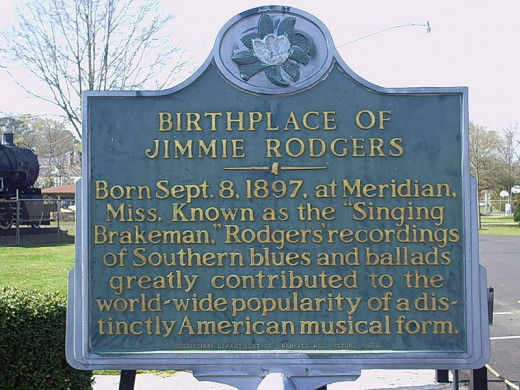
Sign in front of Museum
Roots of American music
Born James Charles Rodgers on September 8, I897 and died May 26, 1933. In those 35 years he has set the model for pop, country, blues and rock singers even today. He was a master of yodeling but not like the Swiss mountain yodelers. He has also been referred to as the “Father of Country Music.” Along with the Carter Family and Hank Williams a standard was set for most of modern popular music, including country, pop, blues and rock. Like other great performers such as Hank Williams he died young but accomplished so much in that short life. He was a victim of tuberculosis (TB), which was prevalent in those days.
After his mother died, he lived with various relatives and finally went back home to live with his father who was a foreman for the Mobile and Ohio Railroad,. who had recently remarried and settled in Meridian, Mississippi. He found Jimmie his first railroad job as a water boy. Prior to this Jimmie had, at the age of 13, twice organizing traveling shows, but was found and brought home by his father. He worked up to being a brakeman for the New Orleans and Northwestern Railroad, which his older brother, Walter had previously filled. Railroad workers and hobos taught him more strumming and picking.
The railroad career was interrupted in 1924 by his getting TB. He took advantage of this by using his free time to get back into entertainment. He performed across the Southeast of the United States until he was forced to go home when a cyclone destroyed his tent . He returned to being a brakeman but again the illness cost him his job. He went to Tucson Arizona with a job as switchman on the Southern Pacific Railroad. Less than a year later he went back to Meridian with a wife Carrie and daughter Anita.
Later, he went to Asheville, North Carolina. and with Otis Kuykendall performed for the first time on WWNC, the first radio station in Asheville. A few months later with the Tenneva Ramblers he did a weekly slot on the stations as “The Jimmie Rodger’s Entertainers.”
Ralph Peer the Victor Talking Machine Company representative was auditioning musicians in Bristol. The group went there on August 3, 1927 and auditioned in an empty warehouse. Peer agreed to record them but the band broke up over an argument about how they would be billed on the recording. So Jimmie showed up by himself and completed his first Victor session alone. He got $100 for recording the test recordings of “The Soldiers Sweetheart” and “Sleep, Baby, Sleep.” The songs had modest success when released on October 7.
Jimmie went to New York with intent to arrange another recording session. In Camden NJ he recorded four songs including “Blue Yodel” which we mostly know as “T for Texas.”This record was his first hit and he became a star after that.
Aware that TB would get him eventually he actually wrote songs about it, such as “T.B. Blues.”
Part of what is impressive about his popularity is that much of it was during the Depression and people did not have much money for entertainment, yet they bought his records.
His influence has lasted from then until the present time.

Gene Autry, also a one time railroad worker, did Jimmie Rodgers songs in the early part of his career. The influence went on from there to Earnest Tubbs, Merle Haggard, Hank Snow, Lefty Frizzell and George Jones all did tribute albums. Blues artists like Muddy Waters, Big Bill Broozy and Howlin’ Wolf were also influenced by Rodgers. , as were Jerry Lee Lewis, and Elvis Presley. Bob Dylan compiled a tribute album of various artists doing Jimmies songs.
In 1978 Jimmie was honored when the United States Postal service issued a 13-cent commemorative stamp for Rodgers, the first of the performing arts series.
NOTE: Information for this hub has come from Wikipedia and the biography of Jimmie Rodgers: Meeting Jimmie Rodgers by Barry Mazor.
© 2010 Don A. Hoglund