I Am A Princess and A Shiny Penny - Self Esteem In Cultural Identity

A Foundation Found in A Penny
I've been blessed to have had a good number of really great teachers over the years. Mrs. Huntington was one such early gem. She was the kind of teacher who knew how to get the kids in her classroom's attention.
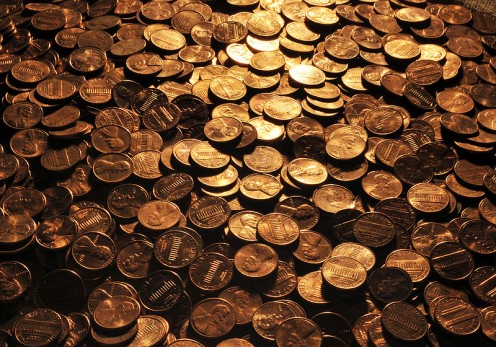
The day she started class by pouring out six quart sized canning jars filled with pennies onto a desk -- we all momentarily stopped talking, fidgeting, and passing notes. This was almost as big as the growing pile of pennies heaped on her desk. Jar after jar, she emptied without saying a word to us.
With a wave of her hand, digging deep into the center of the pile, she rained a handful of them back down the penny mountain.
She asked the class: "What do you notice about these pennies?"
Frank piped up with, "You've got a lot of them. I ain't volunteering to count them, unless I can keep them."
Know-it-all Delores, gave Frank a disgusted look, and flat-out stated, "All these pennies are old and dirty. My dad says money is the root of all evil, and money is dirty. That's why he's never going to give me any."
With that pronouncement, the whole class began giggling and whispering among themselves. Mrs. Huntington, shushed us all and began her lesson.
She wrote on the board:
- All of the coins on the desk are pennies, yet none of them are the same.
- All of the coins on the desk were not made in the same place, but many of them were made in the same place.
- Some coins that were minted in the same year are more worn than the others.
- All of the coins are money, yet each is unique to itself.
- Some of the coins have traveled more than the others.
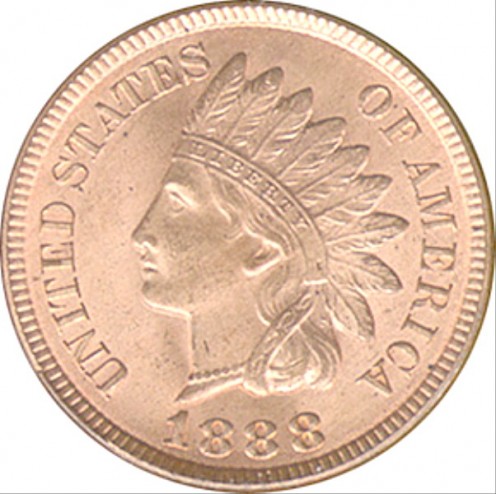
- All of the coins are pennies, yet some of them depict an Indian head.
- There one thing that all of the pennies have in common EXCEPT?????
"What is the one penny exception, and why is that significant to you and your family? "
In groups of three, each of us were given a turn to come up and examine the pile of pennies, and encouraged to touch them and look at the from all angles. None of us could guess the answer, despite many opinions, that were pretty much divided along the lines of boys against the girls.
While we continued to debate, Mrs. Huntington filled a plastic washtub with smelly distilled white vinegar, and placed it on the counter beneath a sunny window. She then turned to us and said:
"Each of you write on a piece of paper what your answer is. Those who get the right answer will get come up, and take as many pennies as you can carry in each hand to keep."
No one got the answer right.
How Much You Shine Is Your Choice!
Since we were just a bunch of ordinary kids without a clue, Mrs. Huntington made a big show out of finding that one penny that was the exception. She sifted through the penny mountain several times, before she plucked the magical penny out of the fray of copper coins.
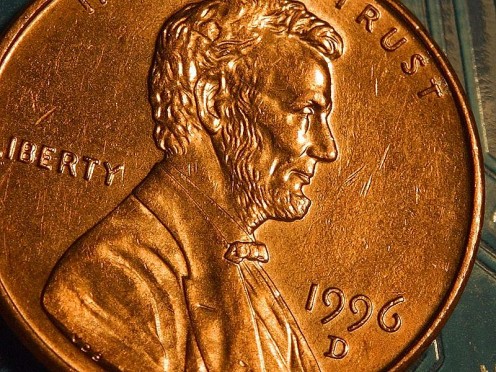
It had been there all the time, at the bottom of the pile -- a bright pristine newly minted penny -- a shiny perfect penny among all the dull ones
Holding it up for everyone to see, then passing it around the class for personal examination, Mrs. Huntington continued the lesson:
"It's quite rare to find a shiny copper penny among all the dull and ordinary ones. In fact, I had to put this one there on purpose. People are like pennies. Look at the list on the chalkboard, and compare yourselves to the pennies:
- You are all children, yet none of you are the same.
- Not all of you were born in the same place, or part of the country, or even in this country. Yet, some of you come from the same places.
- Most of you, but not all of you were born in the same year. Even if you were born in the same year, some of you have had more experiences.
- You are all human beings, yet every one of you have a unique family bloodlines.
- Some of you have never left this county, yet others have travelled to and from far away places.
- You may all be children, however, just like the Indian head pennies, some of you have native peoples blood within your veins.
"So, who among you will choose to be the bright and shiny copper penny?"
The Smell of Vinegar
Well, everyone in the class wanted to be the perfect shiny copper penny, so all hands shot up pretty much in unison in answer to that question. None of us beat Delore's hand, who wasn't about to be an ordinary penny, in case that also meant being dirty.
Thus, began Mrs. Huntington's cultural identify lessons to a classroom of children with very diverse family backgrounds.
She next had us place all of the dull, worn, and dirty copper pennies into the bathtub of distilled white vinegar to marinate over the weekend, while we worked on our homework assignment -- filling out a modest family tree and answering such questions as:
- Where (what country) did your family originally come from?
- Did all of your family come the same place?
- Who in your family is a shiny copper penny?
Later, we would learn that all pennies (metal) will be as shiny as that newly minted proof she planted in that assignment. Soaking metal in distilled white vinegar in a warm place, rinsing thoroughly afterwards in clear water, and completely drying the metal object -- restores it to new. (This is also a good remedy for removing rust from tools and parts).
Her lesson was two-fold:
- That there is a shiny penny of greatness to be found in all of us;
- That despite our different cultural identity differences, we are more alike than not.
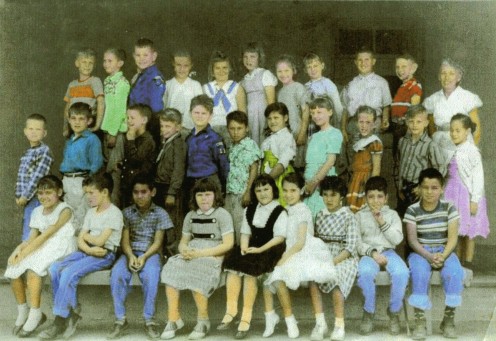
In the end, our small class of twenty-seven students represented over thirty nationalities and fourteen different countries of origin. We spent the balance of that school year studying our differences and similarities as people, and in countries of origin. We learned how we are all related to each other. She wisely chose literature from each of those ethnic backgrounds that represented our class, for everyone to read.
This was to be the foundation that would serve me well in later years, as I took from it, a love of cultural histories, genealogy, and a curiosity in finding the true shine within others who appeared different than myself on the surface.
Note: This lesson should not be done before checking to make sure that you are not bathing a truly valuable penny in distilled white vinegar and destroying it's value.
Villa de Cubero, New Mexico
On Route 66, Villa de Cubero, was a legendary roadside stop, which had it all that early travelers could want in the 1930s through the 1960s. It’s claimed that it is here that Ernest Hemingway stayed when he was writing Old Man and the Sea in 1951.
That fact is fairly interesting since it is well reported that the novella was written in Cuba. It’s also the place was Lucille Ball stayed after leaving Desi Arnez. Today, there’s still a trading post, but this is all part of what’s pretty much a ghost town.
As I grew away from the books and literature of my childhood days, I found myself face-to-face with new and contemporary looks at how many of us, as Americans look at “other people’s history.” I was painfully aware of how much of the real stories or the back stories are more often than not, left out of our textbooks.
Wholly aware of parts of my own heritage, I knew the difference between a Cajun or Franco-American perspective of literature or history and that of others. This was especially true when it comes to history’s many stories -- at least compared to an English speaking viewpoint.
Then, it happened -- I ran into a shiny copper penny from Cubero, New Mexico, long before it became a ghost town. Her strong cultural identity is something we all can learn from, even though she left us in 2008.
It is she who taught me that "I am a princess," for she was one too. As you have already learned in this hub, it’s rare to find a shiny copper penny among all the dull or ordinary ones. Paula Dunn Allen was one of them, shining far beyond her cultural identity in a world that is often a sea of dullness.
Cultural Identity
Sometimes, it all comes down to an awareness of overall wholeness, or knowing where you fit into this puzzle called life in the human race. How we define ourselves determines a lot about how we will define others. It’s all about belonging and knowing where you belong. It's about at least having a sense of where you came from.
It isn’t about one particular cultural identity being better than another. It’s all about the traditions, beliefs, languages, common values, and world viewpoints that define your particular social group that you‘ve inherited or chosen to identify with. Sometimes that’s based on your nationality, ethnicity, where you live, and how your relate to the others.
We might all call ourselves American, and be quite different in our American-ness. Cultural identity isn’t just about one ethnicity group, you can be French and still be American, and under other circumstances, still identify yourself with distant German ancestors, or native American relatives.
Everything and Everyone Are Related
Paula Gunn Allen was a well-respected Native American poet, political activist, literary critic, novelist, and in my opinion, a shiny penny.
While her strongest cultural ties were to her Laguna family, she was also Sioux, Scottish and Lebanese. Raised among her mother’s native people much of her early works centered around quite feminist Indian view points. She was quite controversial at times in many of her lectures and the things she wrote.
On the day that I sat beside her, both of us strangers in a chance meeting, while waiting for our rides, she picked up two discarded, but shiny new pennies from the sidewalk and held them out for me to see.
"I look at you and see that you are a distant princess from an unknown tribe. I'm a princess among my own tribes. We both must work hard to keep that shine."
She then quoted what I now know to be an old Keres song:
"I add my breath to your breath
that our days may be long on the Earth
That the days of our people may be long
That we may be one person
That we may finish our roads together
May our mother bless you with life
May our Life Paths be fulfilled.
As I think back on both Paula Dunn Allen and Mrs. Huntington, two very unrelated and unconnected women I can't help but wonder -- about the odds of knowing two separate women so many years apart, who both saw value in mere pennies and other human beings?
Laguna Pueblo
Paula Dunn Allen was a notable member of the Laguna Pueblo people. The real name of the tribe is “Kawaik.”
Their native language is Keresan, and they are as a group, one of the most well educated and brightest peoples in this country. She was a shining example of uncommon intellect and artistic creativity, among the approximate seven thousand members.
Paula Dunn Allen's Literary Career
Paula Dunn Allen was awarded the prestigious Lifetime Achievement Award by the Native Writer’s Circle of Americas, and many other literary awards.
Her 1983 novel, The Woman Who Owned the Shadows -- was a tale of a mixed blooded woman, and her battle to articulate herself artistically in a world that wouldn’t easily understand her.
Some of her best poetry were the following:
- A Cannon Between My Knees (1981)
- Blind Lion Poems (sometimes printed as The Blind Lion) (1974)
- Life is a Fatal Disease: Collected Poems (1997)
- Skins and Bones: Poems (1988)
- Shadow Country (1982)
Perhaps, some of my favorites among of her body of works, rests in two of her academic papers:
- The Sacred Hoop: Recovering the Feminine in American Indian Traditions (1986); and
- Grandmothers of Light: A Medicine Women’s Sourcebook (1991)
Fun Facts --- Rarest of U.S. Pennies
Here are two examples of the most valuable U.S. pennies:
- Mint 1943 S (San Francisco) - Must be copper --worth around $60,000 at auction (watch for counterfeits for this coin). Only forty are known to have existed as this is when we switched to steel pennies temporarily.
- 1955 uncirculated if it has a double die date and no blemishes -- it is worth about $27,000. Even if it's less than perfect it can be worth over $500.