Ask Carb Diva: Questions & Answers About Food, Cooking, & Recipes #78

I Feel Vindicated
This past week I had the pleasure of reading an article by J. J. Goode, an internationally recognized travel and food writer. He has co-authored four cookbooks and writes for The New York Times, The Wall Street Journal, Gourmet, Saveur, Bon Appétit, Food & Wine, and Every Day with Rachael Ray.
Mr. Goode validated every thought I have held about carelessly crafted recipes; he says that short recipes are to be feared, not desired. The devil isn't in the details. Evil lurks in those instructions that are left unsaid (or unwritten). His musings were published online by Taste on March 26, 2019. The entire article "The Case for Very Long Recipes" is here. If you are interested in food and/or cooking, and especially if you appreciate good writing, you should take the time to read this article.
Sorry for the Interruption In Our Previously Scheduled Program
OK, let's get back on track. Each week I receive questions about food ingredients, cooking or baking terms or methods, requests for recipes, and queries about nutrition. Just about anything food-related has been covered here.
I'm sharing this past week's questions and my responses and it happens every Monday. Want to join in the fun? You can leave your question in the comments below, and next week the answer will be right here. It's that easy.
More About Tapping Trees for Sap
Last week I wrote an article about maple syrup, its history, how the process works today, and (of course) some recipes with maple syrup as a key ingredient. That prompted several questions. This first one is from Shauna (Brave Warrior).
After reading this article, I'm wondering if maple trees ever run out of sap. Do they regenerate? How exactly does the sap form? Is it possible to literally drain a tree dry? Inquiring minds want to know. :-)
Shauna, because of your question I learned something new today; in fact I learned a lot (and that's the really fun part of this for me). The physical process of sap "running" is complicated and fascinating. But first, let me tell you about the source of my information. Alan Suddaby was pursuing a degree in electrical engineering but got a part-time job in the kitchen of Hulbert’s Restaurant to pay for his tuition. He began his work at Hulbert's with nothing more than a slight understanding of how to boil water but soon learned that he enjoyed the science of food. As he explained:
Food marries art and science. In a conversation about cake you are as likely to mention the hygroscopic properties of sugar as you are Marie Antoinette. When cooking, you are as likely to use an immersion circulator with a feedback temperature controller as you are a match or a piece of wood. Food encompasses endless variety that all drives towards the same, gratifying end.
A year after taking that job Alan had graduated with a degree in hand, was working as a full-time cook, writing on a blog called Button Soup, and was then accepted into the NAIT culinary arts program. A star was born.
Alan enjoys researching and writing about food, and wrote an amazingly detailed explanation of the process of why sap runs (and why sometimes it doesn't). His article is here. The Readers' Digest version is:
- There are two types of wood in a maple (or any other tree that is tapped for its sap) tree—heartwood (which is basically inert), and the living, sapwood close to the surface.
- Sapwood transports food (sugars) and water to the limbs, branches, and leaves.
- Freezing and thawing cycles build up pressure in the wood fibers. Bore a hole in the tree and the sap will be squeezed out.
- Tapping does not harm the tree; new sapwood is produced with each growing cycle. Some trees have been giving sap for more than 100 years.
And Mary (Blond Logic) asked
"Do people tap other trees such as the maple?"
Ohmygoodness, yes! There are 22 varieties of trees that can be tapped for their sap.
- Nine varieties of maple (including the sugar maple),
- Gorosoe
- 3 walnuts
- Heartnut
- 6 birches
- Sycamore
- Ironwood.
Details of those trees and how their saps are used is here.
Sources:
Fire and Ice
My mom made a fairly simple dish she called fire and ice. It could be a side of any meal. It was something like vinegar and oil and onion and tomatoes. Do you know of it and recipe. You know I no longer go on line to research I rely strictly on you.
Eric you have made me happy, but boy now the pressure is on. So I'm your Google? Ohmygoodness!
I've not heard of "fire and ice" (at least as you describe it, but I think it was a Robert Frost poem).
I digress but wait while I check my sources {click, click, click, click, click}.
OK, I'm back. Thank you for filling this hole in my culinary knowledge. I had never heard of the summer salad named "Fire and Ice." However, now I know that it's a common attendee at luncheon and dinner tables in the South.
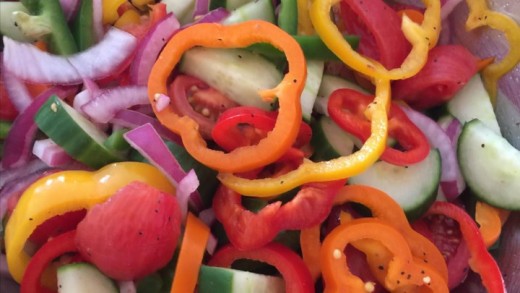
I found this recipe by Louise on AllRecipes. As you said, it begins with firm, summer-ripe juicy red tomatoes. Bell peppers and cucumber provide a crunchy texture and the combination of vinegar, black pepper, and cayenne are the fire.
How To Scale a Fish Without Making a Mess
I have just finished gutting and cleaning a fish to make some fish cakes. Do you have any tips for scaling fish? I am donned in tiny scales at the moment.
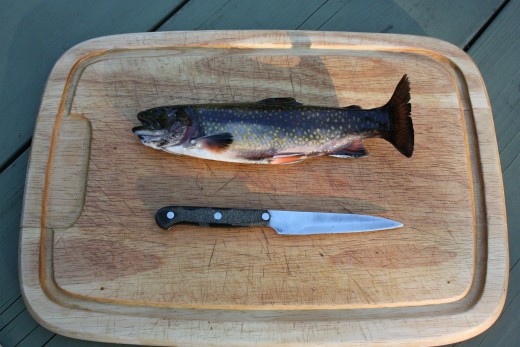
Mary, depending on the size of your fish, this method may or may not work. The next time you have a fish to de-scale, get a large trash bag (big enough to not only hold the fish but to plunge your arms into as well). You won't be able to get ALL of the scales that way, but a significant amount and the scales will be trapped in the bag instead of flying like confetti.
I don't know if you have them available in Brazil, but here in the states, we can get clear (see-through) disposable bags for lining our garbage bins.
A New Topic
For the past 26 weeks, I have been running a series called "Alphabet Soup." Each week I gave you a nourishing soup recipe; the first installment began with the letter A (Albondigas Soup), the next was letter B (Beef and Barley), and so on.
So next week we will begin a new chapter. I asked friends for suggestions on what the next topic should be and Flourish Anyway said this:
How’s this for an idea? “Don’t Throw That Away!” Basically, leftover things in the kitchen that we’d ordinarily toss out as trash ... are there alternative uses, whether in the kitchen or out? For example, one week consider used coffee grounds, another week consider leftover egg shells, etc. I did a brief search for eggshells and was amazed! My dad always asks (perturbed) why are you throwing that out?!? He can find a use for nearly anything. I knew about eggshells and warding off slugs but not the other things. He saves bones from meat that most people throw out, leftover lemon and orange peels, pickle juice, you name it. Very eccentric, but it may be entertaining and useful.
I LOVE this idea. It totally fits in with my "let nothing go to waste" upbringing. But it also alleviates another problem I've been puzzling over. On the first day of each month, I have given you ideas on how to re-purpose leftovers. Together we've explored how to deal with Thanksgiving turkey leftovers, excess rice or mashed potatoes, unused egg whites or yolks, overripe bananas, and even an over-abundance of summer zucchini. But, I'm running out of "leftovers." Flourish's suggestion will keep this thread going for a while and it will take the place of the "1st of the month" article.
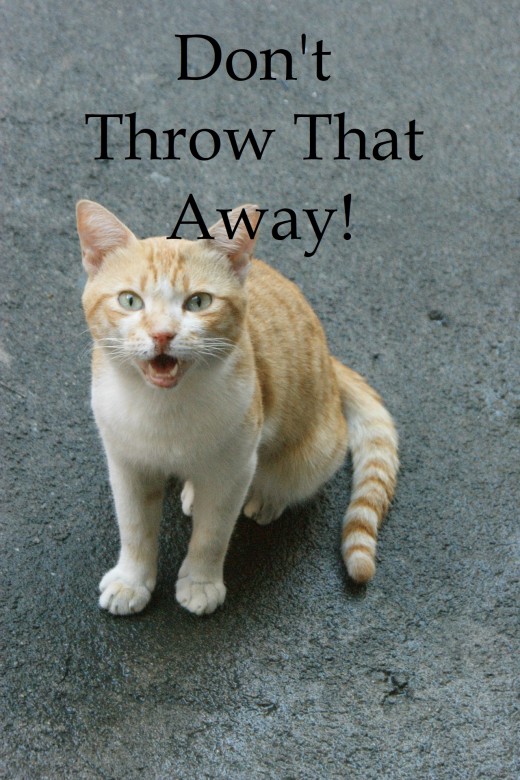
So next week you will see a new topic here called "Don't Throw That Away!"
© 2019 Linda Lum