Will Fitbit Help You Get Fit And Lose Weight?

How I Became the Owner of a Fitbit One
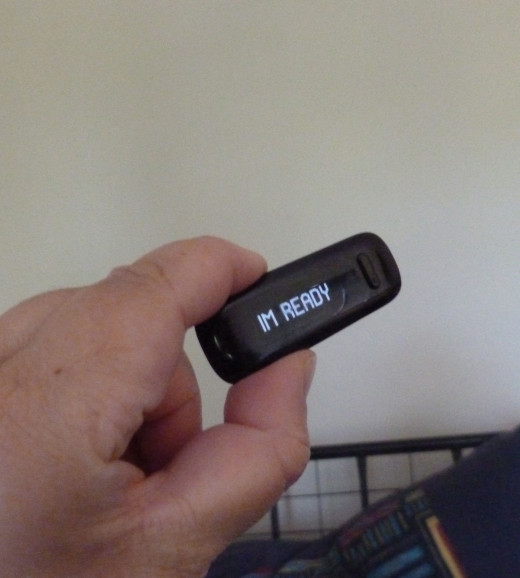
As of a few days ago I am the proud possessor of a fitbit one. I’m not entirely sure how this happened, one minute I was mindlessly surfing on my laptop, then next I was in the checkout bit of my Amazon account.
I’ve been very aware lately of all the weight I put on in the last year, and of how sedentary I have become, I guess my subconscious was working in the background and seized the opportunity to do something about it when I wasn’t paying attention.
But can the fitbit one make me fitter and get me to lose weight?
What is Fitbit
One way of looking at it is that the fitbit is just a jumped up pedometer. Ever since the simple 10,000 steps plan (take ten thousands step a day and cut your food by 25% and you shall be thin) became popular, pedometers are all the rage with us, couch potato fatties.
Of course the fitbit at around $100 has to offer something a little bit more than a $10 pedometer. It is a cute little pod that you clip onto your clothing and wear all day long. It measures how much you walk, and how much energy you burn per day.
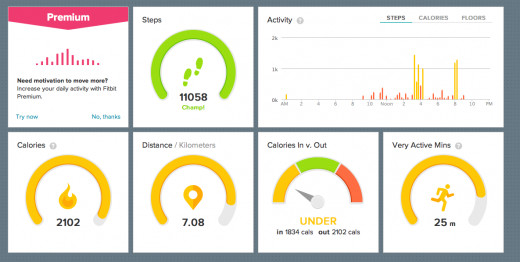
Once you input data about your age, weight, gender, the food you eat every day, it will give you a lot of cute looking graphs and piecharts telling you about your activity and calorie intake and output during the day.

How Does Fitbit Work?
The little pod contains a three dimensional accelerometer, which collects data about your motion, and the intensity of that motion.
The system (for really it is a lot more than just a motion device pod, it is a whole system) then uses sophisticated algorithms to convert this motion data into calculation the calories burned and the distance traveled.
This is more complex than you would think, for example it has to differentiate between a slow walk and a run, which burns a lot more calories.
The fitbit also has an altimeter which can tell if you are walking or running up a slope, which is harder and burns more calories, or if you are climbing stairs. One of the metrics it produces is the number of floors climbed.
You can also wear it in a wrist band at night and it will produce data about how much sleep you had. Although this is not a function that I was particularly interested in.
Do You Have an Electronic Activity Meter
See All the Data on Your Dashboard
Maybe its because I am such a sad geek, but I love my dashboard which I can access after signing in to the fitbit site. I keep checking it to see how close I am to my goal of 10,000 steps and calories burned in any given day.
The dashboard also tells you other things, such as calories burnt vs. calories eaten, and how much more you can eat that day to stay within your diet plan.
When you have met a goal, whether in the number of steps, distance walked, floors climbed etc, the particular panel will morph into a smiling face, then turn green. A little bit childish, but strangely encouraging.
I think there are ways of sharing your data to facebook and other social media. You can also connect with friends who use the system for some healthy competition. Heck there is even the possibility of pushing some data (no. of steps and distance traveled) to your Wordpress blog.
Personally I would find it mortifying to share this kind of information with other people, so it will all remain a secret. However I can see how the sharing options might be fun for other people.
Why Does the Fitbit Have So Many Bits?
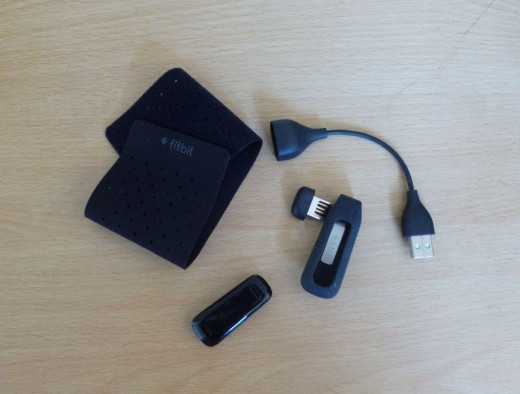
If I have any criticisms of the fitbit, it is that it comes with so many different pieces. There is the device itself and the silicone holder with a clip, which is fine. But there is also the port with which to connect it to a computer so it can recharge its battery, the wrist strap in which it is meant to be worn at night, and finally the dongle that allows it to communicate wirelessly with a computer. I am sure I will be constantly misplacing these different bits, and wasting time trying to locate them.
The dongle is particularly annoying. The most natural thing to do, is to just keep it constantly plugged into a USB port. This way my dashboard will update with my newest activity every time I'm nearby and I don't have to think about it. However I am using it on my Macbook air, which has a total of two USB ports. If I keep the fitbit dongle in permanently, that halves the connectivity of my laptop.

How Accurate Is It?
My other concern is how accurate are the estimates of calories used up. This is important if you are using the device, and the dashboard to lose weight. The site lets you design a weight loss plan, you decide how much you need to lose, and choose the level of difficulty, which depends on the time period, the faster you want to lose the weight, the harder it's going to be.
The program then tells you what energy deficit you need to have. For a "medium" difficulty level this means consuming 500 calories less than you burn. You log your food and activity during the day and the dashboard keeps track of whether you are achieving your plan.
But all this depends on the program being fairly accurate in assessing how many calories you burn. Since you've entered data about yourself (height, weight, age, gender), they can personalise your basal metabolism (how much energy you burn when you are not doing anything). Their algorithms for calculating calories burnt have apparently been verified by studying real data of people carrying out the exercise.
Still I have to wonder about how possible it is to make generalised algorithms, considering how different everybody is.
The other problem is logging in the food eaten. Even if I do it religiously, with no cheating, I often simply don't know exactly how much I eat. I truly don't want to end up weighing every apple, potato and slice of bacon that I eat. The program favours people who eat food from packets and ready meals. I like to cook, and I cook in an untidy way, without measuring most things. It makes it hard to log the food I eat.
So Does the Fitbit One Work?
It is a little bit too early to tell definitely, but so far I would classify my experience as a huge success. The main function of the fitbit is psychological, to motivate people. After all everybody knows how to lose weight and become fitter in principle, it is not rocket science.
It definitely does motivate me to walk more. I really want to reach, or even exceed, the 10,000 step on my dashboard. I now go for a walk in the afternoons, rather than sit in front of the computer. I am also making up excuses to go up the stairs, just to see the 'floors climbed' metric increase.
Heck, I've even started doing more housework, just so that I move more round the house, and get more steps.
I have also so far kept within my eating plan. I will not have that late evening snack if it spoils my nice dashboard statistics.
The real test of course will be whether this lasts, or whether I will get bored with the device. I also have some misgivings about the accuracy of its data as I explained above. According to the Fitbit, I burn a lot more calories than I thought I did, a silver lining of all that excess weight I guess. This means that I can theoretically eat quite a lot and still lose weight.
Time will tell. If it is working I should be able to tell whether I am on the right track within a couple of weeks. The scales will tell the truth. And talking of scales........the