No Thanks Thanksgiving

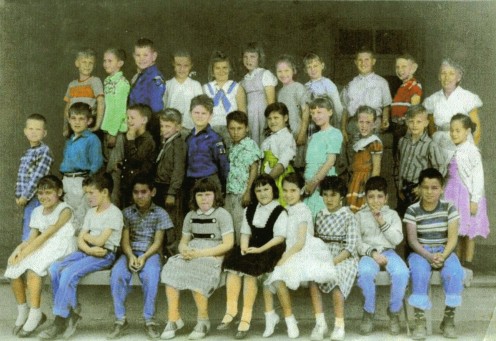
My fall from grace came a half century ago in 1958, when fresh from the high of winning our school spelling bee -- I was chosen to write and read a Thanksgiving essay at our school holiday festivities. In a household consisting of five generations, these two events momentarily lifted my familial status to that of a "princess who could do no wrong."
When you grow up in a crowd, that is an enviable position. However, my destiny on that pedestal was quite a shocking tumble, and involved a lot of fire and smoke.
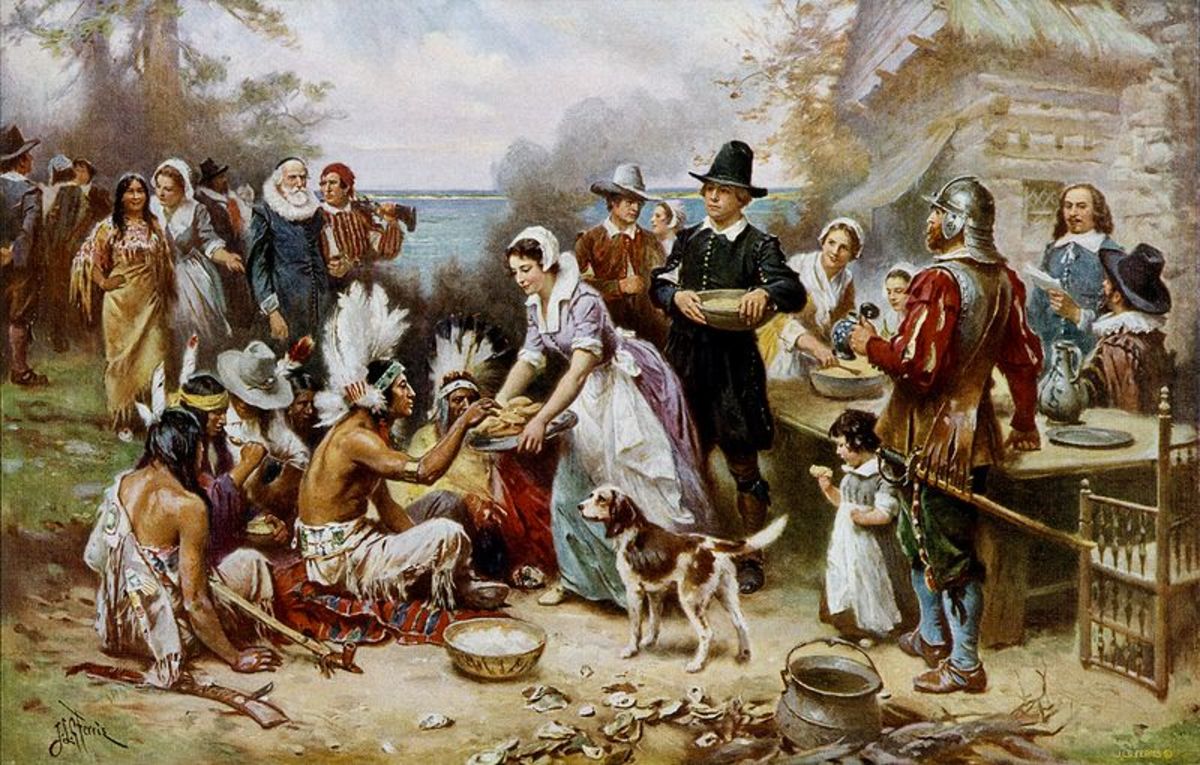
While my grandmother and Grandmere concentrated on making my Indian maiden costume and my brothers turkey costume -- my mother worked on teaching my younger brother how to say the names of the ships who brought the Pilgrims. Even my Pepere Vernon was involved, as he spent hours teaching us both how to properly make a real turkey call.
Homework was done at the kitchen table. My first inkling that I was teeter tottering on the brink of destruction, should have been apparent when my Grandpere's blue eyes radiated a glow like a newly lit pilot light, when I told him of the topic -- The First Thanksgiving.
Huntington Beach, California
Thanksgiving - St. Augustine, Florida - September 8, 1565
It's a matter of recorded historical fact that six hundred Spanish settlers in St. Augustine, Florida attended a Mass of Thanksgiving. Their feast was to celebrate and give thanks for their safe delivery to the New World.
In writing the history books from a strictly English speaking perspective, one argument is -- that this didn't count as the "first Thanksgiving," as La Florida wasn't part of the original thirteen colonies.
Of course, at the time of the Pilgrims, the counter argument is that there was no concept of the original thirteen colonies anyway.
Thanksgiving - San Elizario, Texas - April 30, 1598 (El Paso)
Thirty-three years later, another first Thanksgiving, was Mass of Thanksgiving ordered by Don Juan de Oñateto commemorate the colonists he led safely to a location near El Paso, Texas (San Elizario).
At his Thanksgiving dinner, there were hundred of colonists, soldiers, priests, families, Franciscan monks, native Indians, and even Africans. They weren't reduced to feasting on "donations" from local tribes -- along with them they brought pigs, sheep, goats, and cattle, along with wheat and corn.
Fact vs. Fiction of the First Thanksgiving
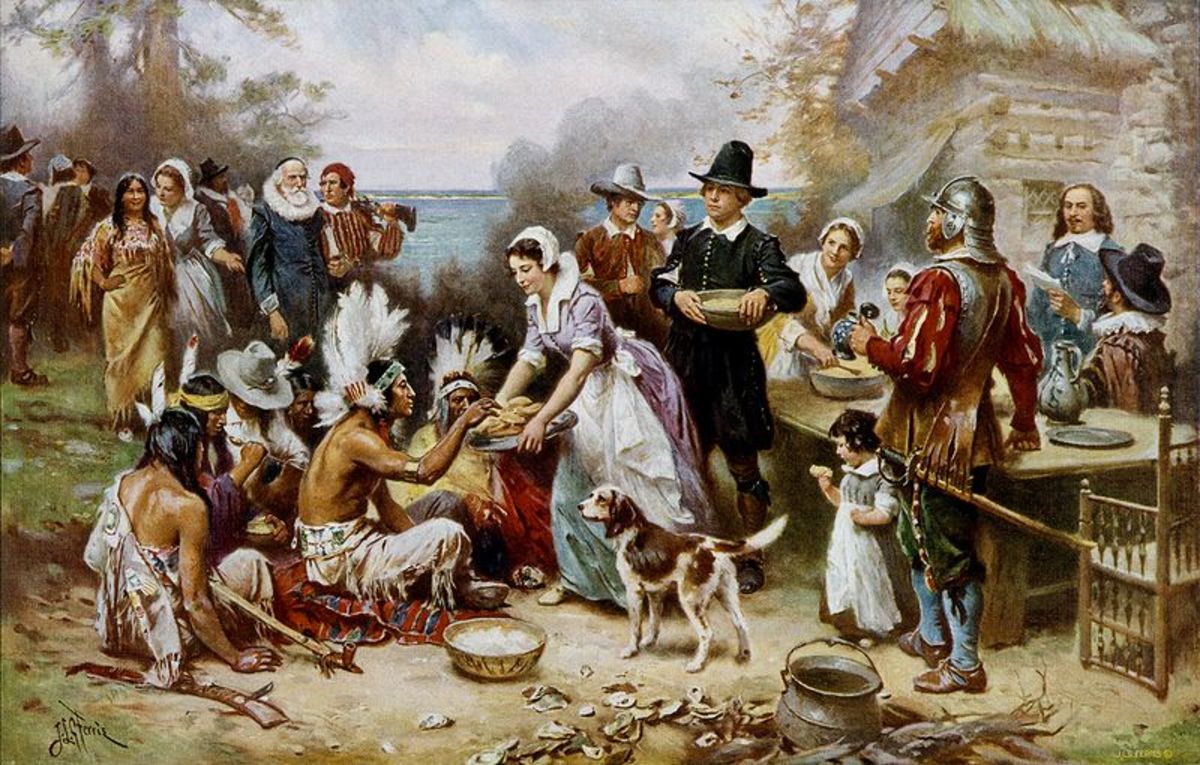
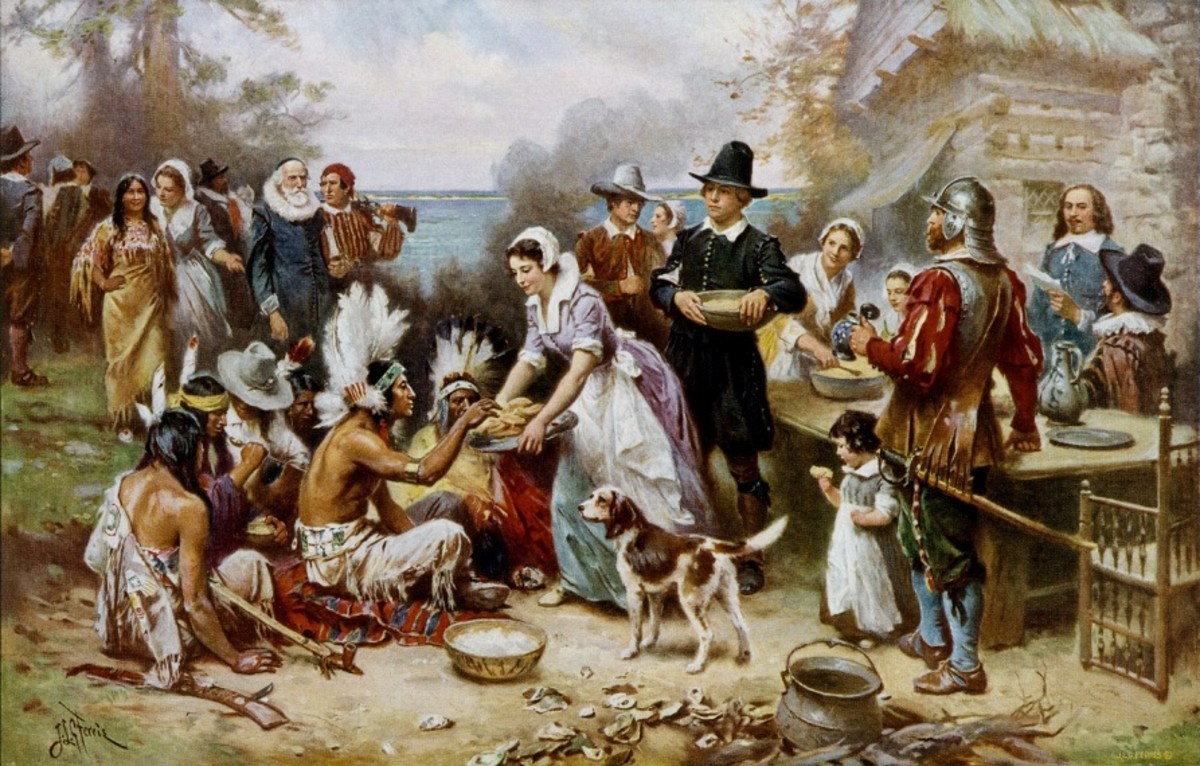
Today, most adults already know that much of what American children are taught about the first Thanksgiving had a back-story, and that it is rooted in more fictional confusion than fact.
My guess is that we've lied about the Pilgrims and their first Thanksgiving in 1621 for so long, and are so attached to the holiday commercialism of it -- that it's hopeless to think that anything is going to change in terms of what's taught. Besides, most of us look forward to this break from work and excuse to get together with family and friends.
However, in 1958, my Grandpere, still firmly believed in his God given mission to correct the uncorrectable, when it came to an American history, that was taught strictly from an English speaking perspective. Our ancestry included both Cajun and native indigenous people. The idea that we were being taught that this country was first settled by the Pilgrims, after 70,000 years of Indian settlement -- was extremely offensive to him -- one he referred to in Cadien, as the "original myth" on his better days. Other days, it's probably best not to translate from Cajun French, his thoughts on "other people's history."
Only eight years old at the time, I was caught unaware of how much trouble "truth in history" can get you into. With the intensity of a lightening bolt, seemingly coming from nowhere, he forcefully put down a copy of Pratt's America's Story for America's Children for my inspection. The book had been my great Uncle Claude's grade school primer.
Grandpere's distrust of an Anglo versions of history was rooted in that book, the day his son first read it out loud in the early 1900s:
"But we are glad to know that the English were not heartless. They gave the Acadians every chance possible, and that, at least, when the time came, that the Acadians could stay no longer -- they were dealt with as fairly as it was possible in a time of sorrow and pitiful woe. . . . "
Apparently, his shock of that false tale of Acadian/Cajun expulsion at the hands of the British historical events, had been a festering ire about romanticized versions of "other peoples" realities for over fifty years by 1958.
Grandpere, born in 1863, had attended a Louisiana Catholic parish school, under the direct tutelage of a charismatic and exceptionally well-educated priest. He held teachers and teaching in high regard. However, the idea that other nationalities had permanent settlements in this country first, and weren't included in our history textbooks -- was an outrage. The priest had done is job well, as Grandpere was a "critical thinker" in a time before the term was coined.
The whole myth of the "first" Thanksgiving was about to be erased from my learning experience in a big way, as he set about to teach me everything he knew that was false about the story. I was instructed to make sure that my First Thanksgiving speech included all people. Considering that many of my classmates had already commented on the playground that "Thanksgiving isn't our holiday," his directive appeared reasonable.
Moreover, even in 1958, the playground in Southern California was filled with taunts about "how someday we'll get our land back" by my fellow Hispanic and native peoples students, whose predominantly Spanish speaking relatives lived on both sides of the border. Sensitive to this, it inspired me to take all of Grandpere's Thanksgiving lectures seriously, as I set about writing my essay.
Thanksgiving 1598 El Paso, Texas
Thanksgiving - Port Royal, Acadia - 1605 - Acadian L'Ordre du Bon Temp
The early Acadian and French settlers in Port Royal, held their first Thanksgiving in a unique round of rotating feasts, that were well documented in the journals of both Champlain and Mar Lescarbot. At one of these Thanksgiving feasts, one of the first plays in the new world was performed for the guests entertainment.
Thanksgiving - Colony of Virginia - December 4, 1619 (Berkeley Hundred)
In the Colony of Virginia, the very day they arrived from their long journey at sea, they held a Day of Thanksgiving. Still, they didn't make it into the classroom history textbooks any more than the Spaniards did.
Shot In the Heart Like An Escaping Turkey
We arrived early the night of the school Thanksgiving celebration. Lacking a school auditorium, our large classroom had been converted into a stage area in the front. While my teacher was outside talking to parents and lining up some of the smaller children who would also be participating -- I took it upon myself to rearrange the front of the room where the podium had been placed. Enlisting the help of two of the biggest boys in my class, we shoved the teachers desk back further in the corner.
After introductions, a small skit, and poetry recitals by younger classmates, it was my turn to bask in the adoring approval of my many fans (my very large family) in front of the whole assembly. With great nervousness, I began reading my proudly penned essay, almost in a whisper. Of course, the teacher stepped in and suggested to me that I speak up louder, so everyone could hear me. I began again, almost shouting this time:
"Tomorrow when some of you are having a Happy Thanksgiving feast, our family will be eating turkey, but not made the same way. We will be happy we are together, but we will be saying, 'No Thanks Thanksgiving.'"
Some of the adults who weren't related to me, were looking at each other quizzically, as if they hadn't heard me. So in my best effort to be heard over the puzzled silence, I continued:
"We don't celebrate an English speaking holiday, because it's rude to our Indian ancestors who had their land stolen from them, or our Acadian ancestors who were murdered, robbed, and sent into exile by the British. . . . "
The next thing I knew, I was being pulled aside by my teacher in a very harsh manner, as she interjected to the audience, "I'm sorry, this school program is running late, and we'll have to move on to the play the 4th graders have been working on."
Just as she snatched my essay from the podium, a scream was heard from the back of the room, "Fire! Fire!" The desk that I had directed to be moved back earlier, had been resting against the room furnace, and had burst into flames. This of course, was the end of my First Thanksgiving speech.
You could say my essay went down in flames. I was lucky I was only knocked off the family pedestal by proud parents, who had to pay for the damage to the desk, and had a lot of explaining to do.
Later that night, I ended up in a lowly dejected spot at the kitchen table -- right next to my Grandpere. I wasn't allowed to write any more essays without my father seeing the results first. Grandpere wasn't in charge of history lessons anymore, without discussing the contents of his lesson plan. This of course, prompted a lively discussion about how Grandpere wouldn't expect my father to "understand" since he was a red-headed Irishman. LOL
They Called Themselves “Saints”
It would be almost one hundred years later before it was popular to refer to them as Pilgrims. Their Thanksgiving celebration was referred to as Forefather's Day. By 1820, even Daniel Webster referred to them as the "Pilgrims." So who were they?
Most Americans have been led to believe that the Pilgrims were only a bunch of devout English, in pursuit of religious freedoms. Some among them were along, solely in pursuit of that other American god, "wealth."
Official Thanksgiving
The holiday we know today as Thanksgiving, wouldn't really exist if it weren't for the efforts of Sarah Josepha Hale (editor of Godey's Lady Book, a fashionable ladies magazine).
She spent years lobbying congress, writing letters to five different presidents, and writing editorials to get a national Day of Thanks made official. Finally, in 1863, Abraham Lincoln decided this was an opportunity to unite people in a common holiday and declared Thanksgiving official.
Gumbo The Real Thanksgiving
On the Thanksgiving Table of Syncretism
In the half century since my flaming turkey of an essay, I've had a lot of time to think about how I really stand on the subject of celebrating this holiday. Like my Grandpere, it hasn't set well with me that my own children and grandchildren are still given textbooks that haven't changed the Thanksgiving myth surrounding the Pilgrims to a more encompassing and realistic viewpoint.
Children today, more than ever, come to the classroom with multicultural challenges and differences. Respecting, promoting, and honoring "all cultures" should mean that we move Thanksgiving celebrations, back to what they originally were -- Fall Festivals and celebrations of all that is good, and right in our lives.
Let's just leave the Pilgrims, as simply a small part of the inspiration for the holiday -- unless we are willing to call the Indians involved by their real names -- the Wampanoag; concede that other peoples were already here on the shores of this land; and admit to the possibility that someone else might have also "discovered" and "settled" here successfully. It just might be more respectful to ourselves, in our richly diverse population, to celebrate a Thanksgiving that is laying on the table of syncretism.
While syncretism wasn't a word my Grandpere would have used, I'd like to think it's one word, he would have savored learning and pondering upon. One definition of "syncretism" is whenever two or more cultures come together and create something new. An example of this would be:
- When Europeans merged Arab culture ideas about navigation, that made New World explorations possible
However, another interpretation of this word, is when it is used to reconcile or merge different or differing values, customs, or peoples -- in common thought, such as in beliefs, lifestyles, or religion. Isn't that what being an American and celebrating an American holiday should be all about?