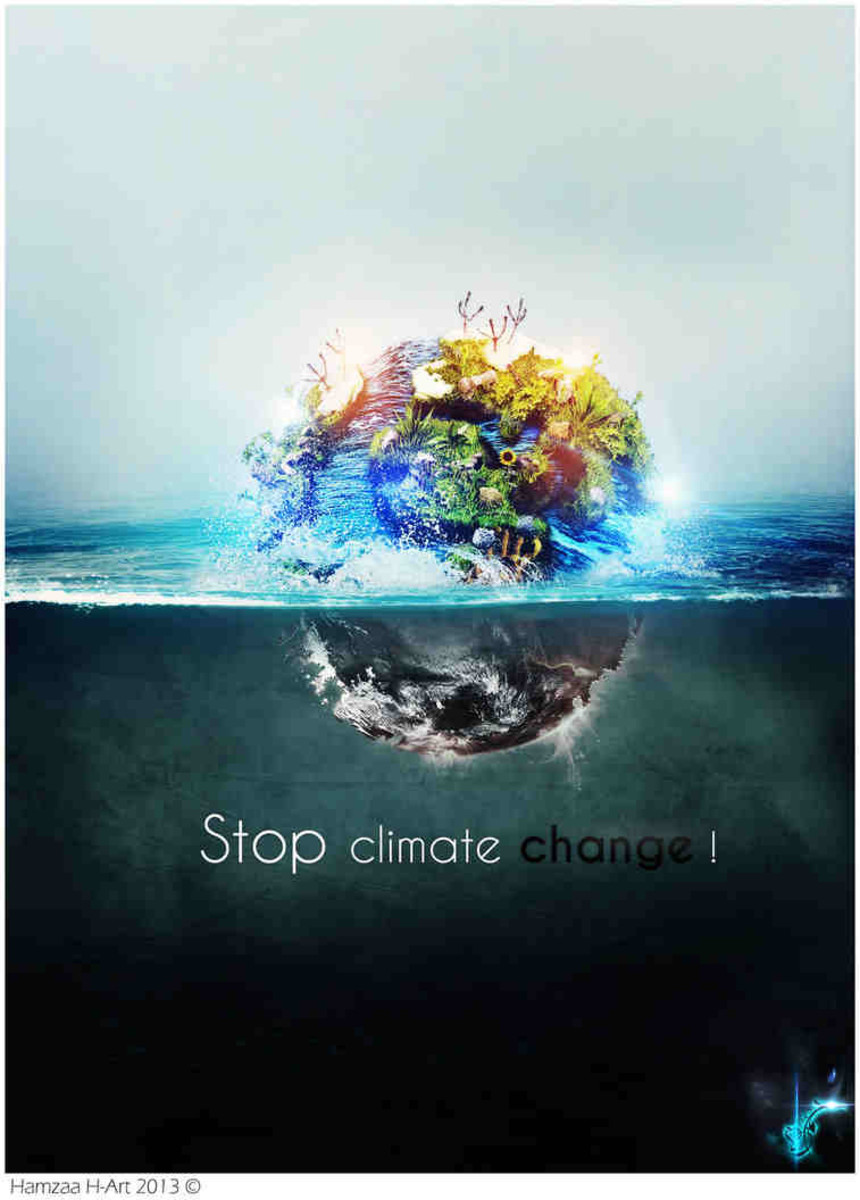
Are Humans Too Insignificant to Change the Climate?

Today, I was reading a discussion on one of my favorite blogs, the Permaculture Research Institute of Australia, and came across this comment from someone named Victoria:
"I think the sun and earth's natural long-term rhythms have far more chance to influence the world. Man is an arrogant little thing to think he is all that important."
It's an argument I see over and over again from climate change deniers on blogs and forums all over the web. You can call me arrogant, but I find it much more incredible that anyone could believe that we are not capable of changing the climate.
There is scarcely a square foot of this planet that humans have not touched or affected in some way, and the truth is, most of the myriad ways in which humans have changed the planet lead directly back to climate change.
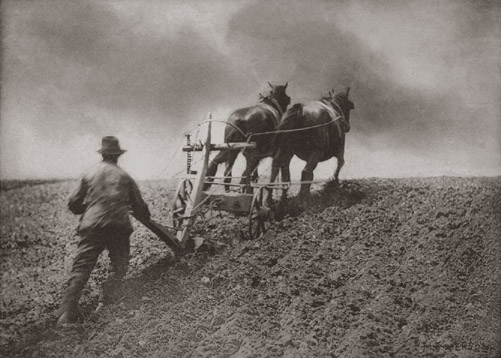
The native tallgrass prairie once covered 400,000 square miles of North America. Today, 99% of it is gone - plowed up to become the breadbasket of the world. Bread is good. I like bread. But every acre of tallgrass prairie traps about 50 tons of carbon in its soil. When the prairie is plowed, the carbon is released into the atmosphere as the greenhouse gas carbon dioxide (CO2).
Oops.
Modern no till farming methods have reduced the amount of CO2 released through agricultural activities somewhat, but where the prairie soils are concerned, it is mostly too little, too late. Atmospheric CO2 is fairly long-lived stuff, so chances are most of the millions of tons of soil carbon released by Manifest Destiny are still up there, heating us up.
- Trees For the World
Deforestation is one of the most urgent environmental problems today, because it affects both human and environmental health in surprising ways.
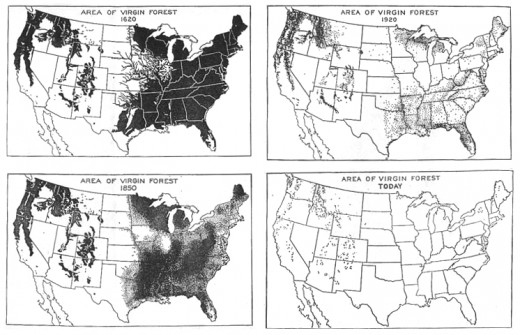
The 19th century was an orgy of destruction in North American forests as well. In some regions, the destruction was greater than 99%.
Worldwide, some 80% of primary (also known as virgin or old growth) forest has been cleared. Deforestation is a one-two punch for the climate. Not only does it release vast quantities of CO2 into the air, it also damages the Earth's ability to reabsorb it.
Trees play a critical role in the water cycle - it is not an exaggeration to say that they literally make rain. When trees are cut down, rainfall patterns change, resulting in less overall rainfall and more frequent droughts. This can make it difficult to re-establish trees on the landscape.
When herds of cattle, sheep, or goats are added to the mix, the result can be permanent deforestation and the conversion of the former forest to arid scrubland or even desert. This, in turn, results in the destruction of soil carbon, which is released back into the atmosphere, leaving the soil behind too depleted to grow crops or trees.
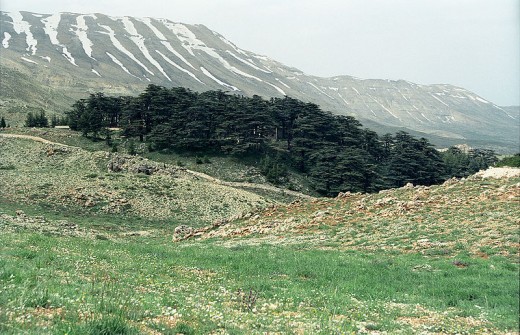
Thanks to deforestation, humans have been affecting climates on a local scale for thousands of years. Many people are dimly aware that much of the Middle East and Mediterranean regions were once forested thanks to vague memories of terms such as the "Fertile Crescent" and the "Cedars of Lebanon" from high school history classes.
One of the earliest surviving pieces of written literature, the Epic of Gilgamesh, describes the battle of Gilgamesh, King of Uruk, with the forest god Humbaba, protector of the magnificent groves of cedars that covered the mountains nearby. The victorious king chops down the cedars to build monuments to himself. Though the battle of Gilgamesh and Humbaba is a legend, the terrible deforestation that followed unfortunately is not. The destruction of the groves led to severe erosion, soil sliding off mountainsides and into rivers, silting trade routes and destroying irrigation canals. The once great Sumerian Empire vanished into desert... and the heavily forested island of Crete rose up to take its place, followed soon after the destruction of its own forest resources by Greece, Macedonia, and Rome.
There is strong evidence that a similar story played out on the other side of the world, in Chaco Canyon, New Mexico, former home of the lost Anasazi civilization. Evidence from pack rat middens suggests the area was originally covered with dryland forests of pinyon pine and juniper. By 1000 AD, these forests had disappeared. Water tables dropped and erosion washed away soil fertility. The Anasazi clung on for a few more centuries, but by 1300 a series of severe droughts brought their perilous situation to a crisis and Chaco Canyon was abandoned. Neither the Anasazi nor the forests ever returned.
The arid and semi-arid regions of the Middle East, Mediterranean, and US Southwest aren't the only areas where deforestation as a result of human activity changed local climates.
Easter Island, now famous for the massive statues of its lost civilization looming over barren, windswept hills, was once covered in lush jungle. On such a small island, deforestation was literally 100%. One wonders what the islanders were thinking when they cut down the last tree. The civilization disappeared soon after, so we can do nothing but speculate.
Even rainy Britain has not been unaffected. Some scientists estimate that 80% of ancient Britain was covered by
forests. By 1066, only 15% remained. After declining further during the
Middle Ages, Renaissance, and early Industrial Revolution, Britain's
forest cover has recovered to about 16% today. Still, the environmental impacts of the lost forests remain.
More Human Impacts on the Environment
As you can see, humans have been affecting climate on a local scale for thousands of years and as populations have exploded over the last two centuries, our impact has increased. Between 2000 and 2005,
for example, the two regions with the highest rates of deforestation,
South America and Africa, lost an average of 4.3 million and 4.0 million
hectares per year each. Nigeria lost 81% of its old-growth forests in
just 15 years (1990–2005). Neighboring Niger, which lost 40% of its
forest cover in the same period, is now losing 200,000 hectares of
arable land per year to desertification, while in China armies of tree planters are trying desperately to hold back the encroaching Gobi Desert, which is now just 75 kilometers from Beijing.
If we could turn local forest to desert a thousand years before the birth of Christ, when the human population is estimated at less than 50 million people (modern Tokyo has an estimated population of 35 million), why is it "arrogant" to believe that 6.9 billion people might be capable of international impacts?
I think a more pertinent question is, will be be capable of learning from the mistakes of past civilizations, or will we rush headlong to our own destruction?