How to Hit a Forehand

The Forehand
One of the most fundamental strokes of Tennis, the forehand key to the progress of both recreational and competitive players. In this article, the forehand will be broken down into several sections:
- Footwork
- Stroke mechanics
- Recovery
The Ready Position
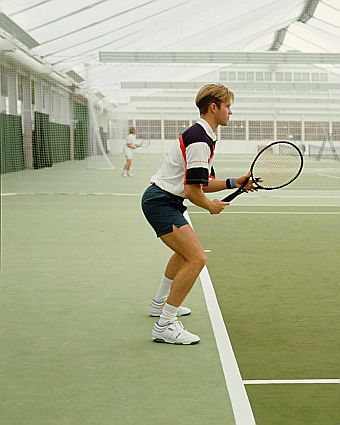
Footwork - The Ready Position
The first issue that must be addressed before moving on to stroke mechanics is that of footwork.
The single most overlooked aspect of the game, and unknown to the masses, exceptional footwork can consistently make up for technical flaws. Despite this fact, the ready position is essential to the development of a player as it is a staple of the rally-ball diet, meaning, the ready position is a part of every single stroke.
Keys to the perfect ready position:
- spread the feet 1-2 inches wider shoulder length
- bend knees so that you are about 6-8 inches shorter than your standing height
- hold the racquet out in front of your body comfortably, with the head pointing forward. (hold a forehand grip)
Footwork - Closed and Open Stance
Next is the footwork towards the ball. Two options that a player has on the forehand is to either hit an open or closed stance shot. (All of this information is written, assuming that the reader is a right-handed player. If not, merely reverse the directions for left-handed players.)
For the closed stance:
- Cross the left foot over the right, making sure to simultaneously turn both shoulders to the right fence. (perpendicular to the baseline).
- With the right foot, step past the left foot and land first with the heel. This is done in order to establish firm balance. Place all of your weight on this leg and hold until directed further.
- Take a final step with the left foot into the court.
- With all of your weight on the right foot, and the left foot now comfortably in front of you, push off with the ball of your right foot into the court, making sure to carry the weight through the hips to the contact.
For the open stance:
- *Repeat step one of the closed stance.
- *Repeat step two of the closed stance.
- Without taking a final step, now direct all of your weight from the right foot into the court while making sure to keep your shoulders turned towards the right fence.
Stroke Mechanics
From the ready position, and following the footwork, the stroke should proceed similar in synchronization as follows:
Stroke Mechanics
Footwork Steps
| Upper Body Steps
|
|---|---|
Step 1
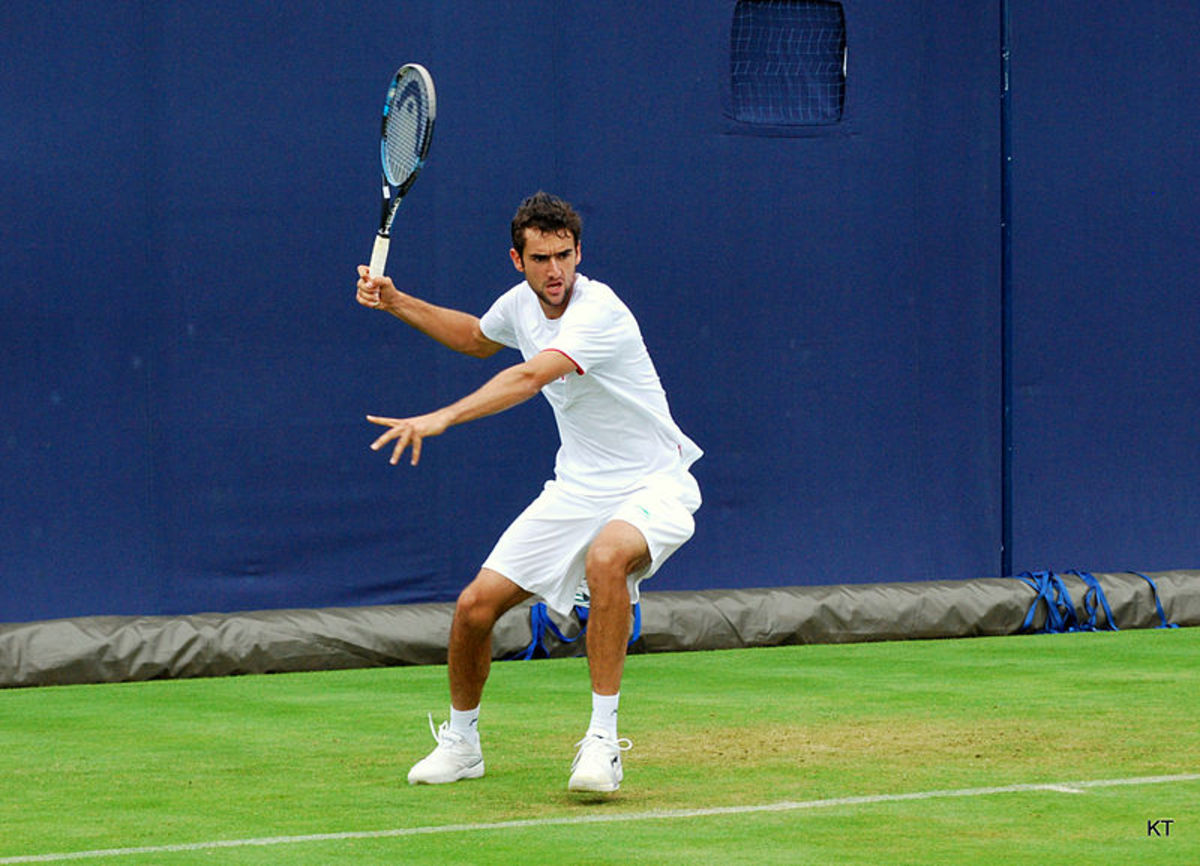
| From the Ready Position, simply turn the shoulders 90 degrees, making sure to maintain the same hold on the racquet.
|
Step 2
| Begin moving the left arm from the throat of the tennis racquet to the ball, making sure to point at it. This increases focus while beginning to consioucly direct body weight in a specific direction.
|
Step 3
| Swing down, swooping just beneath the ball and then coming up to make contact. Like a rotated question mark.
|
The Recovery
The final stage of the forehand is the recovery.
In order to execute a correct closed stance forehand recovery:
- complete your swing across the left bicep, after which you must swing your right foot around so that it is parallel with the baseline, or, so that your both your hips and shoulders are facing the net.
- From there, bring your right foot in front of the left, sweeping across in a Cherokee motion.
- Take one side shuffle to the center to complete the recovery.
- Follow through with your swing across to your left shoulder.
- Immediately transition into your Cherokee shuffle.
- Side shuffle.
Other Great Tennis Articles
- How to Hit a Backhand
One of the more difficult fundamental shots to hit, the backhand is drastically different from the forehand. The difference between the two, is that the backhand stroke can be divided into two separate... - The Definitive Guide to Tennis Balls
Figure out which tennis ball best suits you!